





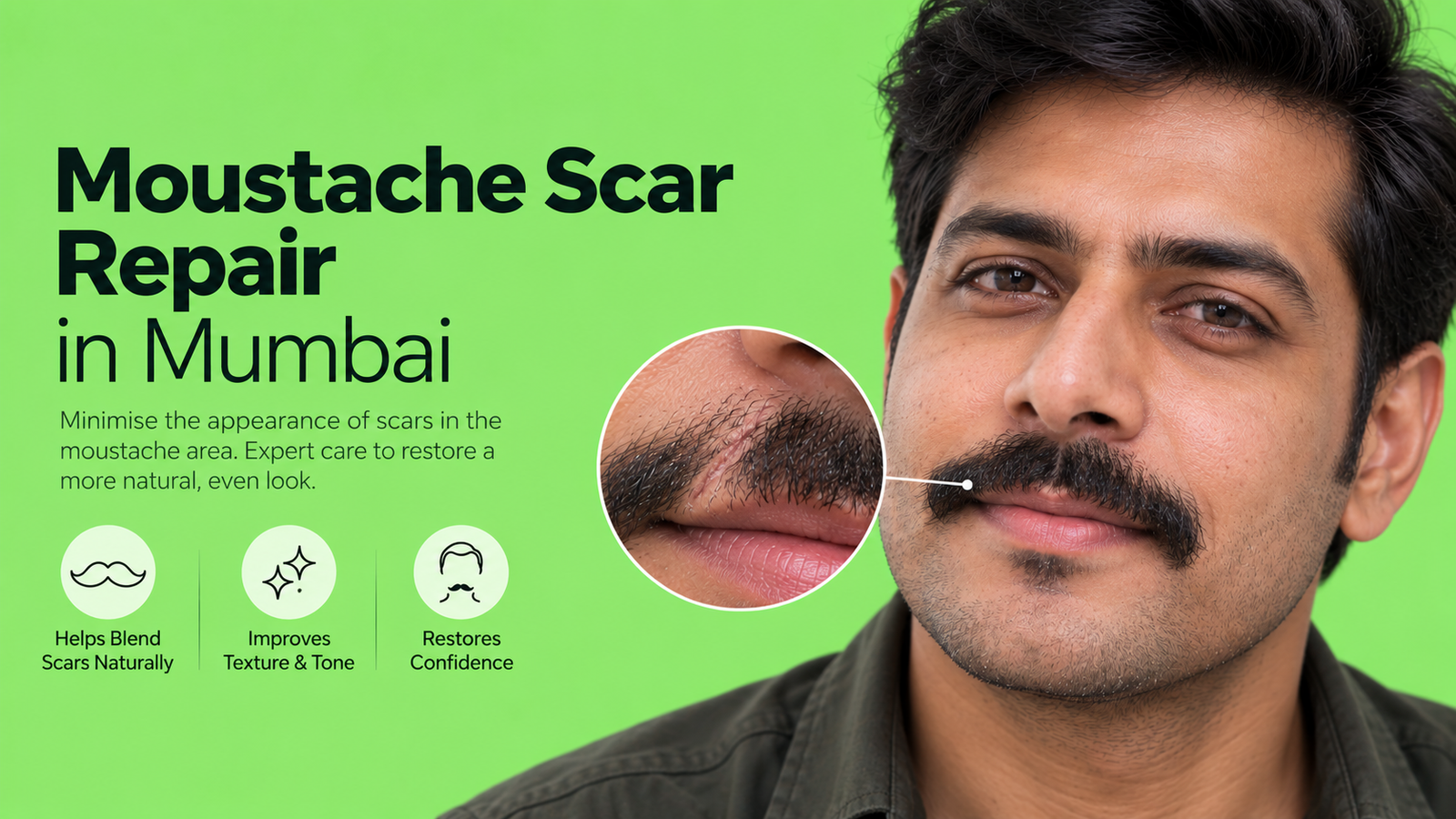
Moustache Scar Repair in Mumbai
A scar through the moustache area can permanently reduce or eliminate hair growth in part of the upper lip. Even when the scar itself has healed, the absence of hair can make it more visible because the normal moustache pattern is interrupted.
For selected stable scars, follicular hair transplantation may be used to place hairs into or around the scar to improve camouflage.
However, scar transplantation is different from routine moustache transplantation.
Scar thickness, maturity, flexibility, blood supply and previous surgery all influence how the area should be treated. A scar cannot automatically be grafted at the same density as normal skin, and some patients may require conservative or staged treatment.
The objective is generally better camouflage of the scar, not a promise that the scar itself will disappear.
Can Hair Be Transplanted Into a Moustache Scar?
In selected patients, yes.
Hair follicles can sometimes be transplanted into scarred moustache skin, but scar tissue is not identical to normal recipient skin.
The amount of fibrosis, skin thickness, flexibility and vascularity may vary considerably from one scar to another.
For this reason, the important question is not simply:
“Can grafts be placed in this scar?”
It is:
“Is this particular scar suitable for grafting, and how conservatively should it be treated?”
What Can Cause a Moustache Scar?
Hair loss through the moustache region may occur following:
- facial injury
- cuts or lacerations
- burns
- previous surgery
- cleft-related surgery
- previous facial procedures
- infection followed by scarring
- previous poorly healed trauma
- other stable facial scars
Different causes can produce very different scar characteristics.
A thin flat scar may behave differently from a thick raised scar, an adherent surgical scar or an irregular burn scar.
Why Is Scar Assessment So Important?
A moustache scar needs to support newly transplanted follicles while they establish themselves.
Important features include:
- scar maturity
- skin thickness
- softness or rigidity
- colour
- vascularity
- surface quality
- adherence to deeper tissue
- previous operations
- history of abnormal scarring
- whether the underlying condition is still active
Two scars of identical size can therefore require very different treatment plans.
What Does a Mature Scar Mean?
A mature scar is generally a scar that has completed most of its active healing and is no longer rapidly changing.
However, time alone should not determine suitability.
The clinician may assess whether the scar remains:
- red
- tender
- itchy
- raised
- progressively thickening
- inflamed
- changing in size
- associated with an active skin disorder
A recently formed or actively changing scar may require additional healing or treatment before transplantation is considered.
Why Does Tissue Quality Matter?
Normal facial skin contains a healthy vascular network and flexible tissue around existing follicles.
Scar tissue may have:
- reduced elasticity
- irregular thickness
- fibrosis
- altered blood supply
- shallow areas
- firm or adherent areas
These differences can affect recipient-site creation and how densely grafts can safely be placed.
The procedure should therefore adapt to the scar rather than forcing the scar to accept a routine density plan.
Why Is Vascularity Important?
Newly transplanted follicles depend on the recipient tissue for blood supply.
Scar vascularity can be less predictable than normal skin.
If too many grafts are crowded into tissue with limited blood supply, graft survival may be reduced and tissue stress may increase.
This is one reason moustache scar repair is often planned more conservatively than transplantation into normal upper-lip skin.
When May Moustache Scar Transplantation Be Unsuitable?
Transplantation may need to be postponed or avoided when:
- the scar is still actively changing
- there is active infection
- there is ongoing inflammation
- an active scarring disorder has not been controlled
- recipient tissue appears unable to safely support transplantation
- the patient has a significant tendency toward problematic scar formation that requires further assessment
- donor hair is unsuitable
- expected camouflage cannot realistically be achieved
Some scars may be better managed using a different reconstructive strategy.
The consultation should therefore determine whether hair transplantation is actually the most appropriate approach.
Where Does Donor Hair Come From?
Donor selection for scar repair still requires attention to:
- calibre
- texture
- curl
- colour
- available supply
- neighbouring native moustache hair
Scalp follicular units may be considered in appropriate cases, but transplanted scalp hair can retain scalp-like growth characteristics and may require trimming.
The surgeon may also consider other donor options in selected patients when they provide a more suitable match.
The goal is not simply to find enough hair—it is to find hair that can reasonably blend with the moustache.
Matching Direction Across Scarred and Normal Skin
Scar repair becomes especially visible where transplanted hairs meet normal moustache hairs.
Recipient sites should therefore be planned to continue the natural flow across the scar.
An isolated patch of hairs that points differently from the neighbouring moustache can highlight the scar rather than camouflage it.
The surgeon also needs to account for the fact that scarred skin may resist a recipient site differently from normal skin.
How Is Moustache Scar Repair Performed?
Step 1: Scar Assessment
The doctor examines the scar’s history, cause, age, stability, thickness, surface quality and surrounding facial hair.
Step 2: Suitability Planning
The area is assessed to determine whether direct follicular transplantation is appropriate or whether treatment should be postponed, modified or staged.
Step 3: Camouflage Design
The transplantation zone is planned to integrate the scar with surrounding native moustache hair.
The objective is camouflage rather than creating an artificial block of density over the scar.
Step 4: Donor Selection
Suitable follicular units are chosen according to the patient’s donor characteristics and neighbouring moustache hair.
Step 5: Local Anaesthesia
Local anaesthesia is used to numb the donor and recipient areas.
Scarred and previously operated tissue may behave differently during anaesthetic infiltration and recipient-site creation.
Step 6: FUE Extraction
Selected grafts are individually harvested from the donor area using an appropriate FUE approach.
Step 7: Graft Preparation
Follicular units are inspected and organised for placement according to the recipient plan.
Step 8: Conservative Recipient-Site Creation
Recipient sites are created according to scar thickness, tissue behaviour, vascularity, surrounding hair direction and planned density.
Step 9: Graft Implantation
Grafts are implanted carefully into the planned sites while maintaining the intended angle and direction.
Step 10: Early Follow-Up
The scarred recipient area is monitored during healing and the patient follows the prescribed postoperative care plan.
Why Is Density Usually More Conservative in Scar Tissue?
Placing more grafts does not automatically produce a better result.
Scarred tissue can have less predictable vascular support than normal skin.
For this reason, the surgeon may deliberately choose a lower initial density and observe how the tissue and follicles respond.
This can be more appropriate than attempting maximum density in one procedure.
Could Treatment Need More Than One Session?
Yes.
A staged approach may be considered when:
- the scar is large
- vascularity is uncertain
- tissue quality varies across the scar
- conservative first-session density is preferred
- additional coverage is needed after the initial result matures
The first procedure may establish a foundation. After the transplanted follicles have had sufficient time to grow and the recipient tissue can be reassessed, additional grafting may be considered if appropriate.
Recovery After Moustache Scar Transplantation
Early recovery can involve:
- temporary redness
- small crusts
- mild swelling or tenderness
- temporary altered sensation
- visible short transplanted shafts
The treated area should not be rubbed or scratched during early healing.
Patients should follow the specific cleansing and medication instructions provided by their treating team.
A scarred recipient area may also be monitored more closely because its tissue characteristics are different from normal skin.
Growth Timeline
Hair growth is gradual.
Early Healing
The transplanted follicles settle while the recipient skin heals.
Initial Shedding
Some visible transplanted shafts may shed during the early weeks.
Early Growth
New growth may begin to appear over the following months.
Progressive Coverage
More follicles enter visible growth and the camouflage effect becomes easier to assess.
Mature Assessment
The final degree of scar coverage should only be judged after sufficient maturation.
The timing and percentage of graft growth can vary, particularly in scarred skin.
Can a Moustache Scar Be Completely Hidden?
Not always.
Hair transplantation does not remove scar tissue.
The objective is to camouflage the scar by restoring hair within and around it.
How effectively this works depends on:
- scar width
- scar colour
- scar thickness
- recipient blood supply
- hair calibre
- surrounding native moustache density
- transplanted graft growth
- hairstyle and moustache length
- scar orientation
Some scars can become substantially less noticeable. Others may remain visible despite hair transplantation.
A realistic consultation should make this distinction clear before treatment.
Risks and Limitations
In addition to the general risks of hair transplantation, scar repair has additional uncertainties.
These may include:
- lower or uneven graft growth
- need for staged treatment
- visible residual scar
- difficulty achieving high density
- textural differences
- pigmentation changes
- folliculitis
- infection
- pitting or irregular surface appearance
- mismatch with surrounding hair
- need for further corrective treatment
A patient should therefore judge success according to realistic improvement in camouflage rather than an expectation of normal unscarred skin.
How Much Does Moustache Scar Repair Cost?
There is no responsible single price that applies to every scar.
Cost can depend on:
- scar size
- number of scars
- graft requirement
- scar thickness and complexity
- donor choice
- previous surgery
- difficulty of recipient-site creation
- requirement for staged treatment
- additional procedures where clinically appropriate
A small stable linear scar and a large irregular post-burn scar should not be expected to require the same treatment plan.
Moustache Scar Repair vs Standard Moustache Transplant
A standard moustache transplant generally places follicles into relatively normal facial skin to create or expand a moustache.
Scar repair focuses on a different problem: placing follicles into altered tissue to camouflage an existing scar.
Patients with non-scar-related weak moustache development should instead review:
Frequently Asked Questions
How old should a scar be before transplantation?
There is no single time period appropriate for every scar. The scar should be assessed for maturity, stability, activity, thickness and underlying cause rather than using time alone.
Can grafts grow normally inside a scar?
Hair follicles can grow in selected scar tissue, but growth can be less predictable than in normal skin because scar structure and vascularity vary.
Will the transplant remove the scar?
No. Hair transplantation does not remove scar tissue. It attempts to camouflage it with strategically placed hair.
Can a burn scar be transplanted?
Selected healed burn scars may be considered, but suitability depends on tissue quality, stability and blood supply.
I have a surgical scar across my moustache. Can it be filled?
Possibly. Surgical scars can often be assessed for follicular transplantation, but width, depth, fibrosis and vascularity need to be examined first.
Why might I need two sessions?
A conservative first session may sometimes be safer in scarred tissue. A later procedure can be considered after graft growth and recipient response have been assessed.
Will hairs grow in the same direction as my moustache?
Correct direction is a central part of planning. Recipient sites should attempt to continue the flow of neighbouring native hairs across the scar.
Moustache Scar Assessment in Mumbai
A photograph can show the location of a scar, but it cannot always reveal tissue thickness, flexibility or vascularity.
An in-person assessment may therefore be particularly useful for scar-related moustache restoration.
The consultation should answer:
- Is the scar mature and stable?
- Is the tissue suitable for grafting?
- How much camouflage is realistic?
- What donor hair is appropriate?
- Should density be conservative?
- Could staged treatment be safer?
- Will some scar remain visible?
Patients can contact Anagen through the Contact Us page.