




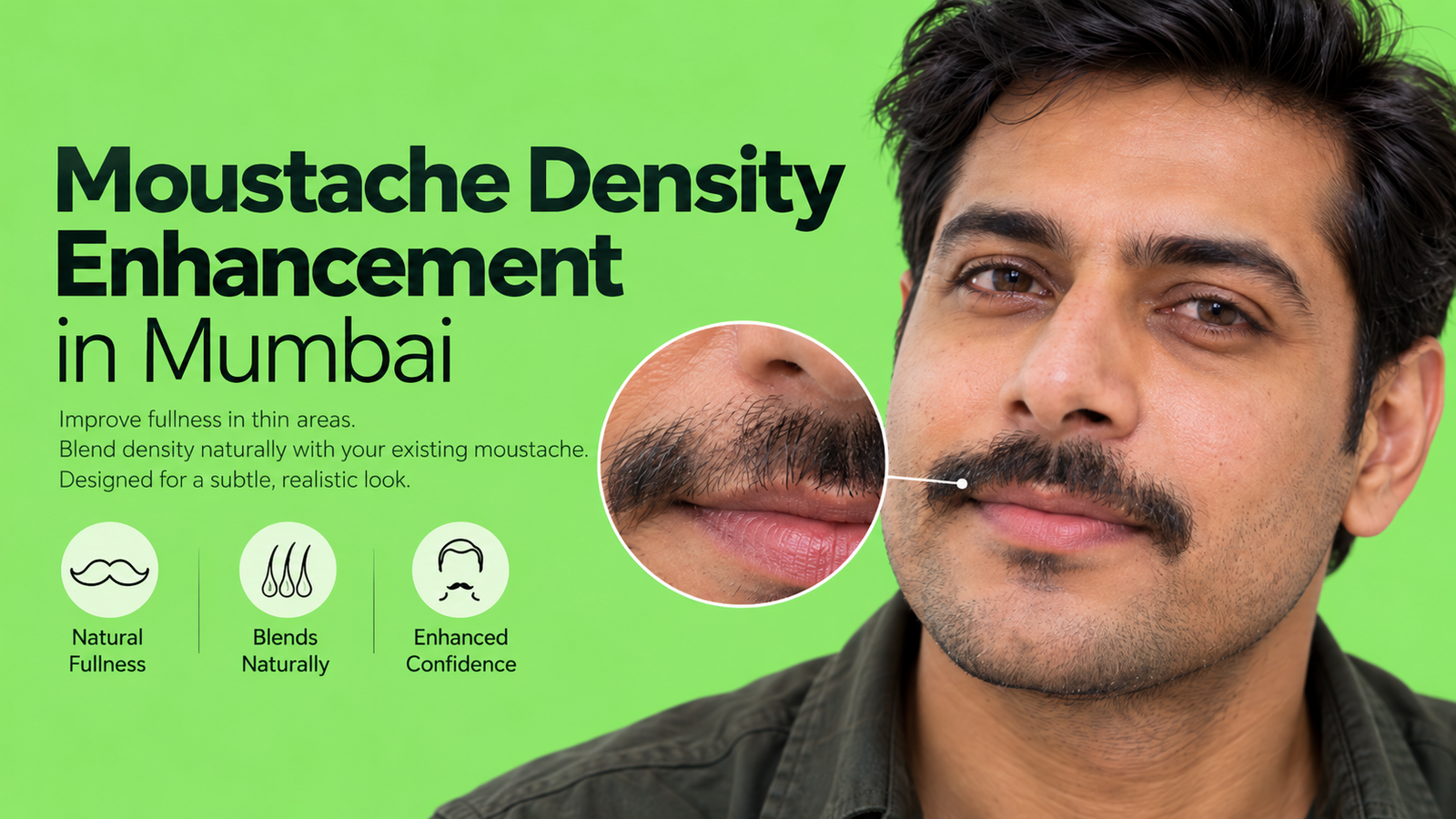
Moustache Density Enhancement in Mumbai
A moustache does not have to be completely absent to cause concern. Some men already have a clear moustache shape but feel that it looks thin, uneven, asymmetric or interrupted by visible gaps.
In these situations, complete moustache reconstruction may be unnecessary.
Moustache density enhancement focuses on strengthening selected weak areas while preserving and blending with the patient’s existing facial hair.
The objective is not maximum graft density. It is a believable improvement that still follows the patient’s natural moustache pattern.
What Is Moustache Density Enhancement?
Moustache density enhancement is a targeted hair transplantation approach for patients who already have native moustache hair but want selected areas to appear fuller or more continuous.
Instead of designing an entirely new moustache, the existing pattern becomes the framework.
Additional follicular grafts can be planned between or around native hairs to improve:
- visible gaps
- uneven fullness
- one-sided sparsity
- weak lateral moustache density
- incomplete blending between moustache zones
- selected areas that look thinner when the moustache is trimmed
The procedure should preserve the identity of the patient’s natural moustache rather than replacing it.
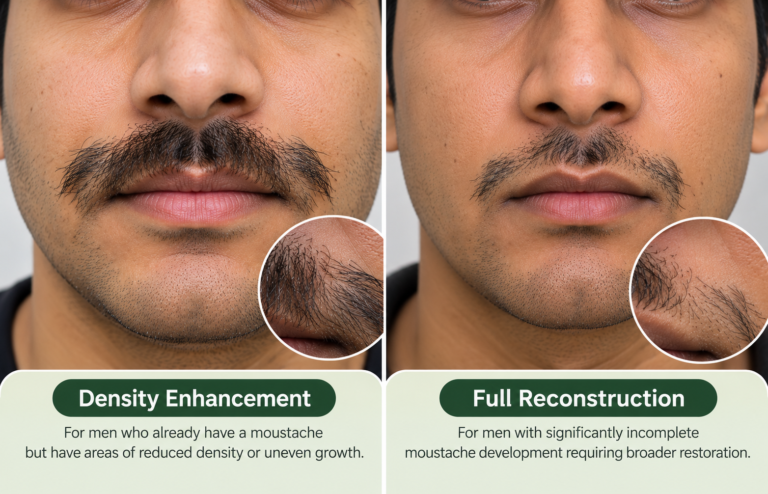
Density Enhancement vs Full Moustache Reconstruction
These are related procedures, but they solve different problems.
Moustache Density Enhancement:
Best suited when a recognisable native moustache already exists and only selected areas need additional fullness.
Moustache Hair Transplant:
More appropriate when the moustache is absent, extremely underdeveloped or requires substantial reconstruction.
Read about our in-detail Moustache Hair Transplant..
Who May Benefit From Moustache Density Enhancement?
Potential candidates may include men with:
- a thin but established moustache
- small stable gaps
- lower density on one side
- weak central-to-lateral transition
- reduced density in selected areas
- uneven visual fullness
- acceptable overall moustache shape but insufficient coverage
The key distinction is that useful native hair is already present.
Do All Moustache Gaps Need Surgery?
No.
Before grafting a gap, it is important to understand why it exists.
A stable lifelong gap may be very different from recent hair loss caused by inflammation, a dermatological disorder, trauma or scarring.
If the density has recently changed or the skin is abnormal, the underlying cause should be assessed first.
For selected patients who do not yet need surgery read our Moustache Growth Prescription to know more.
How Is Existing Moustache Hair Assessed?
Native moustache hair is valuable because it shows the surgeon how the patient’s own facial hair naturally behaves.
Assessment may include:
- native hair direction
- exit angle
- calibre
- curl or wave
- density variation
- location of gaps
- degree of asymmetry
- length at which the patient normally keeps the moustache
- skin condition between existing hairs
A density plan that looks appropriate with a long moustache may look very different when trimmed short.
The patient’s normal grooming preference therefore matters.
How Are Gaps and Uneven Density Corrected?
The goal is not simply to put grafts into every visible space.
A gap is assessed in relation to the surrounding hair.
The surgeon needs to consider:
- how many native hairs are already present
- how those hairs lie against the skin
- whether the gap changes when hairs are grown longer
- whether one side is naturally different from the other
- whether additional grafts can be inserted without damaging useful native follicles
- what level of improvement is realistically achievable
Some small gaps may require very few strategically positioned follicles. Larger sparse zones may require broader distribution.
Natural Density Does Not Mean Maximum Density
Patients sometimes assume that a stronger result requires putting the maximum possible number of grafts into the area.
That is not necessarily correct.
Overpacking can create several problems:
- unnecessary trauma to the recipient area
- increased competition for available space
- difficulty placing grafts between native hairs
- unnatural visual heaviness
- loss of the soft irregular character of a normal moustache
The goal should be visual density, not simply a high graft count.
A moderate number of appropriately positioned hairs can sometimes produce a greater cosmetic improvement than poorly directed dense grafting.
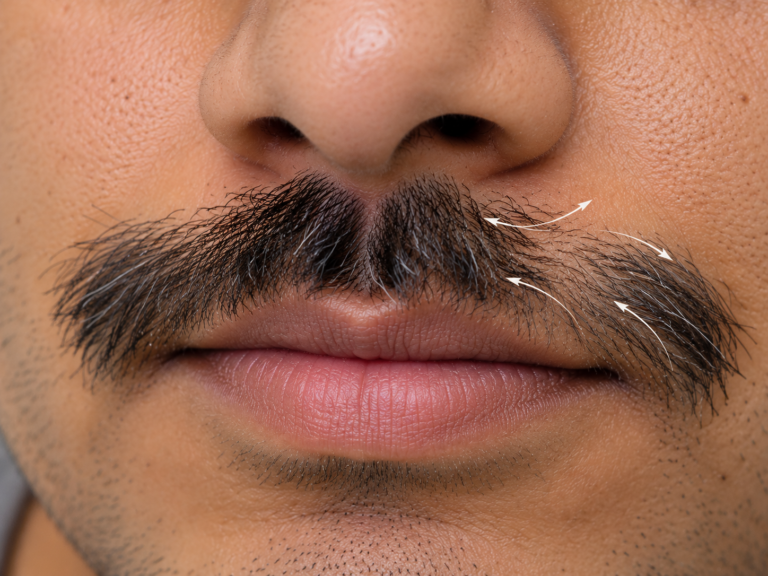
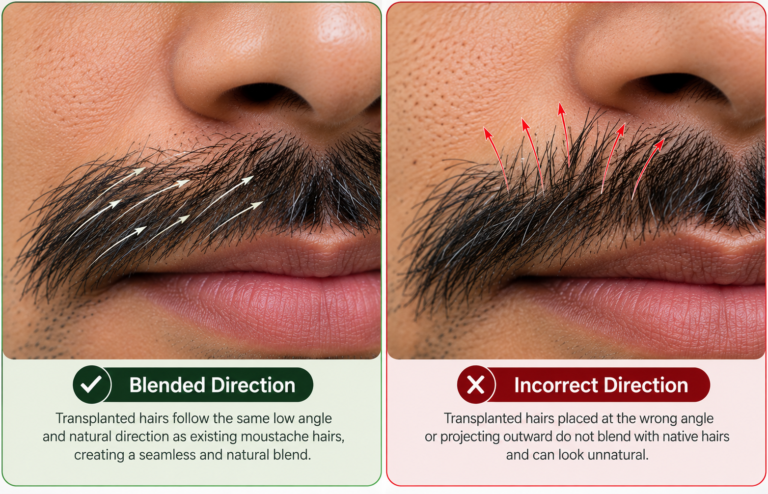
Matching Angle and Direction
A transplanted hair placed between existing moustache hairs should appear to belong there.
The recipient site should therefore match the local:
- exit angle
- direction
- spacing
- orientation
- transition toward neighbouring zones
This is particularly important for patients who keep their moustache short.
When long, surrounding hairs may conceal minor differences. When trimmed close, incorrect direction becomes far more visible.
How Is Moustache Density Enhancement Performed?
Step 1: Density Assessment
The doctor evaluates the existing moustache pattern, sparse areas and quality of native hair.
Step 2: Targeted Planning
Rather than redesigning the entire moustache, specific zones requiring additional coverage are marked.
Step 3: Donor Selection
Suitable follicles are chosen with attention to calibre, texture and available donor supply.
Step 4: Local Anaesthesia
The donor and recipient areas are numbed using local anaesthesia.
Step 5: FUE Extraction
The required follicular units are individually extracted from the donor region using an appropriate FUE technique.
Step 6: Graft Selection
Grafts are sorted so that the most suitable follicular units can be used in different parts of the moustache.
Step 7: Recipient-Site Creation
Small recipient sites are created between or around existing hairs according to the local direction and density plan.
Step 8: Implantation
Grafts are implanted carefully while attempting to preserve native follicles and maintain natural spacing.
Step 9: Post-Procedure Care
The patient receives instructions for protecting, cleaning and caring for the newly implanted area.
How Many Grafts Are Needed for Density Enhancement?
There is no fixed number.
Density enhancement may involve a relatively limited area or several separate weak zones.
The estimate depends on:
- size of each sparse area
- native density
- hair calibre
- number and distribution of gaps
- desired visual improvement
- donor availability
- whether the patient wears the moustache short or long
A patient with a small central gap should not automatically receive the same graft plan as someone with widespread bilateral thinning.
Recovery
Immediately after the procedure, the implanted area may show temporary redness and small crusts.
Because grafts are placed around existing native hair, patients need to follow cleaning instructions carefully without rubbing the transplanted region.
As healing progresses, the treated area gradually becomes less noticeable.
Some transplanted shafts can shed before new growth begins.
When Will the Moustache Look Fuller?
Growth occurs progressively. Early new growth may begin after the initial resting period, commonly becoming noticeable over the following months.
The visual improvement continues as more transplanted follicles grow and the hairs become longer and easier to groom.
A meaningful evaluation requires patience because early density does not represent the mature result.
Will the New Hair Blend With My Existing Moustache?
That is the objective, but the quality of blending depends on several factors:
- donor-hair match
- correct recipient-site direction
- low exit angle
- appropriate graft spacing
- preservation of native follicles
- how the patient trims the moustache
- individual graft growth
If scalp hair is used, transplanted hairs may grow longer than native moustache hair and may require more frequent trimming.
Can Density Be Increased Without Making the Moustache Look Artificial?
Yes, provided the plan remains conservative.
A natural moustache contains variation. It is not a perfectly uniform carpet of hair.
Trying to eliminate every small irregularity can actually make the moustache look less natural.
The aim is to improve noticeable weakness while preserving believable variation.
Results
Yes, provided the plan remains conservative.
A natural moustache contains variation. It is not a perfectly uniform carpet of hair.
Trying to eliminate every small irregularity can actually make the moustache look less natural.
The aim is to improve noticeable weakness while preserving believable variation.
Limitations of Moustache Density Enhancement
Density enhancement cannot guarantee identical density on both sides or create unlimited fullness.
Limitations may include:
- finite donor supply
- differences in donor and native hair
- unpredictable individual graft growth
- difficulty placing grafts in very narrow spaces between existing follicles
- previous scarring
- skin conditions
- the need for a later touch-up in selected patients
Patients should also distinguish improved density from perfect uniformity.
When May Full Moustache Reconstruction Be More Appropriate?
Density enhancement is not the correct procedure when very little useful native moustache hair exists.
Broader reconstruction may be more appropriate if:
- most of the moustache is absent
- both central and lateral zones are poorly developed
- the existing shape cannot serve as a useful framework
- major redesign is required
Learn about our Moustache Hair Transplant from here.
How Much Does Moustache Density Enhancement Cost?
Cost depends on the actual treatment plan.
Relevant factors include:
- number of grafts
- number of sparse zones
- existing density
- complexity of placing grafts around native hair
- donor selection
- previous procedures
- scar tissue if present
- whether further treatment may be required
A targeted density procedure should therefore be planned according to the individual defect rather than priced conceptually as a “full moustache.”
Frequently Asked Questions
I already have a moustache. Do I need a full transplant?
Not necessarily. If your overall shape is good and only selected areas are sparse, targeted density enhancement may be sufficient.
Can only one side of the moustache be treated?
Yes, selected asymmetric areas can be assessed individually. The objective is usually visual balance rather than forcing perfect mathematical symmetry.
Can transplanted grafts damage my existing moustache hair?
Working around native hair requires careful recipient-site creation. Existing follicle location and direction therefore need to be considered during planning.
Can a very small gap be filled?
Potentially, yes. However, the cause and location of the gap should first be assessed, particularly if it appeared recently or lies within a scar.
Will transplanted hairs grow at the same speed as my moustache?
Not necessarily. Hair retains characteristics of its donor source, so transplanted scalp hair may require regular trimming.
Can more density be added later?
A further procedure may be considered after the first transplant has matured, provided there is a genuine need and suitable donor supply remains.
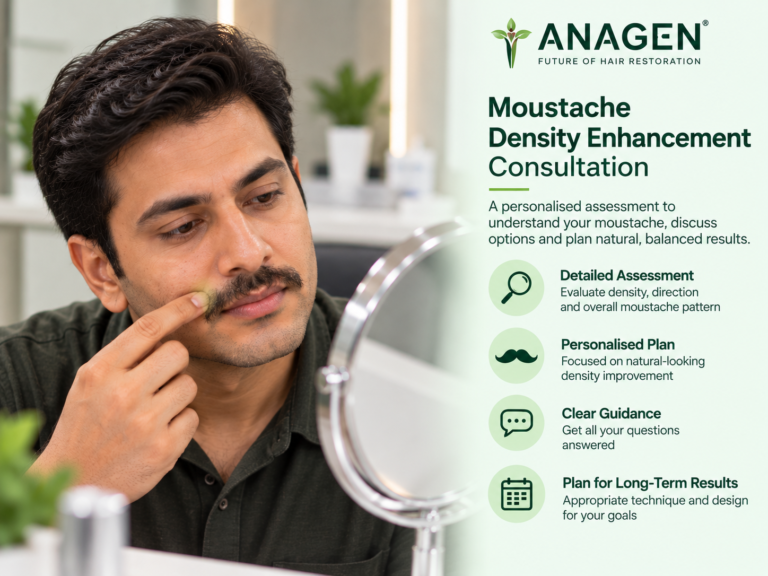
Moustache Density Consultation in Mumbai
If you already have a moustache, the consultation should determine exactly where additional hair would make a visible difference.
A useful assessment considers your normal moustache length, native direction, gaps, symmetry, hair calibre and realistic density goals before deciding how many grafts are required.
Patients can contact Anagen through the Contact Us page.