





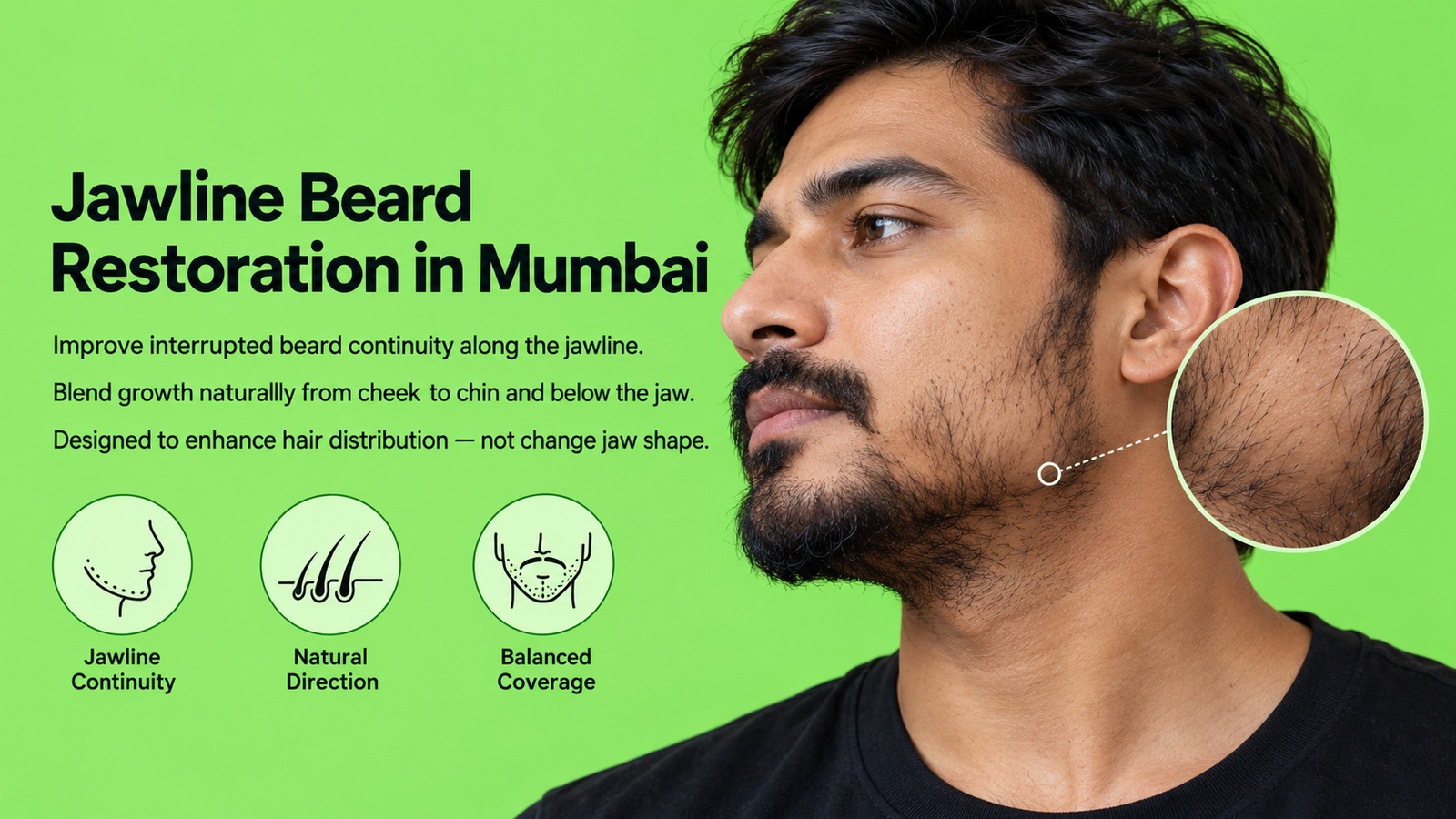
Jawline Beard Restoration in Mumbai
An incomplete beard along the jawline can make an otherwise established beard appear disconnected. Jawline beard restoration focuses on improving hair continuity along this lower facial region while preserving a believable transition from the cheek to the chin and beneath the jaw.
The procedure cannot change the shape of your jawbone. The aim is to improve the distribution of facial hair around your existing facial anatomy, not guarantee a sharper or more angular face.
What Is Jawline Beard Restoration?
This is a region-specific hair transplant plan for selected patients with limited or interrupted growth along the jawline. It can involve a short unilateral gap, inadequate lower-cheek-to-jaw coverage, weak continuity towards the chin or a more extensive bilateral deficit. The surgeon works around the existing beard rather than applying an identical dark band along the jaw.
If the main concern lies high on the cheeks, Cheek Beard Restoration explains that area’s distinct border and direction needs. If you want generally more hair throughout an existing beard, Beard Density Enhancement addresses diffuse sparseness instead.
Why Might Jawline Beard Hair Be Weak?
Jawline sparsity may be part of a person’s developmental or inherited hair pattern, or it may reflect a localised stable gap. Recent loss, inflammation or scarring requires diagnosis first. One side may naturally have more continuity than the other, so identical left and right placement is not automatically appropriate.
A healed scar that crosses the mandibular border creates different surgical considerations because scarred skin may have altered flexibility and blood supply. Read Beard Scar Repair if a stable injury or operative scar caused the missing hair.
How Do You Design a Natural Jawline Beard?
The clinician evaluates three transitions: lower cheek into jawline, jawline around the mandibular angle, and jawline forwards into the chin. Hair direction and exit angle may change as the beard curves around the face. A believable plan generally uses your own pattern to guide the intended contour rather than drawing an isolated row of hairs along a line.
A high-density strip that starts and stops suddenly may look conspicuous at short trimming lengths. A more gradual distribution around the gap can support continuity while leaving normal facial anatomy visible. Styling preferences matter: a patient wanting a short, outlined beard may need particularly careful direction mapping and realistic discussion of visible borders.
Which Direction Should Jawline Hair Grow?
There is no single arrow that works for every patient. At the mandibular angle, native hairs can change orientation as the surface curves from cheek to lower jaw. Near the chin and submandibular region, the pattern may change again. The surgeon studies this closely before making recipient sites, because incorrectly oriented grafts can become especially noticeable during close trimming.
What If Only One Jawline Section Is Missing?
A limited, stable jawline gap may be suitable for a smaller treatment area. The planned zone should blend at both ends, so the restored segment does not look like a separate line. If you already have adequate hair over the remaining beard, extensive multi-zone surgery may be unnecessary.
For very broad deficiency affecting both the cheeks and chin, Full Beard Hair Transplant is the appropriate page for understanding whole-face planning.
How Are Donor Hair and Graft Numbers Chosen?
Available scalp donor follicles are assessed for calibre, curl, colour, safe extraction volume and future requirements. Graft requirements are based on the actual mapped jawline area and remaining native hair, not a fixed number per centimetre. The patient should be told whether the plan addresses only a short connection or a larger curved border.
Hair transferred from the scalp may retain scalp-like length and growth characteristics and require regular trimming. Creating a plausible natural beard with fewer well-positioned grafts may be more useful than dense grafting along a poorly chosen line.
How Is Jawline Beard Restoration Performed?
Step 1: Jawline and Native-Hair Assessment
The surgeon examines both sides of the face, any scars or active skin changes and the existing lower cheek, chin and under-jaw pattern.
Step 2: Map the Jawline Transitions
The precise deficit and its borders are marked according to your natural facial contours, growth pattern and usual beard style.
Step 3: Examine the Donor Area
The clinician selects potentially suitable follicles and confirms what can be harvested while respecting future donor needs.
Step 4: Administer Local Anaesthesia
The planned donor and recipient sites are numbed, and the team monitors comfort and clinical response.
Step 5: Extract and Select FUE Grafts
Individual follicular units are harvested and chosen for appropriate use in the jawline’s visible and transitional areas.
Step 6: Prepare Curved-Contour Recipient Sites
Recipient locations are created to follow the actual three-dimensional mandibular contour and native hair direction.
Step 7: Implant for Continuity
Grafts are placed through the weak segment and feathered into established cheek and chin hair without creating a conspicuous dense band.
Step 8: Provide Jawline-Specific Aftercare
The team explains cleansing, sleeping, avoidance of facial friction, shaving restrictions, activity and follow-up.
Recovery and Growth Along the Jawline
In the first days, some swelling, redness, tenderness and small crusts are possible. Your jawline is subject to normal movement, clothing contact and sleep-position friction, so follow the clinic’s specific advice on graft protection. Increasing pain, spreading redness or discharge deserves prompt contact with your treating team.
The transplanted hair shafts can shed during the early weeks. Visible regrowth often begins around three to four months. Coverage may continue developing over six to nine months; clinicians commonly review maturation around nine to twelve months or later. Avoid treating an early photograph as the final outcome.
What Are the Limitations, Risks and Costs?
Potential complications include infection, inflammation, visible extraction scars or donor thinning, graft loss, uneven growth, conspicuous graft direction and recipient-surface irregularity. A restoration may make hair distribution appear more continuous, but it cannot alter underlying bone, remove scars or guarantee a particular face shape. Scalp-derived hairs may need grooming.
The cost is influenced by the mapped treatment length and width, the number of sides, existing hair, donor requirements, previous facial surgery and whether a broader beard treatment is planned. Request an individual evaluation rather than purchasing an advertised standard ‘jawline package.’
Jawline Beard Restoration Results
Jawline beard restoration is planned around your natural facial contour and existing hair. Explore Anagen’s beard transplant results, once its dedicated gallery is published, to review genuine cases and understand the different restoration requirements. Actual cases do not guarantee the same outcome for a different patient.
Frequently Asked Questions
Will a jawline beard transplant make my jaw sharper?
It may change the appearance of facial-hair coverage, but it does not change your jawbone or guarantee a sharper facial contour.
Can just a small gap between cheek and chin be treated?
Yes, in selected stable cases, the plan may focus on that connection and lightly blend with neighbouring native hair.
Will I have to shave the lower face after surgery?
Follow your own team’s healing instructions. Do not shave across recipient grafts until the team says it is safe.
Arrange a Jawline Beard Consultation in Mumbai
Photograph your face from both profiles, straight on and slightly from below, at your usual beard length. Anagen’s consultation can map the weak segment, donor suitability and whether treatment should remain jawline-specific. Contact Anagen to discuss your options.