





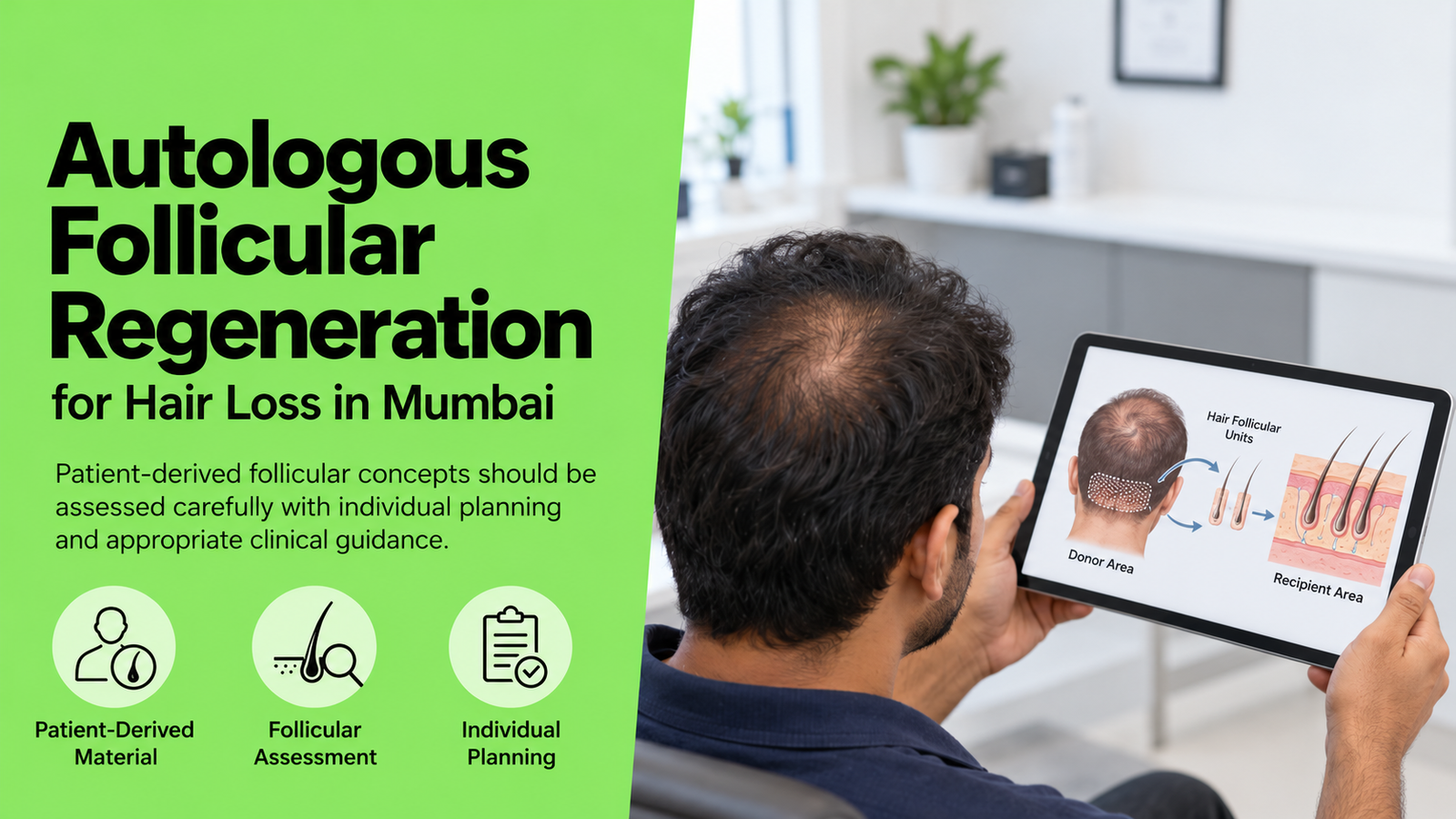
Autologous Follicular Regeneration for Hair Loss in Mumbai
The word “autologous” means that biological material is obtained from the same person who receives it.
In hair restoration, researchers have investigated whether patient-derived follicular tissue or cell-associated preparations can be used to influence hair-follicle biology.
Autologous Follicular Regeneration refers to this broad treatment concept, but the word “regeneration” needs careful explanation.
It does not automatically mean that new hair follicles can be created or that advanced baldness can be permanently reversed.
What Does Autologous Follicular Regeneration Mean?
An autologous approach uses the patient’s own biological source material.
If the treatment is follicular in origin, the source may involve tissue associated with hair follicles, but this must be confirmed for the Anagen protocol.
A procedure could involve collection, processing and administration of biological material, depending on the actual technique.
However, not every autologous preparation contains living cells, and not every follicle-derived preparation has the ability to regenerate hair.
The intended clinical objective should be described as precisely as possible.
Why Use a Patient's Own Biological Material?
Autologous material avoids certain compatibility issues associated with donor-derived material from another person.
However, that does not make the treatment free of risk.
Tissue collection can cause discomfort, bleeding or infection. Processing and administration require appropriate safeguards. The biological properties of the final product also depend on the method used.
Autologous origin alone does not establish effectiveness, regulatory acceptability or long-term safety.
How Is This Different from Hair Transplantation?
Hair transplantation moves intact donor follicles to an area where additional hair coverage is required.
Autologous follicular regenerative research instead investigates biological material derived from the patient’s own tissue and how it might affect scalp or follicular function.
It cannot be assumed that processing tissue produces more transplantable follicles.
Patients with established bald areas may still require assessment for hair transplantation in Mumbai.
How Is Autologous Follicular Regeneration Performed?
A complete Anagen procedure can only be published after protocol confirmation.
Step 1: Diagnosis and Scalp Assessment
The clinician evaluates the cause and stage of hair loss, remaining follicles and medical history.
Step 2: Eligibility and Source Selection
The proposed source material and any collection-site risks must be explained.
Step 3: Collection of Autologous Material
Collection occurs only if required by the verified procedure. The exact method cannot be assumed.
Step 4: Biological Preparation
Processing, cellular composition and quality-control requirements must follow the documented protocol.
Step 5: Scalp Administration
The route of administration and treatment areas require confirmation.
Step 6: Recovery and Follow-Up
Both source and treatment sites, where relevant, require aftercare and review.
Who May Be a Candidate?
A diagnosis of androgenetic alopecia, assessment of miniaturised hair and consideration of other medical causes are necessary.
Patients with sudden shedding, thyroid problems, nutritional deficiencies or scarring scalp disease may need different management.
Eligibility for the proposed regenerative procedure depends on clinical evidence and the verified safety and regulatory framework.
What Does the Evidence Show?
Some specific autologous follicular micrograft approaches have been investigated in controlled studies.
These findings should not be extrapolated automatically to a different Anagen protocol.
The number of patients studied, comparison treatment, follow-up duration and exact technique all matter when interpreting clinical results.
New follicle generation and permanent reversal of androgenetic alopecia have not been established for this unverified protocol.
Safety, Recovery and Cost
Risks may arise from source-tissue collection, processing and administration.
Recovery requirements depend on the procedures actually performed. No exact downtime or session count should be promised without protocol verification.
Price likewise depends on source collection, processing requirements and follow-up.
Frequently Asked Questions
What does autologous mean?
Biological material originating from the same patient.
Does this treatment multiply hair follicles?
That has not been established for the unverified Anagen protocol.
Is this hair cloning?
No such claim should be made without evidence of an actual validated hair-cloning technique.
Is the material obtained from my own follicles?
That requires protocol confirmation.
Is it the same as FBM?
It may overlap; Anagen must clarify whether it is a separate service or a broader explanation of FBM.
Can it replace a hair transplant?
It should not be assumed to replace follicular transplantation for established bald areas.
Understand Your Individual Treatment Options
An assessment can identify the cause of thinning and clarify which established or investigational approaches are relevant.
For a diagnosis-led hair-restoration consultation, contact Anagen.