





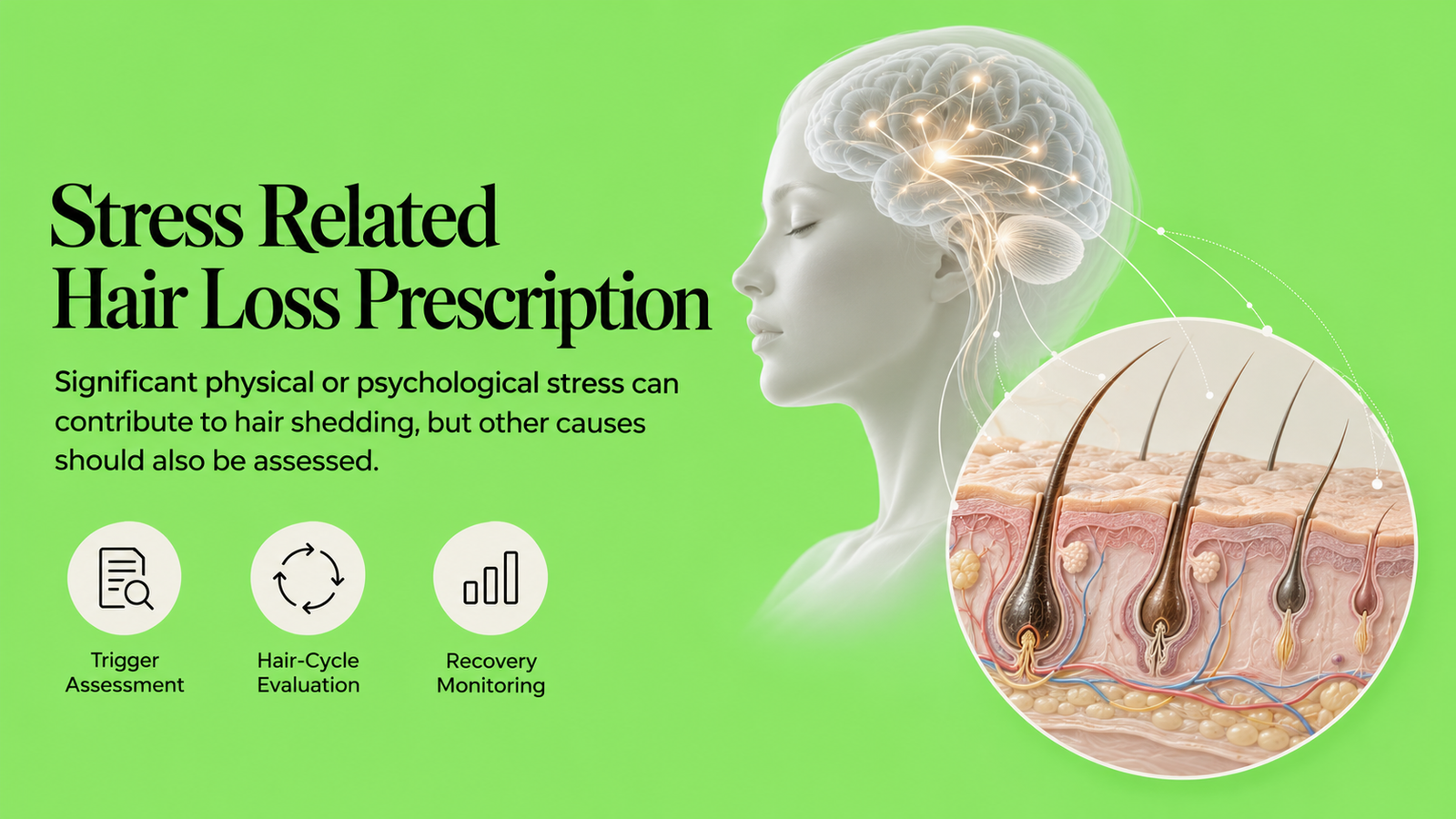
Stress Related Hair Loss Prescription
Hair shedding may increase after a period of significant emotional, psychological or physical stress.
Patients sometimes notice more hair during washing or combing after a major illness, surgery, prolonged physical strain, significant emotional event or another period of physiological disturbance.
However, stress should not automatically be assumed to be the cause of hair loss.
Several medical conditions can produce similar symptoms, and stress-related shedding may occur alongside androgenetic alopecia, nutritional deficiency, thyroid dysfunction or other hair-loss disorders.
One recognised mechanism is telogen effluvium, in which a triggering event leads to increased shedding of hairs that have entered the resting phase.
A Stress Related Hair Loss Prescription should therefore focus on identifying relevant triggers, establishing the actual pattern of hair loss, addressing contributing factors and monitoring recovery.
At Anagen Hair Transplant Clinic, Mumbai, the objective is to assess the cause before recommending hair-growth medication, supplements or procedures.
Can Stress Cause Hair Loss?
Significant physical or psychological stress can be associated with disturbances in the normal hair-growth cycle.
During a period of physiological stress, some follicles may shift into the resting phase earlier than usual.
The affected hairs may subsequently be shed after a delay, producing diffuse hair fall.
This pattern is commonly associated with Telogen Effluvium Prescription, although stress is only one of several possible triggers.
Not every stressful experience causes hair loss, and the presence of stress does not establish a specific hair-loss diagnosis.
A patient may also have more than one contributing factor.
Physical Stress and Psychological Stress
Stress-related hair shedding should be evaluated in the context of the patient’s overall medical condition.
Physical Stress
The body may experience significant physiological disturbance during or after events such as major illness, high fever, surgery, trauma, childbirth or rapid weight loss.
Such events can contribute to a change in hair cycling.
Psychological and Emotional Stress
Major emotional disturbances, prolonged psychological strain and significant life events may be associated with increased shedding in susceptible individuals.
However, the relationship between psychological stress and hair loss is not always straightforward.
The clinician should not assume that stress alone explains the symptoms.
Sleep and Lifestyle Changes
Periods of stress may also be accompanied by altered sleep, reduced dietary intake, weight changes or changes in self-care.
These factors can be relevant when assessing the patient’s overall health.
Stress and Other Hair-Loss Conditions
Stress-related shedding may make previously mild pattern hair loss more noticeable.
A patient may also develop diffuse shedding from a separate medical cause during a stressful period.
Therefore, a diagnosis based solely on the patient’s description of stress is insufficient.
Diagnostic Assessment Before Prescription
The first objective is to establish whether the patient’s hair-loss pattern is consistent with stress-associated shedding or another diagnosis.
1. Hair-Loss History
A clinician may review:
- When shedding began.
- Whether the onset was sudden or gradual.
- Whether loss is diffuse, patterned or patchy.
- Significant illness, surgery or other physical events.
- Major psychological stressors where the patient is comfortable discussing them.
- Changes in sleep, appetite, diet or weight.
- Recent medication changes.
- Relevant menstrual, pregnancy or postpartum history.
- Previous episodes of hair shedding.
- Family history of pattern hair loss.
- Current scalp symptoms.
Patients do not need to disclose unnecessary private details of stressful experiences to receive appropriate hair-loss assessment.
2. Scalp and Hair Examination
The clinician may assess hair density, distribution, shaft calibre, follicular openings and signs of inflammation.
A hair-pull test or trichoscopy may provide additional information when appropriate.
3. Assessing for Telogen Effluvium
Telogen effluvium is a possible diagnosis when the history and examination support a diffuse hair-cycle shedding disorder.
However, not every patient with stress and hair loss has telogen effluvium.
Other diagnoses require consideration when the pattern is atypical.
4. Selective Medical Investigations
Investigations may be considered when history or examination suggests nutritional deficiency, thyroid dysfunction, another systemic illness or unexplained persistent hair shedding.
Routine cortisol testing or a fixed panel of blood tests is not required merely because a patient reports stress.
Prescription Overview
Primary Concern: Increased hair shedding potentially associated with significant physical or psychological stress.
Possible Underlying Cause / Trigger: Major illness, surgery, psychological stress, significant life events, changes in nutrition or other physiological disturbances.
Assessment Required: History of hair loss and relevant triggers, scalp examination, assessment for telogen effluvium or another alopecia, and selective investigations when clinically indicated.
Prescription Goal: Identify the actual shedding disorder, address relevant triggers, support general health and monitor hair-cycle recovery.
Possible Treatment Categories: Management of an underlying medical condition, correction of a relevant nutritional problem, appropriate support for sleep or psychological distress, scalp treatment where indicated and selected hair-directed medication for a separate confirmed diagnosis.
Supportive Hair / Scalp Care: Gentle cleansing, reduced unnecessary traction, balanced nutrition and a manageable hair-care routine.
Monitoring: Changes in shedding, hair density, visible regrowth, persistence of triggers and development of other scalp symptoms.
Follow-Up: Based on the duration and severity of shedding, the underlying condition and clinical response.
When Referral / Further Investigation May Be Needed: Persistent or unexplained shedding, systemic symptoms, suspected nutritional or endocrine problems, significant psychological distress or signs of another scalp disorder.
When Another Hair-Restoration Treatment May Be Considered: Only if an independently diagnosed hair-loss condition warrants additional treatment.
Important: This page provides general prescription information and does not replace an individual medical assessment. The cause of hair loss should be confirmed before medicines, supplements or procedures are selected.
Prescription Management for Stress-Related Hair Loss
1. Confirm the Hair-Loss Diagnosis
The clinician should first determine whether the pattern is consistent with telogen effluvium, androgenetic alopecia, another medical disorder or a combination of conditions.
The presence of stress does not eliminate the need for examination.
2. Identify and Address Contributing Triggers
Where a relevant physical trigger exists, management should focus on the underlying illness, nutritional disturbance or other medical issue.
If psychological stress is significant, appropriate lifestyle measures or professional support may be considered according to individual needs.
No particular stress-management technique should be presented as a guaranteed treatment for hair loss.
3. Support Sleep and Nutrition
A consistent sleep routine, adequate food intake and appropriate general health measures may be useful when these areas have been affected.
Dietary supplements should not be prescribed without a suitable clinical indication.
4. Avoid Unnecessary Hair-Growth Medication
Some cases of trigger-associated telogen effluvium may improve without hair-growth medication after contributing factors resolve.
Prescription medication may be considered when the diagnosis and circumstances justify it, particularly where another form of alopecia is also present.
5. Manage Psychological Distress When Relevant
Hair loss itself may cause anxiety or affect quality of life.
Patients experiencing persistent or significant psychological distress may benefit from support from an appropriate mental-health professional.
This does not mean that the hair loss is imaginary or solely psychological.
Supportive Hair and Scalp Care
Patients experiencing increased shedding may benefit from a simple, consistent hair-care routine.
Gentle shampooing and appropriate conditioning can help reduce unnecessary friction and breakage.
Washing the hair does not itself cause a telogen effluvium episode, although resting hairs ready to shed may become more noticeable during washing.
Avoid repeatedly pulling or vigorously brushing the hair to check for shedding.
Adequate nutrition and treatment of diagnosed scalp disorders may also be appropriate.
The Hair Fall Control Prescription and Hair Care Routine pages can provide additional general guidance.
Monitoring, Follow-Up and Realistic Recovery
When a relevant trigger has resolved and follicles remain viable, stress-associated telogen shedding may gradually improve.
However, visible regrowth is not immediate.
The hair-growth cycle operates over months, so a reduction in shedding and a return of visible volume may occur at different times.
The degree of recovery depends on whether the original trigger has resolved, whether additional triggers persist and whether another hair-loss disorder is present.
Some patients experience prolonged or recurrent episodes that require further clinical evaluation.
Follow-up may involve comparison of scalp photographs, review of shedding patterns and examination for evidence of regrowth or progressive miniaturisation.
When Should Another Hair-Loss Diagnosis Be Considered?
Stress should not be used as a default explanation for every episode of hair loss.
If shedding persists, thinning follows a recognisable pattern, isolated patches appear or the scalp shows significant inflammation, another diagnosis may be present.
Relevant possibilities include:
- Telogen effluvium from a cause unrelated to psychological stress.
- Male or female pattern hair loss.
- Thyroid-related shedding.
- Nutritional deficiency.
- Alopecia areata.
- Scalp inflammatory conditions.
- Hair breakage due to chemical or thermal damage.
If a patient reports repetitive hair pulling, the clinician should also consider a distinct hair-pulling disorder and assess it appropriately rather than labelling it ordinary stress shedding.
Relevant internal pages include Telogen Effluvium Prescription, Thyroid & Hair Loss Prescription, Vitamin Deficiency Hair Loss Prescription and Female Pattern Hair Loss Prescription.
Stress-Related Hair Loss vs Telogen Effluvium
These terms should not be treated as identical.
Stress-related hair loss describes a possible triggering context or patient concern.
Telogen effluvium describes a specific hair-cycle shedding disorder that can be associated with multiple triggers, including stress.
A patient may develop telogen effluvium after illness, surgery, childbirth or nutritional disturbance without a significant psychological trigger.
Conversely, not all hair loss occurring during stress is telogen effluvium.
This distinction matters because prescription treatment should follow the confirmed diagnosis.
Are PRP, GFC or Hair Transplantation Necessary?
PRP, GFC, iPRF, exosomes and other biologic procedures should not be presented as routine first-line treatment for stress-associated shedding.
They do not correct significant psychological stress, systemic illness or nutritional problems.
Hair transplantation is generally inappropriate for active temporary diffuse shedding where follicles remain viable.
If examination identifies a separate form of persistent patterned hair loss, the clinician may discuss appropriate management based on that diagnosis.
Frequently Asked Questions
Can emotional stress cause hair loss?
Yes. Significant emotional stress can contribute to hair shedding in some individuals, particularly through telogen effluvium. However, stress is not the only possible cause.
Why does hair shedding sometimes begin after the stressful event?
Hair-cycle changes can occur before the affected resting hairs are shed. Therefore, visible shedding may appear after a delay.
Is stress-related hair loss permanent?
Stress-associated telogen effluvium is generally non-scarring and may improve when relevant triggers resolve. However, recovery varies and another hair-loss disorder may coexist.
How do I know whether stress is really causing my hair fall?
A clinician should review the timeline, trigger history, scalp examination and alternative diagnoses. Stress alone is not sufficient to establish the cause.
Does reducing stress immediately stop hair shedding?
No. Hair follicles follow biological growth cycles, so changes in shedding may take time even after a trigger has improved.
Do I need blood tests for stress-related hair loss?
Not automatically. Investigations should be selected according to medical history, clinical findings and suspicion of nutritional, thyroid or other systemic causes.
Can stress-related shedding occur with pattern baldness?
Yes. A shedding episode may coexist with or make underlying androgenetic alopecia more noticeable.
Stress Related Hair Loss Consultation at Anagen, Mumbai
Hair shedding during a stressful period deserves appropriate medical assessment rather than being dismissed as stress alone.
A Hair Prescription Consultation at Anagen Hair Transplant Clinic can help distinguish trigger-associated shedding from nutritional deficiency, thyroid dysfunction, pattern hair loss and other scalp disorders.
The objective is to identify the actual cause, select an appropriate management plan and monitor recovery realistically.
Treatment decisions remain subject to individual clinical assessment.