





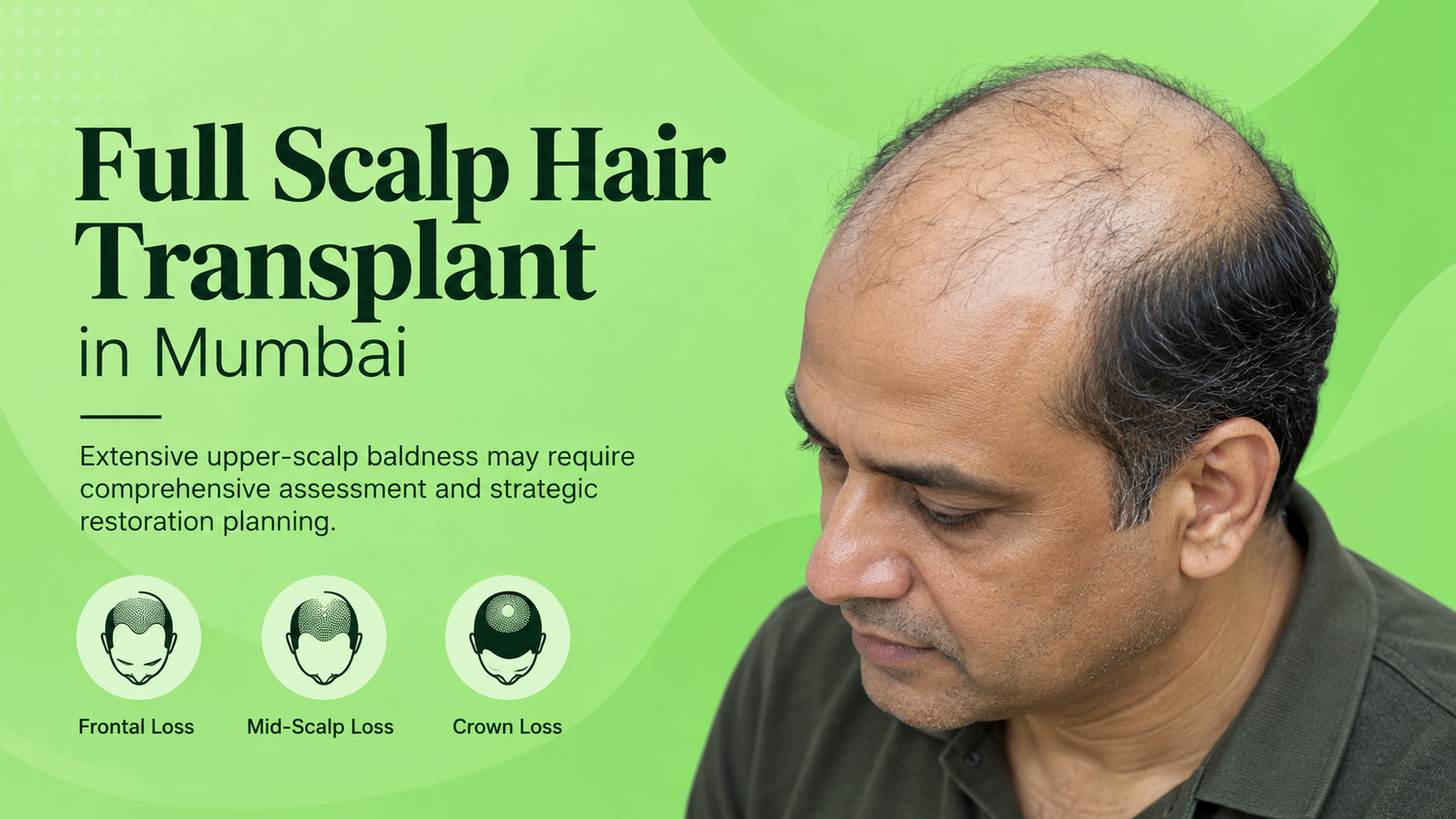
Full Scalp Hair Transplant in Mumbai
Extensive hair loss can affect most of the upper scalp, including the hairline, frontal region, mid-scalp and crown.
In such cases, hair transplantation requires a different approach from restoring one limited area. The main challenge is balancing a large recipient surface with a finite amount of available donor hair.
Full Scalp Hair Transplant at Anagen Hair Transplant Clinic in Mumbai focuses on comprehensive restoration planning, realistic coverage, donor conservation and the possible need for staged procedures.
What Does Full Scalp Hair Transplant Mean?
Full scalp transplantation refers to a comprehensive surgical restoration strategy for patients with extensive loss across a large portion of the upper scalp.
It does not mean that grafts are implanted into every square centimetre of the head or that original hair density can be recreated everywhere.
Instead, the doctor evaluates the total area affected by hair loss and determines how much cosmetically meaningful coverage may be possible with available donor follicles.
Some patients may benefit from treatment across several zones. Others may require prioritised coverage because the number of follicles needed to reproduce native density would exceed their safe donor supply.
Why Is Extensive Hair Loss More Difficult to Restore?
Large recipient areas create substantial demand for follicular units.
The donor region is limited, and excessive extraction can leave visible thinning or irregularity at the back and sides of the scalp.
Full scalp planning must therefore evaluate:
- The total recipient surface area.
- Density and calibre of safe scalp donor hair.
- Hair-to-skin colour contrast and hair curl.
- Previous hair restoration procedures.
- Existing native hair and likely future progression.
- Whether non-scalp donor hair is appropriate.
- The balance between overall coverage and local density.
The objective is to use the available follicles intelligently rather than promise uniform high density across an extensive bald region.
What Is the Donor–Recipient Imbalance?
Donor–recipient imbalance occurs when the number of follicles required for an extensive restoration exceeds the number that can safely be harvested.
For example, creating dense coverage across a small frontal area may be feasible with an adequate donor. Attempting a similar density across a much larger recipient area may not be.
Extracting grafts beyond safe limits can compromise the donor’s appearance and reduce future treatment options.
The doctor must therefore calculate a realistic donor budget before deciding on hairline position, recipient coverage and the number of surgical stages.
Should Coverage or Density Receive Priority?
In extensive baldness, the surgeon may need to choose between covering a larger area more lightly or creating stronger density within a smaller area.
This decision depends on patient preferences, existing hair, donor supply and the relative visual importance of different scalp regions.
For many patients, a natural frontal hairline and adequate frontal coverage create a meaningful visual improvement even when the crown remains relatively sparse.
Other patients may prefer broader but lighter coverage.
Neither approach is universally correct. It is important that the expected trade-off is explained clearly before surgery.
Which Areas Usually Receive Priority?
The treatment plan is designed around the patient’s existing hair and aesthetic goals.
Frontal Hairline
A conservative, mature frontal hairline can help frame the face without consuming an excessive donor budget.
Frontal Scalp
Restoring the frontal third may provide significant visual improvement because it is highly visible during ordinary interaction.
Mid-Scalp
Central coverage helps avoid a disconnected island of frontal hair.
Crown
The crown may require substantial grafts because of its surface area and whorl. It may receive lighter coverage or be planned as a separate stage.
Patients requiring a zone-by-zone breakdown can read Front + Mid + Crown Hair Transplant.
Can Beard or Body Hair Be Used for Full Scalp Restoration?
Selected patients may have useful supplementary follicles outside the scalp.
Beard hair can sometimes provide additional coverage in appropriate recipient regions because of its calibre, while selected body hair may be considered in more specialised cases.
However, beard and body hair can differ from scalp hair in length, curl, shaft diameter and growth characteristics.
They are not automatically interchangeable with scalp follicles, particularly at a delicate frontal hairline.
The suitability of alternative donor hair depends on medical assessment, donor density, extraction feasibility and the recipient region.
Further information is available in Alternative Donor Hair Restoration and Advanced Donor Management.
Why Might Full Scalp Restoration Need Multiple Sessions?
A staged approach can help allocate finite donor hair while allowing the first-stage result and remaining donor capacity to be reassessed.
One possible strategy is to prioritise the frontal scalp and mid-scalp initially, followed by crown restoration or additional density if appropriate.
Some extensive cases may require more than two procedures, while others may be unsuitable for the amount of restoration requested.
Stage timing depends on healing, growth maturation and clinical reassessment.
How Is Full Scalp Hair Transplant Performed?
Step 1: Whole-Scalp Diagnosis
The doctor evaluates the cause, distribution and progression of hair loss.
Step 2: Comprehensive Donor Assessment
Scalp donor density, hair characteristics, previous surgery and available reserve are assessed. Alternative donor regions may also be evaluated where relevant.
Step 3: Define Realistic Coverage Goals
The patient and doctor discuss facial framing, total coverage, density compromises and possible untreated regions.
Step 4: Develop the Staged Surgical Plan
Recipient zones, hairline position and estimated graft requirements are allocated according to available resources.
Step 5: Local Anaesthesia and FUE Harvesting
Suitable follicular units are harvested under appropriate surgical and anaesthetic protocols.
Step 6: Recipient-Site Creation
Recipient sites are planned according to hairline direction, central scalp flow and crown anatomy.
Step 7: Graft Implantation
Grafts are distributed according to the approved treatment priorities.
Step 8: Follow-Up and Donor Reassessment
Healing, new growth, native-hair progression and remaining donor options are reviewed before considering additional surgery.
How Many Grafts Are Required for Extensive Scalp Restoration?
The requirement depends on the total scalp area, existing hair, intended density and donor resources.
Some extensive restoration plans may involve several thousand grafts across one or more surgical stages.
A multi-zone plan involving approximately 4,500–6,500 grafts may be considered in some suitable cases, but that range is not a standard requirement or assurance of full coverage. Larger demands may exceed safely available donor hair.
The patient should receive an explanation of what can realistically be restored before committing to surgery.
Recovery and Expected Results
Early postoperative healing may involve redness, crusting, swelling and temporary sensitivity.
Transplanted hair shafts frequently shed in the early weeks, while new growth often becomes visible after several months.
Frontal improvement commonly develops earlier than final crown maturation, and comprehensive results may need assessment over approximately 12–18 months.
The goal is a meaningful cosmetic improvement, not a guarantee of native density across the entire scalp.
Full Scalp Hair Transplant Results
Extensive restoration requires balancing coverage, density and donor preservation.
Reviewing genuine Male Hair Transplant Results can help patients understand how larger recipient areas are approached and why different scalp regions may achieve different levels of coverage.
View full scalp hair transplant results.
How Much Does Full Scalp Hair Transplant Cost?
The cost depends on the size of the recipient area, total graft requirement, available donor regions, surgical technique, procedural complexity and number of treatment stages.
Alternative donor harvesting, previous surgery and advanced donor planning may also affect the treatment plan.
A reliable estimate requires comprehensive scalp and donor assessment.
Frequently Asked Questions
Can an entirely bald upper scalp be restored?
Some degree of restoration may be possible, but complete coverage or original density cannot be guaranteed.
How many sessions are needed?
The number depends on donor supply, recipient demand and realistic density goals. Some patients benefit from staged treatment.
Is full scalp transplantation the same as three-zone transplantation?
No. Three-zone transplantation focuses on planning front, middle and crown areas. Full scalp transplantation emphasises extensive coverage and donor-recipient limitations.
Can beard hair help with extensive scalp baldness?
In selected patients, beard follicles may supplement scalp donor hair, but they are not suitable for every recipient location.
Will the donor area become visibly thin?
Excessive harvesting can cause visible donor thinning. Safe extraction distribution is an essential part of planning.
Can full scalp transplantation be performed at any Norwood grade?
The surgical decision depends on actual recipient demand and donor characteristics, not only on a classification label.
Discuss Comprehensive Hair Restoration at Anagen
If baldness affects most of your upper scalp, the first step is to establish realistic coverage goals and assess your remaining donor capacity.
Send clear FRONT, FULL TOP, CROWN, BOTH SIDES and BACK DONOR photographs. Include beard donor photographs if alternative donor planning may be relevant.
Anagen can help assess whether extensive restoration is feasible, which regions deserve priority and whether multiple treatment stages may be required.
ANAGEN Hair Transplant Clinic — Andheri West, Mumbai
Call / WhatsApp: +91 92222 22407