





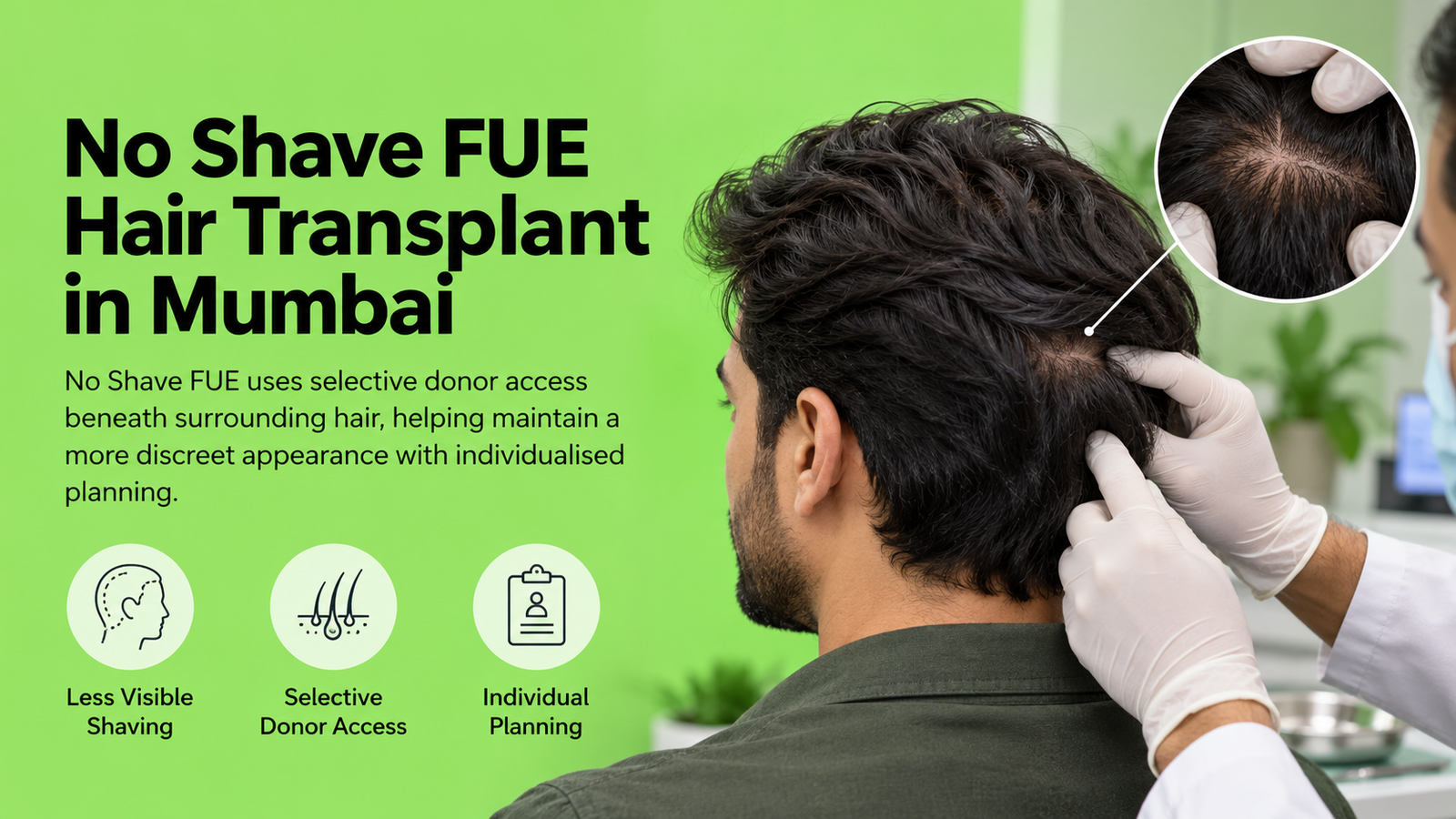
No Shave FUE Hair Transplant in Mumbai
No Shave FUE is an approach to follicular-unit harvesting designed to reduce or avoid broad visible shaving of the donor area.
For many patients, the main concern is not the surgical technique itself but the appearance of their existing hair immediately after transplantation.
No Shave FUE may allow surrounding donor hair to remain longer, helping conceal areas where follicular units have been harvested.
However, this does not always mean absolutely no trimming. The exact preparation method depends on the selected technique, donor characteristics and number of grafts required.
At Anagen Hair Transplant Clinic in Mumbai, the suitability of No Shave FUE should be assessed according to donor access, procedure size, hair length and the patient’s expectations regarding discretion.
What Is No Shave FUE?
FUE is a method of harvesting individual follicular units from the donor scalp using small punches.
Conventional FUE often involves shaving or trimming a broad donor region to make follicular-unit extraction more accessible.
No Shave FUE modifies donor preparation so that extensive visible shaving may be avoided.
Depending on the exact method, some approaches preserve surrounding longer hair while selectively trimming small donor sections. Other techniques may harvest without pretrimming the donor shafts.
These differences are important because patients may have very different expectations when they hear the phrase “No Shave.”
The surgeon should explain exactly which areas, if any, will be trimmed before the procedure.
How Is No Shave FUE Different From Standard FUE?
Both approaches involve individual follicular-unit harvesting.
The main distinction is donor hair preparation and access.
With a standard shaved donor approach, individual follicular-unit exits are more readily visible and accessible.
With No Shave FUE, existing longer hair must be managed around the harvesting area.
This may improve the discretion of donor preparation but can increase technical complexity, reduce visibility and influence how many grafts can practically be harvested during a session.
It does not change the biological process of healing or new hair growth.
How Can No Shave FUE Improve Discretion?
When surrounding hair remains longer, it may cover some of the donor harvesting sites during the initial recovery period.
This can be useful for patients who prefer not to have a visibly shaved donor region for occupational, personal or social reasons.
The degree of concealment depends on existing hair length, density, hairstyle and the extent of harvesting.
Very short hair may provide less coverage, while naturally longer hair may conceal certain areas more effectively.
However, the recipient region can still show redness, crusting or swelling.
A No Shave FUE procedure should never be described as completely invisible.
Who May Be Suitable for No Shave FUE?
No Shave FUE may be considered for appropriately selected patients who want to retain their existing hairstyle during donor harvesting.
Suitability depends on several factors.
The surgeon must assess donor density, hair length, follicular-unit characteristics, required graft number, scalp condition and the ability to harvest safely while preserving surrounding hair.
Smaller treatment areas may sometimes be easier to manage than extensive sessions, although there is no universal graft-number cutoff that applies to every clinic or patient.
Patients with limited donor hair, extensive baldness or complicated revision requirements may need an alternative donor-preparation approach.
How Is No Shave FUE Performed?
Step 1: Hair Loss Assessment
The surgeon evaluates the patient’s diagnosis, hair-loss pattern, treatment goals and clinical suitability.
Step 2: Donor Density and Hair-Length Evaluation
The donor region is assessed for follicular-unit density, hair length, calibre, miniaturisation and the amount of natural hair available for concealment.
Step 3: Recipient-Area and Graft Planning
The hairline and recipient coverage are planned, and the estimated graft requirement is compared with the practical donor harvesting capacity.
Step 4: No-Shave Donor Preparation
The donor hair is arranged to permit harvesting. Depending on the verified method, selective trimming or another preparation technique may be used. Any trimming should be explained before surgery.
Step 5: Local Anaesthesia
Suitable local anaesthesia is administered according to the clinical plan.
Step 6: Follicular Unit Extraction
The surgeon harvests individual follicular units using an appropriate FUE punch while managing the surrounding longer hair and preserving donor distribution.
Step 7: Graft Inspection and Handling
Harvested grafts are inspected and protected. The graft-handling process should not be compromised by the more demanding donor access.
Step 8: Recipient-Site Preparation
The recipient region is prepared according to the planned direction, depth, angle and distribution of follicular units.
Step 9: Graft Implantation
Follicular units are placed into the selected recipient positions using the planned implantation method.
Step 10: Donor-Area Care and Follow-Up
The patient is advised on gentle washing, avoiding trauma to the surgical sites, protecting the grafts and attending follow-up assessments.
No Shave FUE vs Long Hair FUE
The two techniques may share a goal of preserving more of the patient’s existing hair.
However, Long Hair FUE specifically focuses on extracting follicular units with longer shafts retained.
No Shave FUE is a broader term describing reduced or avoided donor shaving. It may include selective trimming or other unshaven harvesting methods.
Therefore, the surgeon should clarify whether the procedure retains the full donor hair shaft, preserves mainly the surrounding hairstyle or combines these features.
The final choice should be based on the actual harvesting method rather than the marketing label.
Does No Shave FUE Limit the Number of Grafts?
It can affect practical harvesting capacity.
The procedure may require additional time and more complex access to individual follicles.
For extensive restoration, the surgical team must consider whether the chosen preparation method permits safe extraction, adequate graft inspection and appropriate implantation within a reasonable surgical plan.
No technique should be advertised as allowing an unlimited number of grafts.
The need to avoid excessive donor harvesting remains unchanged.
Recovery After No Shave FUE
Retaining the surrounding hair may reduce the visible appearance of donor preparation, but the extracted follicular units still leave small healing sites.
Mild redness, tenderness and crusting may occur.
The recipient region may also show visible postoperative changes even if donor shaving has been minimised.
Transplanted shafts may shed during the following weeks, and new growth generally develops over months.
No Shave FUE does not prevent temporary postoperative shedding or guarantee a faster recovery.
No Shave FUE Hair Transplant Cost in Mumbai
The cost depends on the number of grafts, treatment area, donor hair characteristics, complexity of the shaving approach, procedure duration and selected implantation method.
Additional time or specialised extraction techniques may affect the quotation.
Patients should confirm exactly which donor preparation will be used rather than relying on the package name alone.
View No Shave FUE Hair Transplant Results
The discretion offered by retained surrounding hair is different from the final biological outcome of transplantation.
Long-term hair growth depends on donor quality, graft handling, implantation and individual healing.
For original patient photographs, view hair transplant results under the dedicated Anagen Results section
Frequently Asked Questions
Does No Shave FUE mean no hair trimming at all?
Not always. Some methods use selective trimming or pretrimming. The exact preparation technique must be clarified before surgery.
Can 3,000 or more grafts be transplanted without shaving?
There is no universal number. Feasibility depends on donor characteristics, chosen method, surgical experience and session planning.
Will anybody notice the donor area after No Shave FUE?
Surrounding hair may conceal some extraction sites, but visible postoperative changes can still occur.
Is No Shave FUE better than shaved FUE?
Not universally. Its principal advantage is related to donor hair preservation and discretion, while conventional shaving may offer more straightforward access.
Does No Shave FUE prevent hair shedding?
No. Transplanted hair can still undergo temporary shedding during the early postoperative period. Retaining the surrounding donor hair does not prevent this natural biological process.
Can I return to work immediately after No Shave FUE?
Some patients may feel comfortable returning to non-strenuous activities relatively soon, particularly when surrounding hair conceals portions of the donor area.
However, visible redness, crusting or swelling may remain, especially in the recipient region. The timing of returning to work depends on the extent of surgery, occupation and individual healing.
Patients should follow their surgeon’s postoperative instructions and avoid activities that could disturb the newly implanted grafts.
Plan Your No Shave FUE Consultation at Anagen
If you want a hair transplant without significantly changing your existing hairstyle, the first step is determining whether No Shave FUE is suitable for your donor characteristics and graft requirements.
At Anagen Hair Transplant Clinic in Andheri West, Mumbai, your consultation can help establish:
- Whether your existing hair length provides adequate donor-area coverage.
- Whether selective trimming or a fully unshaven harvesting approach is appropriate.
- How many grafts may be safely harvested.
- Whether the proposed procedure can be completed in one session.
- What visible postoperative changes you should realistically expect.
The goal is to select a clinically appropriate extraction technique while considering your preference for a discreet recovery.
Send clear FRONT, TOP and BACK donor-area photographs on WhatsApp: +91 92222 22409.
[IMAGE 7 — SECTION IMAGE / CONSULTATION CTA]