





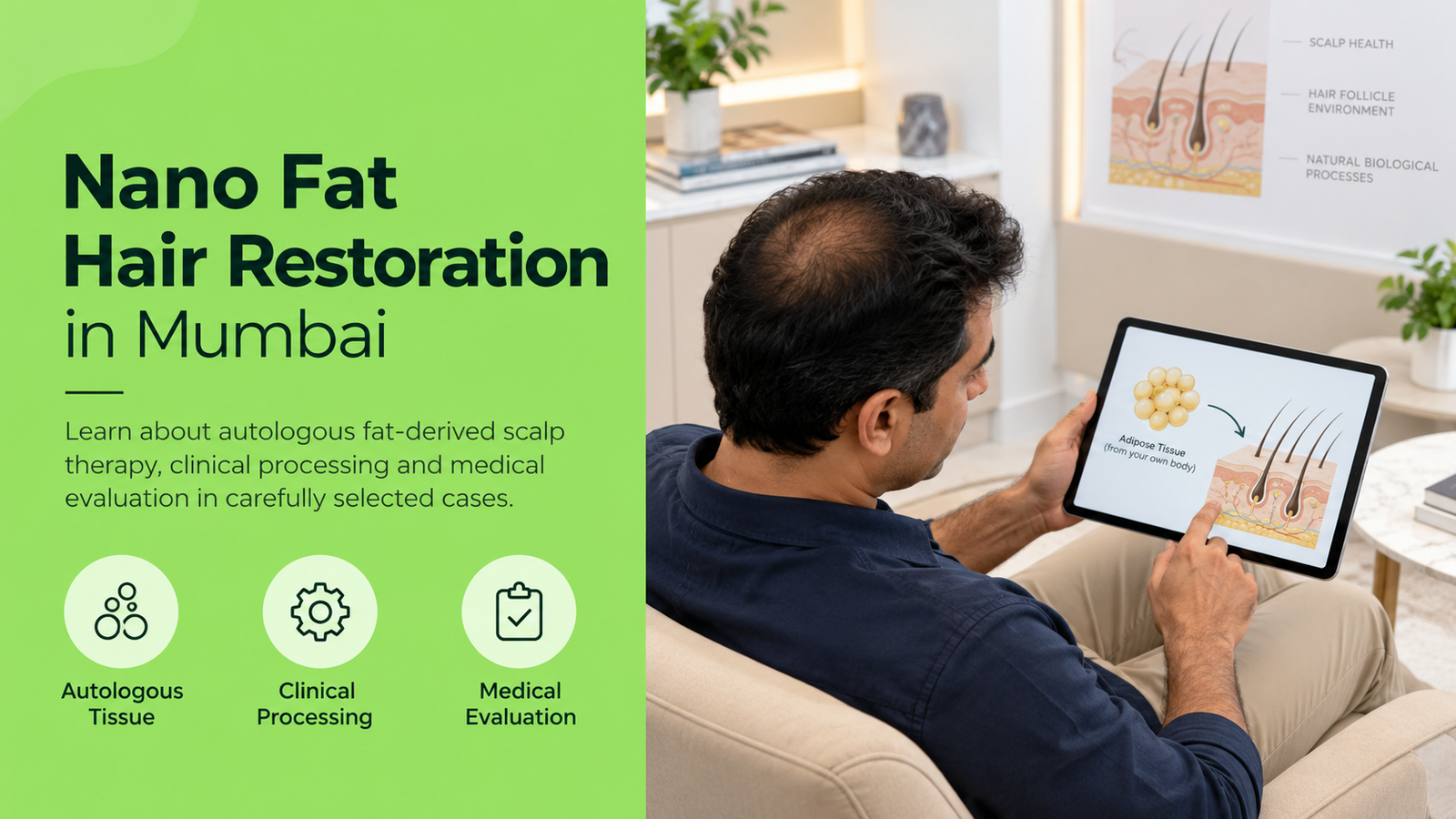
Nano Fat Hair Restoration in Mumbai – Autologous Fat-Derived Scalp Therapy
Fat tissue contains more than stored fat. It also includes connective tissue, blood vessels and different cellular components.
Researchers have investigated whether processed autologous adipose tissue can be used in tissue-repair and regenerative applications.
One technique studied in aesthetic and regenerative medicine involves processing harvested fat into a preparation commonly called nanofat.
Researchers have begun exploring nanofat-derived approaches in selected patients with hair loss.
However, nanofat hair restoration remains an evolving field, and not every processed-fat preparation is the same.
What Is Nanofat?
Nanofat generally refers to an autologous fat-derived preparation produced by processing harvested adipose tissue.
The technique differs from ordinary fat transfer, where intact fat tissue is used primarily for volume restoration.
Nanofat processing changes the physical structure of the harvested tissue and may produce a material suitable for particular applications, depending on the method.
However, the term does not establish one universal product, precise cellular composition or clinical indication.
Nanofat should not automatically be called purified stem-cell therapy or stromal vascular fraction therapy.
Where Does the Fat Come From?
Autologous nanofat uses adipose tissue obtained from the same patient.
A clinician may consider an appropriate donor area depending on the verified procedure and the patient’s anatomy.
The collection technique, quantity, local anaesthesia and donor-site effects must be explained before treatment.
Why Is Nanofat Being Investigated for Hair Loss?
Adipose tissue contains biological components involved in tissue structure and signalling.
Research has explored whether processed adipose-derived preparations may influence the environment surrounding existing hair follicles.
Early clinical studies have examined nanofat or related adipose-derived preparations in androgenetic alopecia.
Some have reported encouraging hair-related findings.
However, studies are relatively small, techniques vary and larger controlled investigations are required.
A result achieved using one preparation cannot automatically be attributed to every form of nanofat.
Is Nanofat a Stem-Cell Treatment?
Not automatically.
Nanofat and isolated stem-cell products are different concepts.
The processing method may influence which tissue and cellular components remain in the preparation.
If a product contains a specifically isolated cellular fraction, its identity must be verified rather than inferred.
The regulatory classification may also change according to tissue manipulation and intended clinical use.
How Is Nano Fat Hair Restoration Performed?
The following describes a general clinical framework for an autologous fat-derived procedure. It does not specify Anagen’s unverified technical protocol.
Step 1: Hair-Loss Assessment
The clinician examines the scalp, establishes the diagnosis and reviews established treatment alternatives.
Step 2: Patient and Donor-Site Suitability
The intended adipose tissue source, medical risks, medications and possible contraindications are considered.
Step 3: Fat-Tissue Collection
An appropriate collection procedure is required if the proposed treatment uses autologous harvested fat. The exact method must be confirmed.
Step 4: Nanofat Preparation
The harvested material is processed according to the verified protocol.
The exact processing technique, cellular composition and quality-control requirements must be identified.
Step 5: Scalp Administration
The preparation is administered only according to an appropriately authorised treatment protocol.
Step 6: Donor-Site and Scalp Aftercare
Both the tissue collection area and scalp treatment area may require post-procedure care.
Step 7: Follow-Up
The patient is monitored for complications and any clinically meaningful changes in hair-related measurements.
Who May Be Suitable?
Potential candidates would require a diagnosed hair-loss condition and a clear rationale for using the proposed nanofat preparation.
Patients with remaining functioning follicles may have different options from individuals with advanced complete baldness.
Eligibility also depends on suitability for fat collection, anaesthesia, procedural risks and the regulatory status of the exact treatment.
Someone with hair shedding from thyroid disease, nutritional deficiency or active inflammatory scalp disease may need different care.
Recovery and Possible Side Effects
Nanofat differs from an ordinary scalp injection because collection of adipose tissue may be part of the procedure.
Potential donor-site effects include pain, bruising, swelling, bleeding, contour changes or infection.
Scalp administration may cause discomfort, swelling, bruising and other procedure-related reactions.
The exact risk profile depends on the collection technique, preparation and method of administration.
A patient’s relevant medical conditions and medications must be reviewed before any procedure.
Can Nanofat Regrow Hair?
Early research suggests potential effects on selected hair-related outcomes.
However, nanofat should not be marketed as proven to create new hair follicles, reverse advanced baldness or permanently stop androgenetic alopecia.
Nanofat vs PRP and Cellular Therapy
PRP is a platelet-rich plasma preparation.
Nanofat is derived from processed adipose tissue.
Cellular therapy refers to a treatment involving defined cellular components, which may or may not apply to a particular nanofat preparation.
The source of a treatment does not, by itself, determine its efficacy.
Does Nanofat Replace Hair Transplantation?
Nanofat is not the same as transferring intact follicles.
For a completely bald scalp region, the possibility of transplantation depends on donor supply and other clinical factors.
The proposed nanofat approach cannot be assumed to generate sufficient new follicles to replace transplantation.
Nano Fat Hair Restoration Cost in Mumbai
Cost may include consultation, tissue collection, processing, administration, aftercare and follow-up.
Anagen-specific pricing will be confirmed after the actual protocol and regulatory status are established.
Frequently Asked Questions
What is nanofat?
A processed autologous adipose-tissue preparation.
Where is the fat collected?
The harvest site depends on the verified procedure and individual patient.
Is nanofat stem-cell therapy?
Not automatically. The actual components and processing must be established.
Does nanofat treatment involve donor-site recovery?
If adipose tissue is collected, donor-site recovery may be necessary.
Can nanofat create new follicles?
There is insufficient basis for promising new follicle creation from this treatment.
Is nanofat better than PRP?
Universal superiority has not been established.
Discuss the Evidence and Treatment Options
Patients considering nanofat should understand that the procedure may involve tissue collection, specialised processing and additional safety considerations.
For assessment of hair thinning and available treatment options, contact Anagen.