





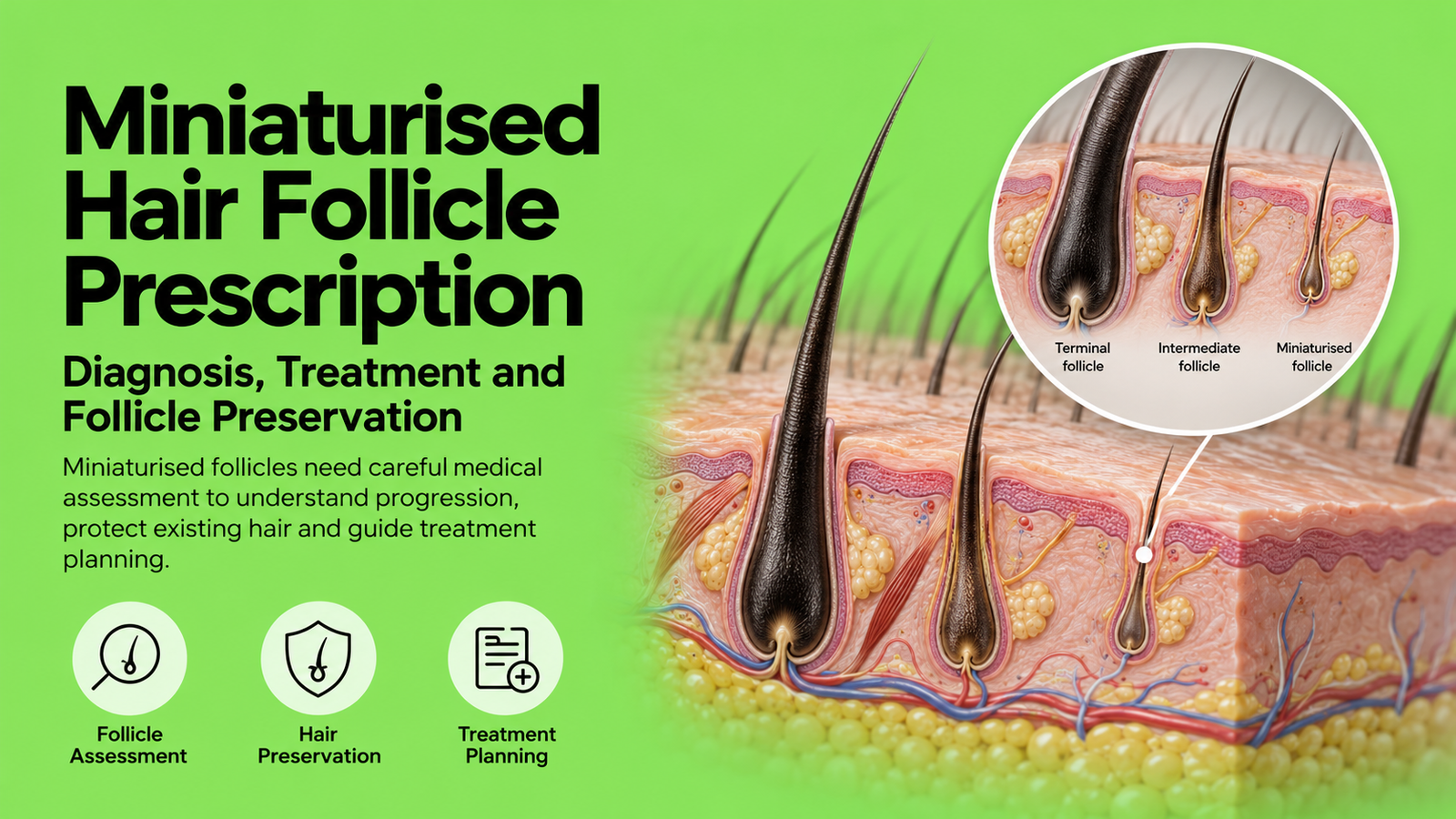
Miniaturised Hair Follicle Prescription: Diagnosis, Treatment and Follicle Preservation
Hair follicle miniaturisation occurs when a follicle progressively produces finer, shorter and less visually prominent hair.
A patient may initially notice that the hairline looks less dense, individual hairs have become unusually fine or the scalp is increasingly visible under normal lighting.
Miniaturisation is an important feature of androgenetic alopecia, particularly in men with progressive hairline recession or crown thinning.
However, identifying miniaturisation does not automatically determine the exact diagnosis or guarantee that the affected follicles can be restored.
A miniaturised hair follicle prescription focuses on assessing the remaining follicular activity, identifying the underlying cause and selecting medical treatment that may help preserve or improve responsive follicles.
What Is Hair Follicle Miniaturisation?
A terminal scalp follicle generally produces a relatively thick, pigmented hair capable of growing to a substantial length.
During miniaturisation, the follicle may begin producing hair shafts with progressively reduced diameter and length.
This can affect the visual appearance of the scalp even before a large number of hairs have disappeared from view.
The process is gradual and varies between follicles.
Some follicles may continue producing fine hairs for extended periods, while others may show more advanced changes.
The appearance of fine hairs does not automatically mean the follicles are dead. Equally, the presence of a fine hair does not prove that full restoration is possible.
Why Do Hair Follicles Become Miniaturised?
In male androgenetic alopecia, genetic susceptibility and androgen-related signalling contribute to gradual miniaturisation of susceptible follicles.
Dihydrotestosterone, or DHT, is one important androgen involved in the biological process.
The follicles at the frontal scalp, temples and crown may be affected differently from relatively resistant donor-region follicles.
Miniaturisation can also appear in other hair-loss conditions, so it must be interpreted together with the patient’s history, scalp findings and hair-loss distribution.
The Androgenetic Alopecia Prescription page explains the underlying disease in more detail.
How Miniaturisation Affects Hair Density
A scalp with many thick terminal hairs can appear relatively well covered.
When increasing numbers of follicles produce finer hairs, more light may reach the scalp between the shafts.
The patient may notice:
- Reduced frontal hairline density.
- Finer hairs around the temples.
- Increased scalp visibility at the crown.
- Decreased hair volume despite retaining visible hair.
- Greater variation in shaft thickness.
- Shorter, finer hair within affected regions.
Not all reductions in visual density are caused by miniaturisation. Increased shedding, shaft damage and other disorders may produce similar complaints.
How Do Doctors Diagnose Follicular Miniaturisation?
Miniaturisation is assessed in the context of the patient’s complete hair-loss history and scalp examination.
Trichoscopy is particularly useful because it magnifies hair shafts and follicular openings, allowing the doctor to assess features that may not be obvious to the naked eye.
The examination may evaluate:
- Hair shaft diameter diversity.
- Proportion of finer hairs.
- Differences between frontal and occipital scalp.
- Distribution of miniaturised hairs.
- Changes in follicular-unit appearance.
- Associated scalp inflammation.
- Other findings suggesting a different diagnosis.
Clinical photographs may help document the pattern and degree of hair loss.
Trichoscopy can support diagnosis and monitoring, but it cannot reliably guarantee that a particular follicle will respond to medication.
Additional investigations may be necessary when the clinical pattern is atypical.
Prescription Overview
Primary Concern: Progressive follicular miniaturisation associated with finer, shorter hairs and reduced scalp coverage.
Likely Assessment Focus: Degree and distribution of miniaturisation, underlying diagnosis, existing follicular activity and scalp characteristics.
Prescription Goal: Manage the underlying condition, reduce further miniaturisation where possible and support existing responsive follicles.
Possible Prescription Categories: Appropriate hair-growth medicines, androgenetic alopecia treatment when indicated and therapy for relevant associated conditions.
Supportive Care: Scalp care, management of coexisting inflammation and correction of identified medical contributors.
Monitoring: Hair shaft calibre, proportion of finer hairs, overall scalp coverage, treatment tolerance and progression.
Follow-Up: Clinician-planned review using consistent clinical assessment methods.
When Another Treatment May Be Considered: Extensive miniaturisation with inadequate response, insufficient remaining hair coverage or suitability for another restoration approach.
Can Miniaturised Hair Follicles Be Treated?
Medical treatment may help some miniaturised follicles maintain or improve hair production, depending on the cause, degree of miniaturisation and individual response.
The objective is not necessarily complete conversion of every fine hair into a fully developed terminal hair.
An appropriate prescription may aim to reduce progression, improve hair shaft calibre in responsive follicles and maintain available coverage.
Treatment should be selected according to the underlying diagnosis, not solely on the presence of fine hairs.
Hair-Growth Support
Topical minoxidil is an established option for male androgenetic alopecia and may support hair growth in responsive follicles.
The clinician should consider the patient’s scalp condition, previous response, adverse effects and ability to maintain treatment.
Androgen-Pathway Management
Where miniaturisation is associated with diagnosed male androgenetic alopecia, finasteride or another clinically appropriate prescription approach may be discussed in selected patients.
Potential sexual, reproductive, mood-related and other adverse effects require informed discussion.
Treatment of Additional Contributing Conditions
If another scalp or medical disorder contributes to hair changes, that condition may require separate management.
Treating a coexisting problem is not equivalent to guaranteeing reversal of androgenetic miniaturisation.
Why Early Assessment May Be Useful
Earlier recognition can help establish whether progressive miniaturisation is present while substantial native hair coverage remains.
In some patients, existing responsive follicles may have greater potential for preservation or improvement than follicles affected by longstanding, advanced miniaturisation.
However, early diagnosis does not guarantee that all hair loss can be prevented.
The benefit of assessment is that it may support more appropriate treatment planning and realistic expectations.
Monitoring Miniaturised Follicles During Treatment
Follow-up may include standardised scalp photographs and repeated trichoscopic assessment where appropriate.
The doctor may compare the distribution of fine hairs, hair shaft calibre variation, scalp visibility and progression of thinning.
Monitoring should also include medication tolerance, adverse effects, adherence and any newly developed scalp symptoms.
Response is individual. A patient may achieve stabilisation without dramatic visible thickening.
Long-Term Follicle Preservation and Maintenance
When progressive androgenetic alopecia is responsible, treatment may need to continue to maintain its benefit.
A suitable maintenance plan may involve medical follow-up, reviewing ongoing treatment, monitoring native hair and addressing associated scalp problems.
The intensity and duration of treatment should depend on clinical need and tolerability.
Some patients may maintain useful coverage with medical management, while others continue to lose hair despite treatment.
A maintenance plan should therefore remain adaptable rather than promise permanent preservatio
When May Medical Management Be Insufficient?
Medical treatment may have limited cosmetic benefit when follicles are severely miniaturised or an area has very little remaining visible hair.
The degree of potentially responsive follicular activity, extent of baldness and patient’s expectations influence the treatment strategy.
In appropriate cases, hair transplantation may be considered to redistribute suitable donor follicles into areas with inadequate coverage.
However, transplantation does not automatically treat continuing miniaturisation in other native scalp regions.
Selected adjunctive procedures, including PRP, iPRF or GFC, may also be considered where appropriate, but evidence, treatment indications and limitations should be explained separately.
Realistic Expectations for Miniaturised Hair Follicles
The response of miniaturised follicles varies between patients and scalp areas.
Some patients may experience improved hair calibre or reduced progression. Others may see limited change despite appropriate treatment.
The existence of a miniaturised hair shaft does not guarantee full restoration to terminal hair.
Prescription treatment cannot create an unlimited supply of new donor follicles or permanently remove the underlying susceptibility to androgenetic alopecia.
A medically responsible treatment plan should explain both the potential benefit and the reasons improvement may be limited.
Frequently Asked Questions
What is a miniaturised hair follicle?
It is a follicle producing a relatively finer or shorter hair shaft compared with a typical terminal hair in that scalp region.
Can miniaturised follicles become thicker again?
Some responsive follicles may show improved hair calibre with appropriate treatment. Complete recovery cannot be guaranteed.
How is hair follicle miniaturisation diagnosed?
Clinical examination and trichoscopy may identify differences in hair shaft diameter and distribution consistent with miniaturisation.
Is miniaturisation always caused by male pattern baldness?
No. Androgenetic alopecia is a common cause, but other conditions may also affect hair calibre and follicular appearance.
Does a miniaturised follicle mean the follicle is dead?
No. Miniaturisation refers to altered hair production and should not automatically be equated with complete follicular destruction.
Can PRP or GFC reverse miniaturisation?
Selected supportive procedures may be discussed for particular diagnoses, but complete reversal cannot be promised. Evidence and expected benefit vary by technique.
When should hair transplantation be considered?
Transplantation may be assessed when existing follicles provide inadequate coverage, medical improvement is limited and the patient has suitable donor hair and realistic expectations.
Miniaturised Hair Follicle Consultation at Anagen
Identifying follicular miniaturisation can help clarify which scalp regions may still be candidates for medical management and which areas may require another restoration strategy.
At Anagen, a hair prescription consultation can assess hair calibre, distribution of thinning, scalp condition and relevant medical history before recommending a suitable management plan.
The focus should be on preserving responsive existing hair where possible, recognising treatment limitations and making informed long-term decisions.