





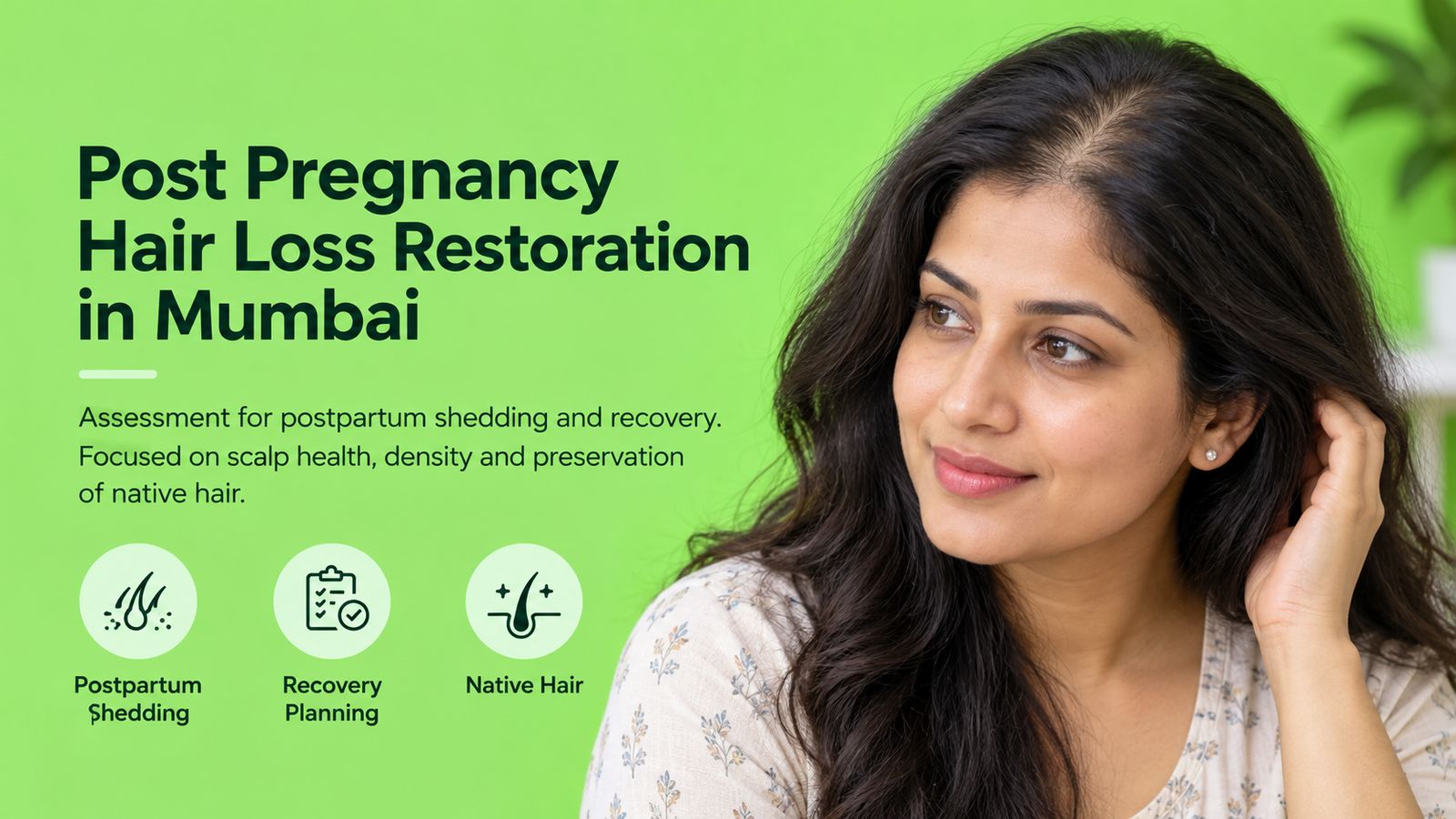
Post Pregnancy Hair Loss Restoration in Mumbai
Hair shedding after pregnancy can be alarming.
A woman may suddenly notice large amounts of hair during washing or brushing, reduced volume around the temples or part line, or a more visible scalp than before pregnancy.
In many cases, this does not mean the follicles have been permanently lost.
Post-pregnancy shedding commonly reflects a temporary change in the hair-growth cycle.
For that reason, hair transplantation is usually not the first question that should be asked.
The priority is to determine whether the hair is experiencing temporary postpartum shedding, whether recovery is occurring, or whether pregnancy has revealed another underlying hair-loss condition.
Why Does Hair Shed After Pregnancy?
Hair follicles move through natural phases of growth, transition and rest.
Hormonal changes during pregnancy can alter the proportion of follicles remaining in the growth phase.
After delivery, a larger number of hairs can enter a shedding phase over a relatively similar period.
This can make normal hair-cycle turnover look sudden and dramatic.
The important point is that shedding does not automatically mean the follicle has been destroyed.
Temporary Shedding Versus Permanent Hair Loss
The key clinical question is whether hair is expected to recover.
Postpartum shedding may improve as the hair cycle normalises.
However, persistent thinning can sometimes reveal another condition that was already developing, such as female pattern hair loss.
Other medical or nutritional factors may also contribute.
When Does Postpartum Hair Loss Need Assessment?
Assessment becomes especially useful when:
- Shedding seems unusually prolonged
- Density is continuing to decline
- The scalp remains visibly thin
- The part line continues to widen
- There was significant hair loss before pregnancy
- There are symptoms suggesting another medical problem
- Recovery appears incomplete
Medical and Nutritional Evaluation
Depending on the clinical history, evaluation may consider:
- Iron status or ferritin where appropriate
- Thyroid function where relevant
- Nutritional intake
- Recent illness
- Medication
- Sleep and general health
- Previous hair-loss history
- Family history of female pattern hair loss
Not every patient needs every investigation.
Testing should be based on history and clinical assessment rather than ordered indiscriminately.
Does Post-Pregnancy Hair Loss Need a Hair Transplant?
Usually not during active postpartum shedding.
If follicles remain viable and the process is temporary, transplanting the scalp would not address the real problem.
Transplantation may only become relevant later if:
- A permanent pattern of thinning remains
- Hair loss has stabilised
- Another underlying condition has been assessed
- Donor hair is suitable
- A defined residual area requires restoration
This is a relatively small subset of postpartum patients.
Post-Pregnancy Hair Loss Prescription
Women whose main problem is postpartum shedding may be more appropriately directed toward medical evaluation and a personalised hair-loss prescription rather than surgical consultation.
Can PRP, iPRF or GFC Be Used After Pregnancy?
Selected supportive treatments may be discussed only after appropriate clinical assessment.
They should not be presented as necessary for every postpartum patient or as guaranteed methods of regrowth.
In many women, time and recovery of the normal hair cycle remain central to management.
When Persistent Loss Requires a Different Diagnosis
If hair fails to recover as expected, the question becomes:
Is this still postpartum shedding, or has another form of hair loss become visible?
Possible considerations include:
- Female pattern hair loss
- Thyroid-related hair loss
- Nutritional deficiency
- Chronic telogen effluvium
- Hormonal factors
- Other scalp disorders
When Could Transplantation Eventually Be Considered?
Hair transplantation may eventually be considered only if there is a stable permanent deficit.
Examples might include:
- Persistent stable frontal-temporal loss
- Permanent central-density reduction
- Underlying female pattern hair loss that has been properly assessed
- Stable donor region
- Realistic treatment expectations
Recovery Without Surgery
A major goal of this page is to help patients understand that improvement may occur without transplantation.
When postpartum shedding is temporary, the original follicles can resume growth as the cycle normalises.
The timeline varies considerably between women.
There should be no promise that all patients recover to exactly their previous density.
Post Pregnancy Hair Loss Results
Many women experiencing postpartum shedding recover without surgery.
If persistent permanent thinning remains after proper assessment and stabilisation, relevant female hair-restoration cases may help illustrate the types of surgical restoration considered in selected patients.
Cost of Post Pregnancy Hair Loss Treatment
There is no meaningful “postpartum hair-transplant cost” before a diagnosis has been made.
Cost depends entirely on what treatment is actually appropriate.
The patient may require:
- Assessment only
- Medical management
- A prescription programme
- Selected supportive treatment
- Observation and follow-up
- In a minority of stable permanent cases, transplantation
Frequently Asked Questions
Is hair loss after pregnancy normal?
Increased shedding can occur after pregnancy because of changes in the hair cycle. Persistent or severe loss should still be assessed.
Does postpartum hair loss mean my follicles are dead?
Not necessarily. Many follicles remain viable and can return to growth.
When should I worry about persistent thinning?
Persistent loss, worsening part-line widening or failure to recover may justify further medical and scalp assessment.
Do I need PRP after pregnancy?
Not automatically. Treatment should depend on diagnosis and individual suitability.
Can pregnancy trigger female pattern hair loss?
Pregnancy-related shedding can sometimes make underlying pattern thinning more noticeable.
Can I eventually have a hair transplant?
Yes, but only in selected patients with stable permanent residual loss and suitable donor hair.
Hair Thinning After Pregnancy? Start With an Assessment, Not Surgery
If your hair has become noticeably thinner after pregnancy, the correct first step is to understand whether the shedding is temporary and whether recovery is already taking place.
For an initial review, send clear photographs of:
Front • Top/Part Line • Both Temples • Crown • Back/Donor Area
Where clinically relevant, Anagen may guide you toward medical evaluation, prescription treatment, selected supportive treatment or continued observation.
Hair transplantation should only enter the discussion if stable permanent loss remains later.