




Body Hair Restoration in Mumbai
Body hair can have a role in selected hair-restoration plans when the usual scalp donor supply cannot independently meet the patient’s needs.
But “body hair restoration” should not be understood as a single standardised procedure.
Different donor regions produce hairs with different characteristics, and each possible donor-recipient combination needs to be assessed individually.
The aim is not to use body hair simply because it exists.
The aim is to determine whether a selected non-scalp follicle can make a useful cosmetic contribution in a particular restoration plan.
What Does Body Hair Restoration Mean?
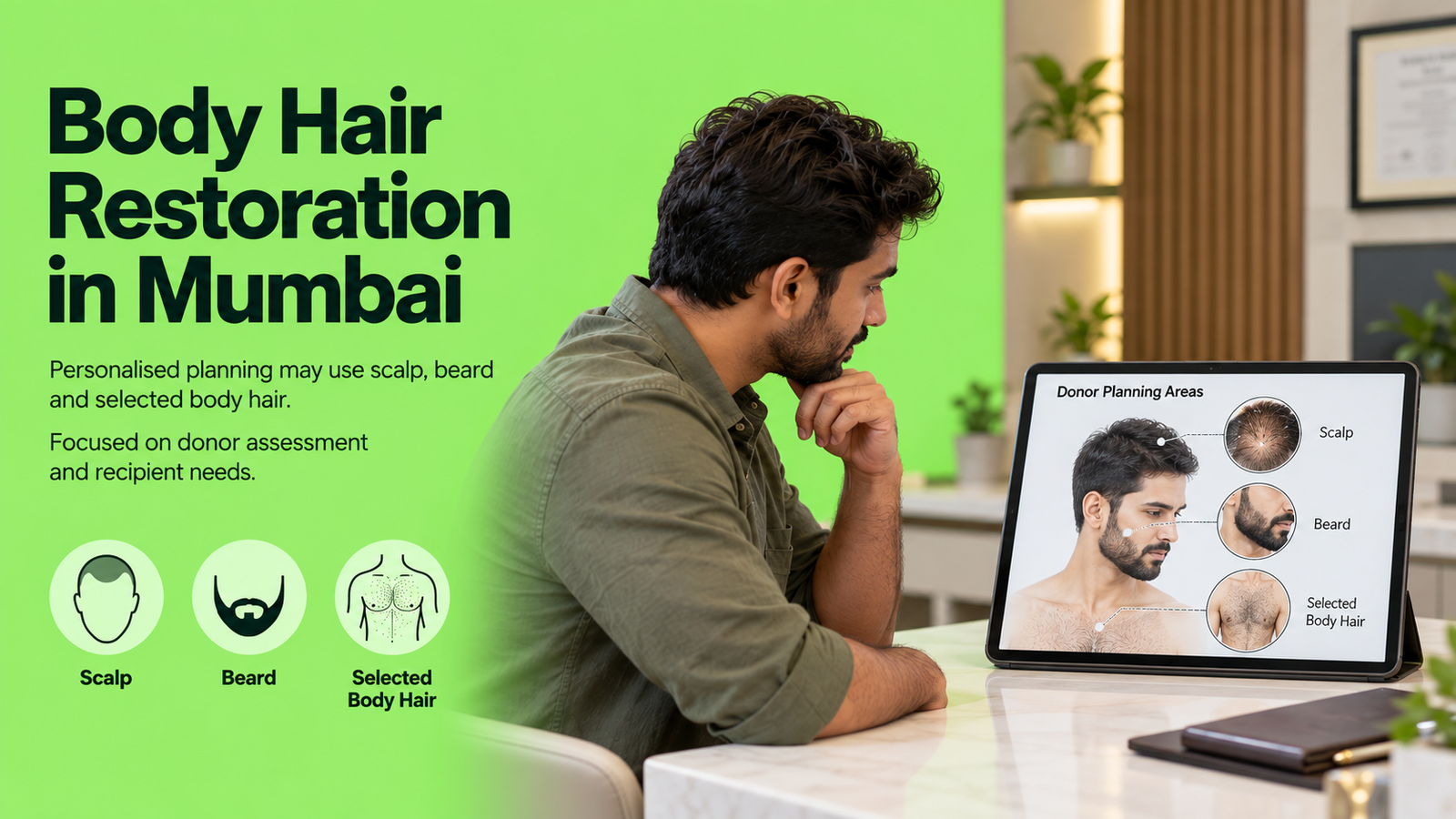
Within this proposed service positioning, Body Hair Restoration refers to the broader use of suitable non-scalp follicles as part of an individualised hair-restoration strategy.
Potential applications may include selected:
scalp restoration
facial-hair restoration
reconstructive requirements
The donor source cannot be chosen independently of the recipient area.
Hair calibre, texture, curl, colour and expected growth need to match the cosmetic purpose.
Why Donor–Recipient Matching Matters
A follicle does not lose all of its original characteristics simply because it is moved to another location.
A thick beard follicle, for example, is not automatically equivalent to a fine scalp follicle.
Similarly, chest hair can have a different visible length or texture.
The clinician therefore needs to consider both sides of the equation:
What donor hair is available?
and
What kind of hair does the recipient area require?
When Can Body Hair Be Useful?
Body hair may be considered where:
- scalp donor availability is restricted
- additional follicular resources are required
- a suitable alternative donor exists
- the recipient area can accommodate the donor characteristics
- the donor area can be harvested responsibly
When May Body Hair Not Be Useful?
Body hair may add little benefit when:
- the donor hair is too sparse
- growth characteristics are unsuitable
- donor visibility would be unacceptable
- hair texture cannot be blended convincingly
- the recipient requirement exceeds realistic donor capacity
- the expected improvement does not justify additional harvesting
Different Donor Sources Have Different Roles
Scalp Hair
Generally preferred for scalp restoration because it offers the closest biological and cosmetic match.
Beard Hair
May add visual bulk in selected scalp-restoration cases but can be significantly coarser.
Chest Hair
May provide supplementary follicles in carefully selected patients but often has greater differences in length, calibre and growth behaviour.
Other Body Hair
Should be considered only when its characteristics and donor-site implications make it worthwhile.
Individualised Planning
A body-hair restoration plan should consider:
- recipient location
- available scalp donor reserve
- alternative donor characteristics
- future hair loss
- previous transplantation
- visible donor impact
- whether staged surgery is preferable
- realistic cosmetic priorities
Patients specifically seeking scalp transplantation using non-scalp follicles should be directed to Body Hair To Scalp Hair Transplant.
What Results Are Realistic?
The cosmetic contribution from body hair depends heavily on matching and distribution.
The objective is not maximum graft numbers.
The objective is to use available follicles in locations where they can provide meaningful improvement without creating an obvious mismatch or depleting donor areas unnecessarily.
Original patient results should remain within the Results section.
Frequently Asked Questions
Is body hair identical to scalp hair after transplantation?
No.
Is every body-hair follicle useful for transplantation?
No.
Can several donor sources be combined?
They may be combined in selected patients when the characteristics and restoration plan justify it.
Does more donor hair always mean a better result?
No. Placement, calibre, recipient priority and long-term donor preservation are equally important.
Body Hair Restoration Consultation in Mumbai
Because this service category can involve several different donor-recipient combinations, the first step should be diagnostic planning rather than choosing a procedure from its name.
Anagen should assess:
- what area needs restoration
- why hair is absent or insufficient
- which donor types are available
- whether transplantation is appropriate
- whether a more specific Anagen service page better describes the patient’s actual treatment need
Use Anagen’s Contact page to arrange assessment.