





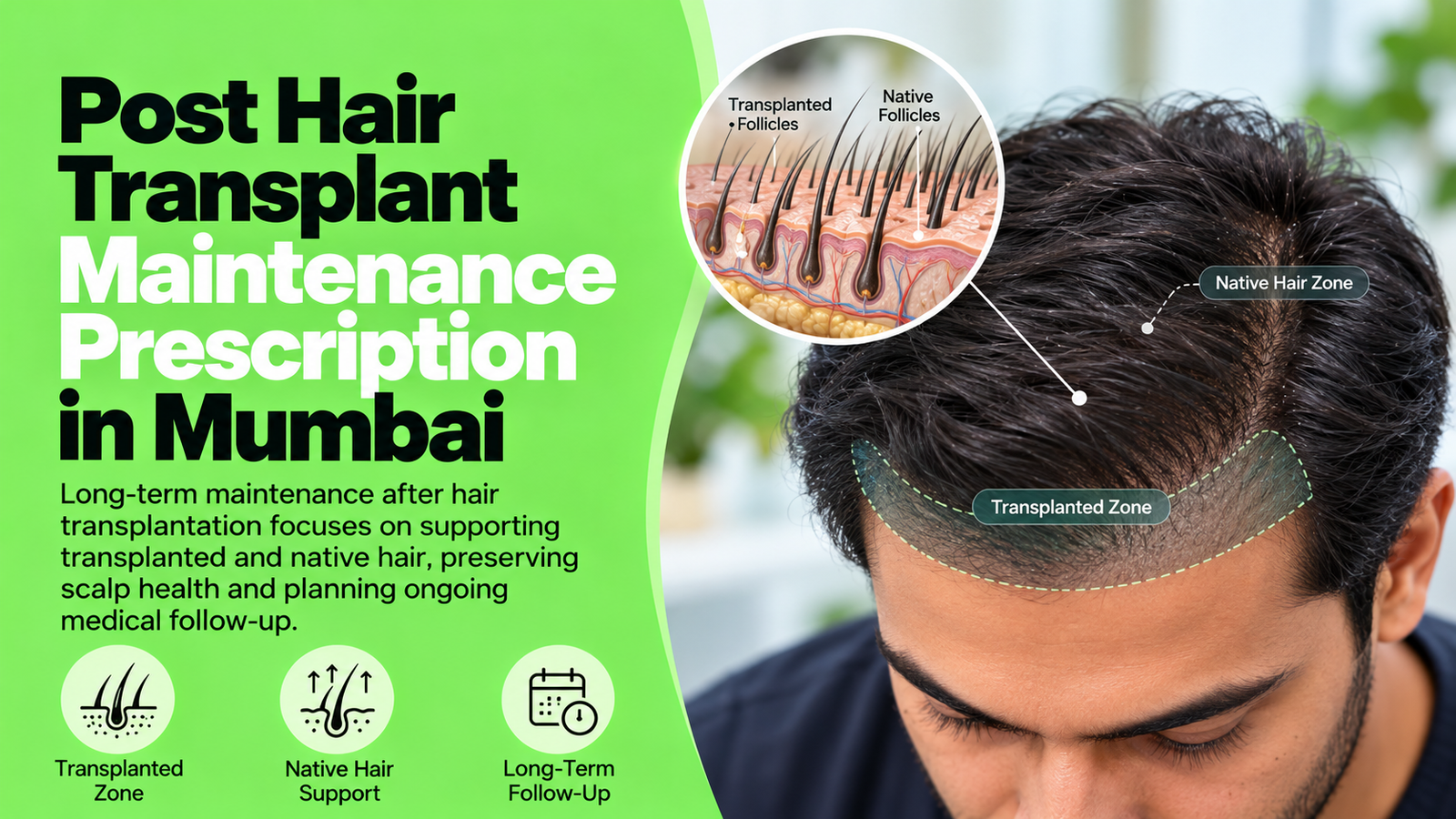
Post Hair Transplant Maintenance Prescription in Mumbai
Hair transplantation is one part of a longer hair-restoration journey. Once the transplanted follicles are established, attention also needs to be given to the surrounding native hair and the possibility of continued hair-loss progression.
At Anagen Hair Transplant Clinic, Mumbai, a Post Hair Transplant Maintenance Prescription focuses on assessing native-hair stability, scalp health and the need for ongoing medical management.
Depending on the patient’s diagnosis, a long-term plan may include prescription medicines, periodic density assessments and selected supportive treatments. The objective is to maintain overall hair coverage where possible and identify future changes before deciding whether additional treatment is appropriate.
Why Hair Maintenance Matters After a Hair Transplant
A hair transplant redistributes selected donor follicles into areas where additional hair coverage is required. However, transplantation does not automatically stop the underlying biological process responsible for hair loss in the surrounding native hair.
Some patients continue to experience thinning in non-transplanted regions, particularly when they have progressive androgenetic alopecia.
A Post Hair Transplant Maintenance Prescription focuses on assessing existing native hair, identifying ongoing miniaturisation, managing the underlying hair-loss condition and maintaining scalp health over time.
At Anagen Hair Transplant Clinic, Mumbai, long-term maintenance planning should consider both the transplanted follicles and the patient’s remaining native hair.
Not every patient requires the same medicine or combination of treatments. Prescribing decisions depend on the original diagnosis, current hair condition, medical history and suitability for treatment.
The aim is to support a sustainable long-term management plan rather than assuming the surgical procedure alone prevents every form of future hair loss.
Early Postoperative Care vs Long-Term Hair Maintenance
These are two distinct stages of care.
Early Postoperative Care
The immediate postoperative period involves surgical recovery, graft protection, wound healing and monitoring for complications.
Instructions about scalp washing, sleeping position, medicines used around surgery, activity restrictions and application of topical products belong to the treating surgeon’s approved postoperative protocol.
This page does not replace those instructions.
Long-Term Prescription Maintenance
After the early healing phase, management may focus on the health of native hair, progression of the original hair-loss condition and maintenance of overall scalp coverage.
Long-term treatment decisions may include diagnosis-specific medication, scalp care, follow-up photography and consideration of supportive treatment where appropriate.
The timing of starting or restarting any medication after transplantation must be determined by the treating surgeon.
Understanding Transplanted Hair and Native Hair
Following transplantation, the scalp contains both surgically relocated follicles and the patient’s remaining native follicles.
Transplanted Follicles
Transplanted follicles generally retain many biological characteristics of their original donor region.
When suitable donor hair is used, these follicles may be relatively resistant to the androgen-related miniaturisation affecting susceptible scalp regions.
However, transplanted hair should not be described as completely immune to every cause of future thinning or loss.
Long-term appearance can also be affected by aging, medical conditions, donor characteristics and the survival or behavior of individual grafts.
Native Hair
Native hair in the frontal, mid-scalp and crown regions may remain susceptible to progressive miniaturisation.
This is especially important in patients with androgenetic alopecia.
Native hair can become finer or less dense over time even when the transplanted follicles remain established.
As a result, the overall appearance may change after transplantation if surrounding non-transplanted hair continues to thin.
What Should Be Assessed During Long-Term Maintenance?
Follow-up should consider the underlying hair-loss condition and the condition of existing scalp hair.
A clinician may assess:
- The patient’s original hair-loss diagnosis.
- Current hairline, frontal, mid-scalp and crown coverage.
- The condition of transplanted regions.
- Native-hair density outside transplanted zones.
- Hair-shaft caliber and miniaturisation.
- Changes in donor-region hair.
- Scalp inflammation, itching or scaling.
- Current medication use and tolerability.
- Any new medical conditions.
- The patient’s long-term hair-restoration objectives.
Standardized photographs and trichoscopic examination may help document progression.
A future maintenance plan should be based on these observations rather than automatically repeating the same medicines or procedures in every patient.
Prescription Overview
Primary Concern: Long-term hair maintenance after transplantation, including ongoing native-hair thinning and progressive underlying hair loss.
Assessment Required: Original diagnosis, transplant history, current native-hair density, follicular miniaturisation, scalp condition and treatment history.
Prescription Goal: Manage the underlying hair-loss condition, preserve suitable native hair where possible and support long-term overall hair coverage.
Possible Prescription Categories: Diagnosis-specific topical or oral hair-loss therapy, management of scalp disorders and correction of confirmed medical or nutritional factors.
Supportive Care: Appropriate hair care, scalp maintenance and selected procedural support when indicated.
Monitoring: Native-hair density, hairline and crown progression, follicular miniaturisation, scalp health, treatment adherence and medication tolerance.
Follow-Up: Individualized long-term review according to hair-loss activity, prescribed treatment and clinical needs.
When Another Treatment May Be Considered: Progressive thinning despite appropriate management, newly established structural gaps or clinically suitable areas that may benefit from further surgical evaluation.
Important: This page provides general prescription information and does not replace an individual clinical assessment. The medicine, dose, frequency and duration, where required, should be selected according to the diagnosis, medical history and clinical findings.
What Prescription Medicines May Be Considered After Hair Transplantation?
Long-term medication is selected according to the diagnosis rather than the surgical procedure alone.
1. Topical Hair-Growth Medication
Topical minoxidil may be considered for suitable patients with pattern hair loss.
Its role is generally related to managing existing hair and supporting growth where responsive follicles remain.
The decision about when topical medication is appropriate after transplantation must come from the surgeon.
Application to healing or irritated scalp should not be initiated without medical approval.
2. Oral Hair-Loss Medication
Selected oral medications may be considered in patients with ongoing androgenetic alopecia or other diagnosed conditions.
For example, finasteride may be used in appropriately selected adult men with male pattern hair loss, subject to clinical assessment and discussion of potential adverse effects.
Other medicines may have different sex-specific indications, reproductive restrictions or systemic monitoring requirements.
These considerations must be addressed individually.
3. Treatment of Underlying Scalp Disease
Persistent scalp inflammation, dermatitis or infection should be assessed and treated separately from ordinary hair-loss maintenance.
An inflamed or uncomfortable scalp may also affect the tolerability of topical medicines.
4. Correction of Relevant Medical Factors
Where examination suggests a medical condition or nutritional deficiency contributing to hair changes, appropriate investigation and treatment may be included.
Unnecessary supplements do not guarantee preservation of transplanted or native hair.
5. Individualized Combination Management
Some patients may be candidates for more than one approach.
However, there is no universal combination of oral medicines, topical solutions and procedures that is appropriate after every hair transplant.
The prescription should reflect the diagnosis, expected benefit, medical safety and patient preferences.
Can Native Hair Continue Thinning After a Hair Transplant?
Yes. Transplantation does not remove the genetic or biological susceptibility of native hair in surrounding areas.
If native hair continues to miniaturise, gaps may become more visible between established transplanted regions and nearby untreated scalp.
Progression may occur in the mid-scalp, crown or other areas depending on the individual’s hair-loss pattern.
This does not automatically mean that transplanted grafts have failed.
It may indicate continued progression of the original hair-loss condition in the native hair.
The clinical response may involve reassessing medical maintenance rather than immediately planning another surgery.
Why Long-Term Hair-Loss Planning Matters
Hair-restoration planning should consider how hair distribution may change over time.
For patients with progressive androgenetic alopecia, preserving existing native hair may be important to maintaining a balanced overall appearance.
The clinician may reassess:
- Whether the original pattern of hair loss is progressing.
- Whether medical treatment is effective and tolerable.
- Whether new regions show miniaturisation.
- Whether the donor area remains suitable.
- Whether further surgical intervention is reasonable.
- Whether cosmetic expectations remain achievable.
Patients should understand that successful transplantation and progression of native-hair loss can occur simultaneously.
Can PRP, iPRF, GFC or LLLT Be Included in Maintenance?
Selected patients may discuss additional non-surgical treatments as part of broader hair-loss management.
These are separate procedures and devices rather than mandatory components of a maintenance prescription.
PRP Hair Treatment
PRP Hair Treatment involves platelet-rich plasma preparation and administration.
Evidence has been studied in some hair-loss conditions, but benefit varies, and the procedure is not required for every transplant patient.
iPRF Hair Treatment
iPRF Hair Treatment involves a different autologous blood-derived preparation.
The clinical evidence and procedural characteristics should be evaluated separately from conventional PRP.
Advanced GFC Hair Treatment
Advanced GFC Hair Treatment is another platelet or growth-factor-associated treatment category, depending on the preparation system.
It should not be assumed to be superior to standard medical therapy.
Low Level Laser Therapy
Low Level Laser Therapy (LLLT) may be discussed for selected patients with pattern hair loss.
Evidence and device characteristics vary, and LLLT is not a substitute for evaluating continued hair-loss progression.
Scalp Microneedling
Scalp Microneedling has been investigated as a procedural adjunct in certain hair-loss settings.
Evidence is not uniform, and the risks, potential benefit and appropriate timing after transplantation require clinical assessment.
None of these options should be described as automatically essential after hair transplantation.
How Should Hair Be Monitored After Transplantation?
The focus of long-term follow-up is not merely whether the transplanted area contains hair.
The clinician should also assess whether the surrounding native hair remains stable.
Monitoring may include:
- Standardized photographs of the hairline, mid-scalp and crown.
- Review of native-hair caliber and visible density.
- Assessment of previously transplanted zones.
- Examination of scalp comfort and inflammation.
- Documentation of medicine adherence and adverse effects.
- Review of any newly developing thinning regions.
- Discussion of maintenance options and future planning.
Changes should be evaluated under similar photographic conditions whenever possible.
A patient should not be told that additional transplantation is necessary merely because some scalp visibility remains.
The decision depends on the diagnosis, available donor resources, risk of future loss and overall surgical suitability.
Realistic Expectations After Hair Transplantation
Hair transplantation may provide lasting coverage from suitable donor-derived follicles, but the appearance of the scalp can continue to change as surrounding native hair ages or undergoes further thinning.
Long-term medical treatment may help selected patients maintain native hair, but no prescription guarantees preservation of every follicle.
Treatment effectiveness varies according to the diagnosis and individual response.
Supportive procedures cannot guarantee that additional surgery will never be required.
In some patients, continued medical maintenance may be sufficient. Others may require reassessment of newly developed structural hair-loss areas.
Decisions about further transplantation should take account of donor limitations, future hair-loss risk and realistic density expectations.
Frequently Asked Questions
1. Do I still need medication after a hair transplant?
Some patients benefit from ongoing medical treatment for their underlying hair-loss condition. Others may not require the same approach. The decision depends on diagnosis and clinical suitability.
2. Can native hair continue thinning after transplantation?
Yes. A transplant does not automatically stop progressive hair loss in non-transplanted native follicles.
3. Are transplanted hairs and native hairs managed differently?
They may have different biological characteristics and susceptibility to pattern hair loss. Long-term assessment considers both groups of follicles.
4. When can I restart hair-growth medicine after surgery?
The treating surgeon must determine the appropriate timing. No general online schedule should replace postoperative instructions.
5. Can PRP or GFC be used after hair transplantation?
Selected patients may discuss these treatments as optional adjuncts. Their benefit is variable, and neither is universally required after surgery.
6. How long should maintenance continue?
Maintenance depends on the underlying diagnosis. Progressive hair-loss disorders may require long-term monitoring and, where appropriate, ongoing treatment.
7. Can I need another hair transplant in the future?
Yes. Further transplantation may be considered if additional structural hair loss develops, but it is not automatically necessary and depends on donor availability and clinical assessment.
Post Hair Transplant Maintenance Consultation at Anagen, Mumbai
Long-term hair-restoration planning involves both the transplanted follicles and the native hair that may continue to change over time.
A clinical follow-up can help determine whether prescription management, scalp care, selected supportive procedures or further restoration assessment is appropriate.
Arrange a Hair Prescription Consultation
Review your current hair density, native-hair condition and long-term maintenance requirements with a qualified clinician.