





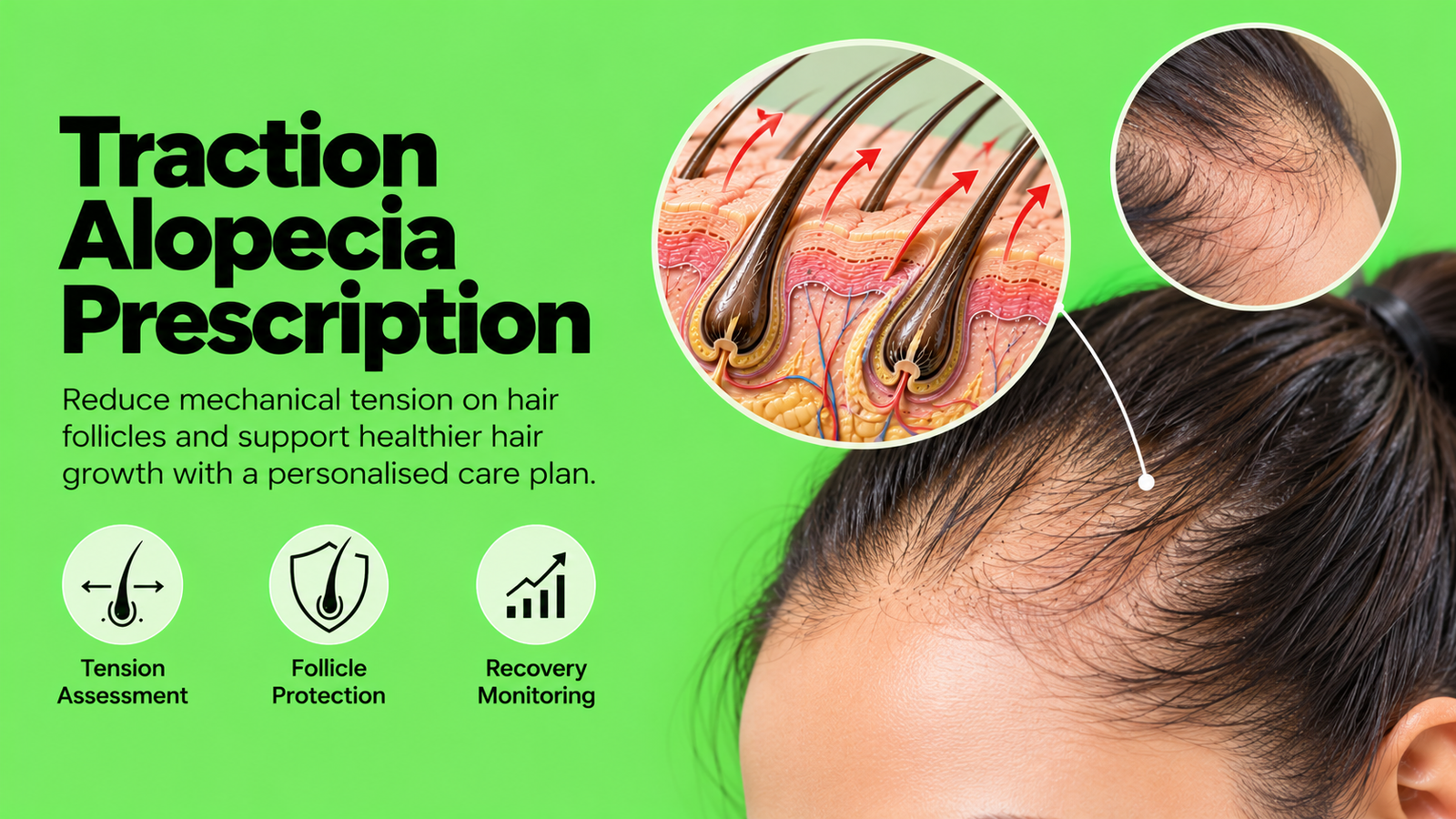
Traction Alopecia Prescription
Traction alopecia is hair loss associated with repeated or prolonged pulling forces on hair follicles.
It commonly affects areas exposed to sustained tension, including the frontal hairline, temples and other regions depending on the styling practice involved.
Tight ponytails, buns, braids, extensions and other tension-producing styles may contribute when worn repeatedly or tightly.
The most important distinction is between early traction-related loss, in which follicles may remain capable of recovery, and longstanding traction alopecia, in which permanent follicular damage or scarring may have developed.
A Traction Alopecia Prescription should begin with identifying and reducing the mechanical cause.
How Repeated Tension Affects Hair Follicles
Hair follicles are designed to produce and retain hair, but sustained pulling can create mechanical stress around the follicular opening and surrounding tissue.
In the early stages, patients may experience hairline thinning, broken hairs, discomfort or small inflammatory bumps.
With continued tension, follicular damage may progress. Longstanding traction can eventually lead to scarring and reduced capacity for regrowth.
The pattern depends on where the tension is applied rather than on a particular ethnicity, gender or hairstyle alone.
Symptoms and Early Warning Signs
Patients may notice:
- Gradual thinning along the frontal or temporal margins.
- Hair breakage near the hairline.
- Discomfort or tenderness when a hairstyle is tightly secured.
- Small bumps or redness around follicles.
- Progressive widening of a thinning area.
- A few retained fine hairs at the margin of the hairline.
Some patients have no pain despite ongoing traction.
The presence or absence of discomfort does not reliably establish whether scarring has occurred.
Diagnostic Assessment Before Prescription
Hairstyling and Grooming History
The clinician may ask about the type of hairstyle, frequency of use, degree of tightness, use of extensions and whether tension is concentrated in particular scalp regions.
The objective is to identify modifiable mechanical forces without blaming or judging the patient’s grooming preferences.
Scalp Examination
Examination may focus on hairline shape, follicular openings, inflammation, broken hairs and areas of progressive thinning.
Trichoscopy may help identify features supporting traction alopecia or suggest an alternative diagnosis.
When scarring or another inflammatory alopecia is suspected, further investigation, including biopsy in selected cases, may be appropriate.
Prescription Overview
Primary Concern: Hairline or scalp thinning associated with repeated mechanical pulling.
Possible Underlying Cause / Trigger: Tight hairstyles, sustained traction, extensions, hair accessories or other repetitive tension.
Assessment Required: Hairstyling history, examination of hairline distribution, assessment of follicular openings and inflammation, with further investigation when required.
Prescription Goal: Remove damaging tension, preserve remaining follicles, treat associated scalp inflammation and determine recovery potential.
Possible Treatment Categories: Hairstyle modification, treatment of diagnosed inflammation, selected hair-directed medication and management of stable permanent alopecia where appropriate.
Supportive Hair / Scalp Care: Low-tension hairstyles, gentle grooming, reduced excessive traction and avoidance of additional chemical or heat damage.
Monitoring: Hairline stability, inflammation, hair breakage, evidence of new growth and possible scarring.
Follow-Up: According to severity, duration and response to elimination of traction.
When Referral / Further Investigation May Be Needed: Persistent progression, suspected scarring, marked inflammation, unusual distribution or concern about another alopecia.
When Another Hair-Restoration Treatment May Be Considered: Stable permanent follicular loss may be assessed for transplantation after confirming disease inactivity and donor suitability.
Important: This page provides general prescription information and does not replace an individual medical assessment. The cause of hair loss should be confirmed before medicines, supplements or procedures are selected.
Prescription Management for Traction Alopecia
1. Reduce or Remove Traction
This is the most important initial intervention.
Patients may need to loosen hairstyles, reduce the weight of extensions, alternate tension patterns or temporarily discontinue practices causing discomfort or progressive thinning.
A hairstyle does not need to be abandoned permanently in every situation. The practical goal is to minimise damaging tension.
2. Assess Scalp Inflammation
Redness, tenderness, pustules or persistent inflammation may require medical assessment.
Prescription anti-inflammatory or other scalp treatment may be considered where clinically indicated.
3. Consider Hair-Directed Medication Where Appropriate
Some patients with retained viable follicles may be considered for hair-directed treatment after diagnosis.
The choice depends on clinical findings, evidence, contraindications and the possibility of another hair-loss disorder.
Medication cannot reliably restore follicles already destroyed by established scarring.
4. Monitor Whether the Hairline Stabilises
Reduced tension should be followed by reassessment of hairline density and progression.
Persistent thinning may reflect longstanding damage or an alternative condition.
Supportive Hair and Scalp Care
A protective routine may include gentle detangling, avoiding repeated tight pulling and reducing unnecessary heat or chemical stress.
Hair accessories should not create persistent discomfort or pressure.
The Hair Care Routine and Hair Fall Control Prescription pages may offer broader guidance on reducing mechanical damage.
If scalp inflammation is present, care products should be selected according to the diagnosis.
Can Hair Recover From Traction Alopecia?
Recovery potential depends strongly on the stage and duration of injury.
Early traction-related hair loss may improve when damaging tension is removed and follicles remain viable.
Longstanding loss associated with follicular destruction or scarring may not recover with medicines or hairstyle changes.
A clinical assessment is necessary to distinguish these situations.
When Is Hair Transplantation Considered?
Hair transplantation may be considered in selected patients with stable, established permanent hairline loss.
This requires assessment of follicular scarring, stability of the condition, ongoing traction habits, recipient-area suitability and donor availability.
Relevant service pages may include Female Hairline Restoration and Scar Hair Transplant, but surgical treatment should not be promoted as an automatic solution.
A patient with active traction or progressive inflammation should first receive appropriate management.
When Another Diagnosis Should Be Considered
Hairline recession can also occur with frontal fibrosing alopecia, androgenetic alopecia, alopecia areata and other conditions.
Inflammation, loss of follicular openings or unexpected progression may require further dermatological investigation.
Frequently Asked Questions
Can traction alopecia grow back?
Early cases may improve when tension is removed. Established scarring may prevent regrowth.
Which hairstyles can contribute to traction?
Any hairstyle producing repeated or prolonged tight pulling can contribute, including tight braids, buns, ponytails and extensions.
Does traction alopecia always cause pain?
No. Some patients experience tenderness, while others notice thinning without discomfort.
How can I know whether scarring is present?
Clinical examination, trichoscopy and occasionally biopsy may help assess follicular damage.
Can minoxidil be used for traction alopecia?
A clinician may consider hair-directed treatment in selected cases, but it does not replace traction reduction and cannot reliably regenerate scarred follicles.
When is a hair transplant appropriate?
Only after suitable assessment confirms stable permanent loss, an appropriate recipient area and adequate donor hair.
Traction Alopecia Consultation at Anagen, Mumbai
Traction-related hair loss should be addressed before avoidable damage becomes more established.
A Hair Prescription Consultation at Anagen Hair Transplant Clinic can help assess the pattern of traction, identify inflammation, evaluate follicular viability and determine whether conservative management or another treatment pathway is appropriate.