





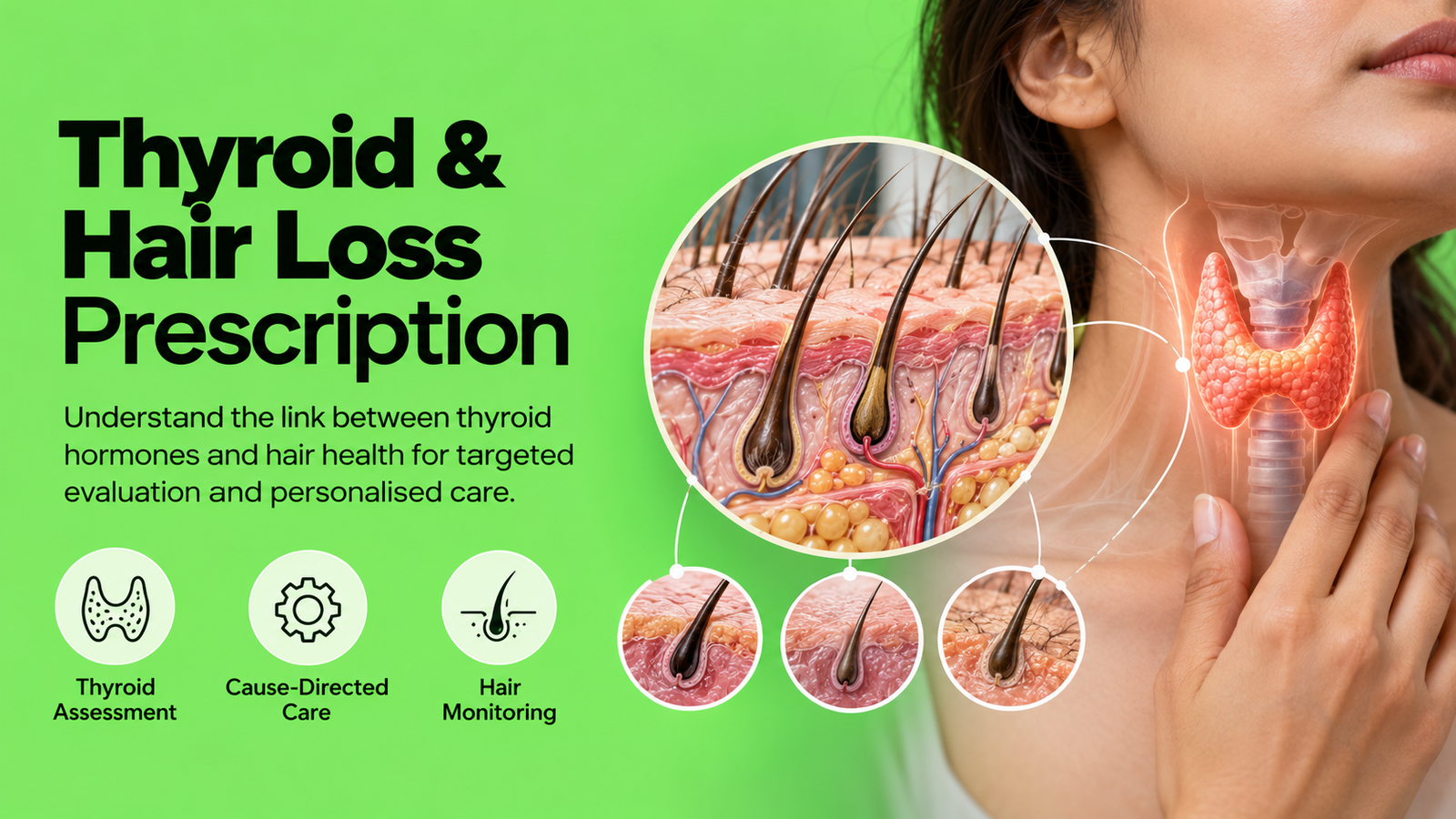
Thyroid & Hair Loss Prescription
Hair shedding can sometimes be associated with an underactive or overactive thyroid gland. However, not every person experiencing hair fall has thyroid disease, and an abnormal thyroid result does not necessarily explain every form of hair loss.
A thyroid and hair loss prescription should begin by identifying whether thyroid dysfunction is contributing to the patient’s shedding, whether thyroid treatment is already underway, and whether another scalp or hair-loss condition is present.
At Anagen Hair Transplant Clinic, Mumbai, the prescription approach is based on establishing the likely cause of hair loss before selecting hair-growth medication, supportive treatments or procedures.
Thyroid-related hair shedding may improve when the underlying disorder is appropriately managed, but the process is gradual and individual recovery varies.
How Can Thyroid Dysfunction Affect Hair?
Thyroid hormones help regulate metabolism and influence normal hair-follicle cycling. Disturbances in thyroid function may alter the proportion of hairs in different phases of the growth cycle.
Both hypothyroidism and hyperthyroidism can be associated with increased hair shedding or changes in hair quality.
Patients may notice more hair during washing or combing, reduced overall volume or a wider-looking parting.
These findings are not specific to thyroid disease. Similar changes may occur with telogen effluvium, nutritional deficiencies, androgenetic alopecia or other medical conditions.
Diagnostic Assessment Before Prescription
The first objective is to determine whether thyroid dysfunction is a plausible contributor to the patient’s current hair concerns.
Medical and Hair-Loss History
A clinical assessment may consider:
- When the shedding began and whether its onset was sudden or gradual.
- Whether thinning affects the whole scalp or follows a particular pattern.
- Any previous diagnosis of hypothyroidism or hyperthyroidism.
- Current thyroid medication and recent changes made by the prescribing physician.
- Symptoms such as unexplained weight changes, altered temperature tolerance, fatigue or palpitations.
- Recent illness, childbirth, major weight change, dietary restriction or emotional stress.
- Family history of patterned hair loss.
- Other medication use and relevant medical conditions.
Symptoms and history help determine whether thyroid testing or further medical evaluation is indicated.
Hair and Scalp Examination
The clinician may examine hair density, distribution of thinning, follicular openings and scalp condition.
A hair-pull test or trichoscopy may be helpful in selected cases.
Diffuse shedding may suggest a hair-cycle disorder, whereas progressive miniaturisation over the central scalp or temples may point toward pattern hair loss.
Prescription Overview
Primary Concern: Diffuse hair shedding or altered hair quality potentially associated with thyroid dysfunction.
Possible Underlying Cause / Trigger: Hypothyroidism, hyperthyroidism or another concurrent hair-loss condition.
Assessment Required: Medical history, scalp examination, review of existing thyroid diagnosis and medication, and targeted investigations when clinically indicated.
Prescription Goal: Identify the cause, support appropriate thyroid disease management and monitor hair-cycle recovery.
Possible Treatment Categories: Underlying thyroid treatment by the responsible physician, treatment of any coexisting scalp disorder and selected hair-directed treatment where indicated.
Supportive Hair / Scalp Care: Gentle washing, minimising excessive traction, balanced nutrition and avoidance of unnecessary hair treatments.
Monitoring: Thyroid disease control through the treating physician, hair shedding, scalp density, symptoms and treatment tolerance.
Follow-Up: Individualised clinical reassessment based on thyroid stability, severity of shedding and changes in hair density.
When Referral / Further Investigation May Be Needed: Suspected uncontrolled thyroid disease, significant systemic symptoms, atypical scalp findings or persistent hair loss despite appropriate thyroid management.
When Another Hair-Restoration Treatment May Be Considered: Only if a separate, appropriately diagnosed hair-loss condition warrants treatment after the underlying medical problem has been addressed.
Important: This page provides general prescription information and does not replace an individual medical assessment. The cause of hair loss should be confirmed before medicines, supplements or procedures are selected.
Are Thyroid Blood Tests Required?
Thyroid investigations are selected according to the patient’s history, symptoms, examination and existing medical records.
A clinician may review TSH and other thyroid-related investigations when appropriate. Additional testing depends on the suspected thyroid disorder and the treating physician’s judgement.
A person with established thyroid disease may already have a monitoring plan. Repeating investigations without reviewing existing results may be unnecessary.
An abnormal laboratory result must be interpreted clinically and does not automatically prove that thyroid disease is the sole cause of hair loss.
Prescription Management: Treating the Underlying Cause
If thyroid dysfunction is contributing to shedding, appropriate management of the thyroid disorder is central to the treatment plan.
1. Thyroid Disease Management
The patient’s physician or endocrinologist should review thyroid symptoms, laboratory findings and existing treatment where necessary.
Thyroid medicines should not be started, discontinued or adjusted solely because of hair shedding without advice from the prescribing doctor.
2. Identify Coexisting Hair-Loss Conditions
A patient with thyroid dysfunction may also have androgenetic alopecia, nutritional deficiency, postpartum shedding or scalp inflammation.
When more than one cause exists, treating only the thyroid disorder may not fully address the hair concerns.
3. Hair-Directed Prescription Treatment
The clinician may consider hair-directed medicines when a separate diagnosis supports their use. Such treatment should not replace correction of the thyroid disorder.
4. Avoid Unnecessary Supplements
Routine vitamins or supplements are not a substitute for thyroid evaluation. Nutritional supplementation should address an identified or clinically suspected deficiency.
Supportive Hair and Scalp Care
While the thyroid condition is being appropriately managed, supportive care may reduce avoidable hair breakage and improve scalp comfort.
Use a suitable mild shampoo, avoid unnecessarily aggressive brushing, reduce tight hairstyles and limit harsh heat or chemical processing if the hair is fragile.
Adequate dietary protein and balanced nutrition support general hair health. Additional supplements should be used only when appropriate to the clinical assessment.
Patients with dandruff, itching, redness or another scalp disorder may require separate evaluation.
For general maintenance, patients can also explore the Hair Fall Control Prescription and Hair Care Routine pages. These do not replace diagnosis or thyroid treatment.
Monitoring, Follow-Up and Hair Recovery
Hair does not immediately regain density when thyroid levels improve.
The follicular growth cycle takes time to respond, and visible changes may lag behind improvement in the underlying medical condition.
Follow-up may assess whether thyroid management is stable, shedding has reduced, new growth is becoming visible and another cause of thinning is present.
Standardised scalp photography or trichoscopy may be useful when clinically appropriate.
When Should Another Diagnosis Be Considered?
Further investigation may be needed when hair loss continues despite adequate thyroid management, thinning is clearly patterned, isolated patches develop or the scalp shows pain, marked inflammation, scaling or possible scarring.
Relevant alternatives may include Telogen Effluvium Prescription, Female Pattern Hair Loss Prescription, Androgenetic Alopecia Prescription and Vitamin Deficiency Hair Loss Prescription.
The final diagnosis should come from clinical assessment rather than selecting a prescription based on symptoms alone.
Is PRP, GFC or Hair Transplantation Required?
Thyroid-related shedding does not routinely require a hair transplant.
PRP, GFC or other Biologix procedures do not correct thyroid dysfunction. Their role, if any, should be assessed separately based on an established hair-loss diagnosis and the available evidence.
Hair transplantation should not be offered as the primary solution for active diffuse shedding caused by an inadequately addressed systemic problem.
Frequently Asked Questions
Can thyroid disease cause hair loss?
Yes. Both underactive and overactive thyroid function may be associated with diffuse shedding, but thyroid disease is not the only possible explanation.
Can hair grow back after thyroid levels are controlled?
Hair recovery is possible, particularly when follicles remain viable, but the degree and timing depend on the underlying condition and whether another hair-loss disorder is present.
Does everyone with hair loss need thyroid testing?
No. Testing should be guided by the patient’s history, symptoms, examination and clinical suspicion.
Can thyroid-related shedding occur with pattern baldness?
Yes. A patient can have thyroid-associated shedding and male or female pattern hair loss simultaneously.
Should I change thyroid medicine if my hair is falling?
No medication should be independently stopped or adjusted. Any change should be discussed with the prescribing physician.
What if my thyroid results are normal but shedding continues?
The clinician may reassess other causes, including telogen effluvium, pattern hair loss, nutritional factors, medication effects and scalp disorders.
Thyroid & Hair Loss Prescription Consultation at Anagen, Mumbai
Hair loss associated with thyroid dysfunction requires evaluation of both the medical condition and the scalp. Identifying the cause helps determine whether thyroid management, scalp treatment, hair-directed medication or monitoring is the appropriate next step.
A Hair Prescription Consultation at Anagen Hair Transplant Clinic, Mumbai, can help assess the hair-loss pattern and coordinate further medical evaluation when required.
Treatment decisions are subject to individual clinical assessment.