





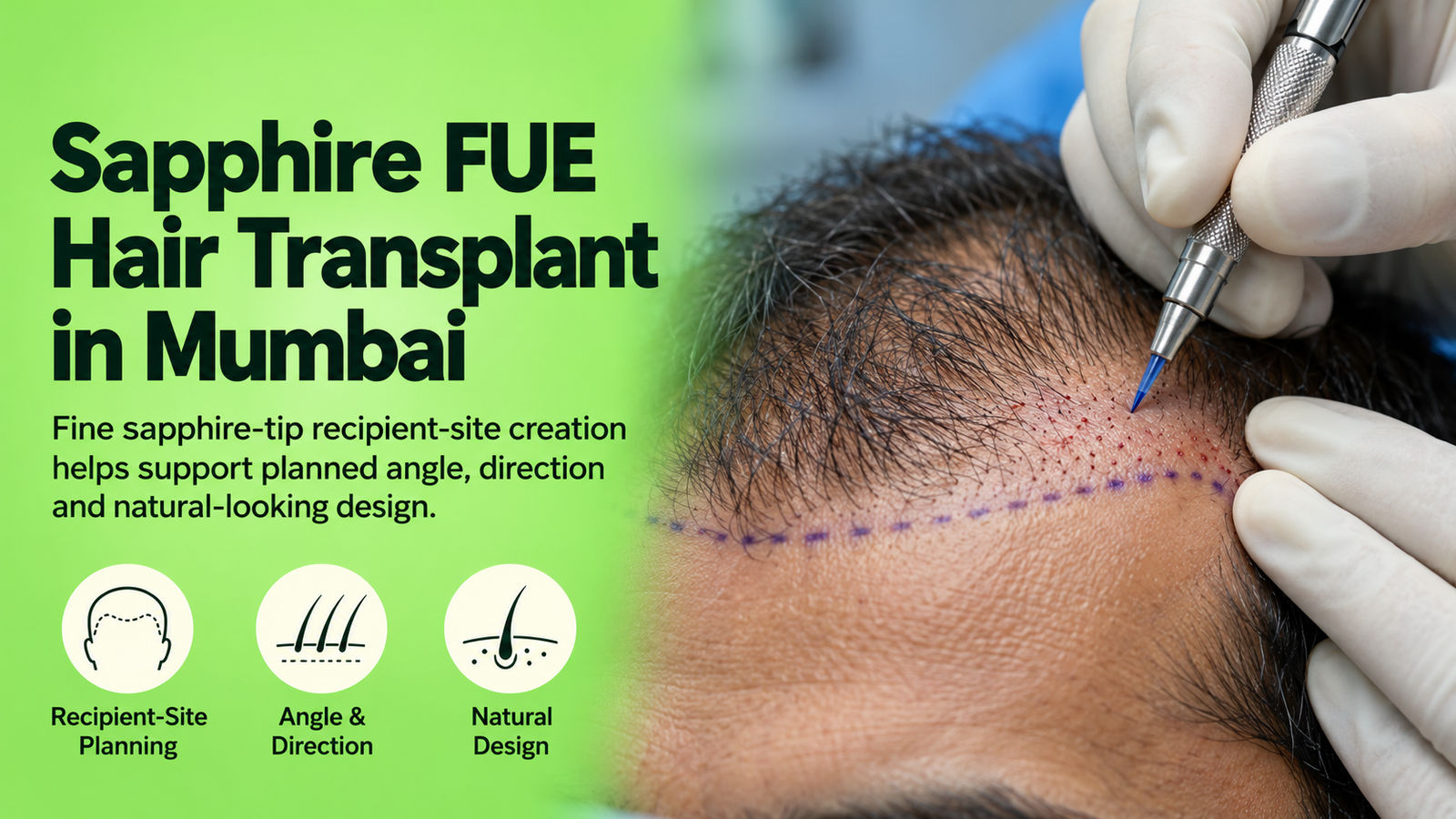
Sapphire FUE Hair Transplant in Mumbai
Sapphire FUE Hair Transplant combines follicular-unit harvesting using FUE with recipient-site creation using specially designed sapphire blades.
The sapphire component is used to prepare the small incisions into which harvested follicular units may subsequently be placed. It does not refer to the instrument used for extracting hair from the donor area.
For patients comparing Sapphire FUE with other hair-transplant techniques, the important considerations are recipient-site precision, hair angle, direction, depth, graft size and the overall surgical plan.
At Anagen Hair Transplant Clinic in Mumbai, the suitability of sapphire recipient-site creation should be evaluated according to individual scalp characteristics and restoration goals.
What Is Sapphire FUE Hair Transplant?
FUE involves harvesting individual follicular units from the donor area using small punches.
After extraction, the surgeon prepares the recipient region to accommodate the harvested grafts. Sapphire FUE commonly refers to the use of sapphire-tipped blades for creating these recipient sites.
The material used for site creation does not determine the donor extraction method, the number of grafts needed or the eventual hair density by itself.
It is one technical choice within a complete hair-restoration procedure.
How Is Sapphire FUE Different From Conventional FUE?
The main distinction is the instrument selected for recipient-site creation.
In a conventional FUE procedure, the surgeon may use appropriately selected steel blades, needles or other recipient-site instruments.
In Sapphire FUE, a sapphire-tipped blade is used for site creation where indicated.
Both approaches may use the same basic FUE donor-harvesting principles.
Therefore, the comparison is not between two completely different sources of donor grafts. It is primarily a comparison of recipient-site preparation methods.
What Does the Sapphire Blade Actually Do?
A recipient-site incision determines where a follicular-unit graft will be placed.
The surgeon must consider the intended direction, angle, depth, spacing and dimensions of each recipient site.
Blade material alone cannot establish those decisions.
The size and geometry of the selected instrument must be compatible with the graft and the surrounding scalp tissue.
Poorly planned sites can compromise hair direction, graft positioning or the surrounding native hair, irrespective of whether the instrument is sapphire or steel.
Why Do Angle, Direction and Depth Matter?
Hair does not grow vertically from every part of the scalp.
The natural frontal hairline generally requires carefully planned low-angle emergence and a gradual transition in density.
The mid-scalp needs a pattern that follows existing hair direction, while the crown contains a whorl with changing orientations.
Site depth must accommodate the graft appropriately without unnecessary tissue injury.
Recipient-site orientation is especially important when implanting among existing hair, where neighbouring follicles need to be considered.
The artistic design and surgical execution remain more important than the name of the blade.
For further explanation of hairline planning, explore Creative Hairline Design.
How Is Sapphire FUE Hair Transplant Performed?
Step 1: Hair Loss and Scalp Assessment
The surgeon evaluates the type and extent of hair loss, scalp condition, existing native hair and clinical suitability for transplantation.
Step 2: Donor Assessment
Donor density, follicular-unit distribution, hair calibre and long-term harvesting capacity are assessed.
Step 3: Hairline and Recipient-Site Design
A realistic hairline and recipient coverage plan are established, including anticipated direction, angulation and graft distribution.
Step 4: Donor Preparation and Local Anaesthesia
The donor area is prepared and appropriate local anaesthesia is administered.
Step 5: FUE Follicular-Unit Extraction
Individual follicular units are harvested using suitable FUE punches. Sapphire blades are not the extracting instrument at this stage.
Step 6: Graft Inspection and Preparation
Grafts are examined and protected while awaiting placement.
Step 7: Sapphire Recipient-Site Creation
The surgeon uses appropriately selected sapphire blades to create recipient sites according to the planned angle, depth, size and direction.
Step 8: Follicular-Unit Implantation
The harvested grafts are placed into the prepared recipient sites using an appropriate implantation method.
Step 9: Postoperative Assessment
The scalp is examined, aftercare guidance is provided and follow-up is arranged.
Sapphire FUE vs DHI Hair Transplant
Sapphire FUE and DHI are not necessarily competing methods.
Sapphire usually describes a recipient-site incision instrument.
DHI commonly refers to the use of an implantation instrument or approach in which graft placement and site creation may be integrated.
Both may follow follicular-unit extraction from the donor scalp.
The correct comparison is therefore between recipient preparation and implantation strategies, rather than simply between two marketing names.
Does Sapphire FUE Produce Higher Density?
Sapphire blades do not create additional donor grafts.
The achievable density depends on recipient-area size, donor availability, hair calibre, graft characteristics, existing native hair, scalp vascularity and surgical judgement.
Attempting to create too many closely spaced sites can introduce unnecessary tissue risk.
A responsible plan prioritises appropriate coverage and natural appearance rather than pursuing the highest possible numerical density.
Patients specifically concerned about transplant density may also review Dense Packing Hair Transplant.
Recovery and Expected Results
Initial redness, small crusts, swelling and temporary scalp sensitivity may occur after Sapphire FUE.
Transplanted hair shafts can shed during the early recovery period, followed by progressive growth over subsequent months.
A sapphire blade does not eliminate micro-incision healing or the biological hair-growth cycle.
There is insufficient basis for promising that every patient will heal faster or achieve better final density solely because a sapphire instrument was used.
Sapphire FUE Cost in Mumbai
Pricing depends on the graft requirement, transplant area, donor characteristics, surgical complexity and selected implantation instruments.
The use of sapphire blades should be explained as one part of the procedure, not as a guarantee of better results.
View Sapphire FUE Hair Transplant Results
A natural hair transplant depends on the overall surgical plan. Sapphire recipient-site creation is only one component.
For actual clinical outcomes, view hair transplant results under Anagen’s dedicated Results pages, including hairline and crown restoration.
Frequently Asked Questions
Is sapphire used to extract donor hair?
No. FUE punches are used for follicular-unit harvesting. Sapphire blades are used for recipient-site creation.
Is Sapphire FUE better than normal FUE?
Not automatically. The final outcome depends on the complete clinical plan and execution.
Does Sapphire FUE leave scars?
It involves small surgical incisions and can produce scarring or visible healing changes. It is not scarless surgery.
Can Sapphire FUE be used for crown restoration?
It may be considered when the surgeon chooses sapphire recipient-site creation for the crown, taking account of the whorl direction and graft plan.
Is Sapphire FUE the same as DHI?
No. They describe different aspects of recipient-site creation and graft implantation.
Does Sapphire FUE guarantee higher density?
No. Density is constrained by donor capacity, tissue considerations and design.
Plan Your Sapphire FUE Consultation at Anagen
Before selecting Sapphire FUE, the surgeon should assess whether this recipient-site instrument is appropriate for your scalp, hairline direction, density requirements and available grafts.
At Anagen Hair Transplant Clinic, Andheri West, Mumbai, you can discuss your restoration design and the instruments proposed for your procedure.
Send clear FRONT, TOP and BACK donor-area photographs on WhatsApp: +91 92222 22409.