





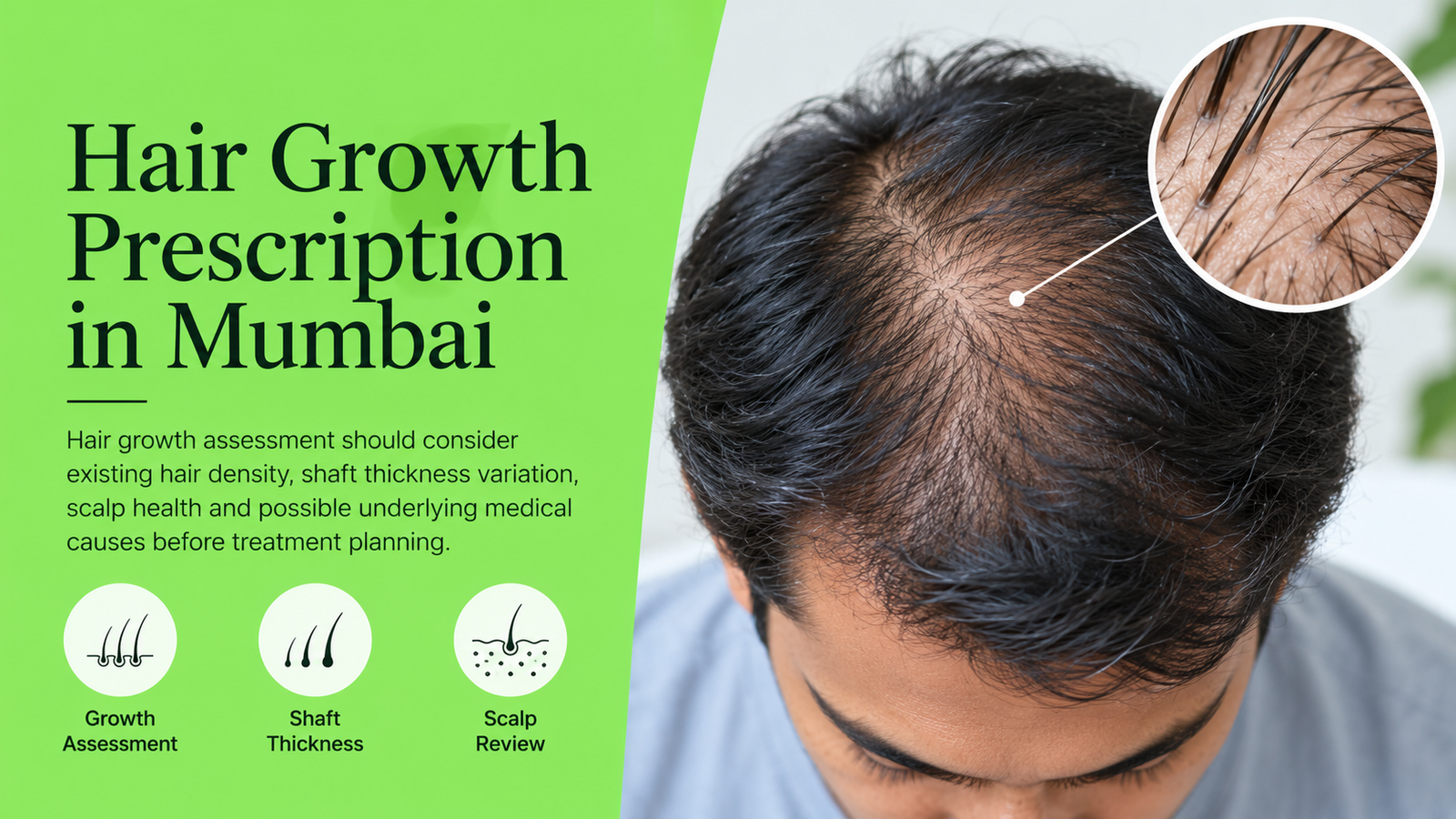
Hair Growth Prescription in Mumbai
Hair growth may slow, hair density may gradually reduce, or existing hair may become finer due to genetic hair loss, medical conditions, nutritional deficiencies or other factors affecting the hair-growth cycle.
A Hair Growth Prescription focuses on medically appropriate treatment to support existing follicles, manage the diagnosed cause of hair loss and maintain hair growth wherever possible.
At Anagen Hair Transplant Clinic, Mumbai, prescription planning begins with assessing the scalp, existing hair density, follicular condition and relevant medical history.
Not every patient requires the same medicine. Some people need treatment for progressive pattern hair loss, while others may benefit from correcting an underlying medical condition or monitoring temporary hair shedding.
The purpose of a doctor-guided prescription is to establish a treatment plan that is suitable for the diagnosis rather than recommending a universal hair-growth product.
Understanding Hair Growth Prescription and Medical Hair Maintenance
Hair growth may slow, hair density may gradually reduce, or existing hair may become finer due to genetic hair loss, medical conditions, nutritional deficiencies or other factors affecting the hair-growth cycle.
A Hair Growth Prescription focuses on medically appropriate treatment to support existing follicles, manage the diagnosed cause of hair loss and maintain hair growth wherever possible.
At Anagen Hair Transplant Clinic, Mumbai, prescription planning begins with assessing the scalp, existing hair density, follicular condition and relevant medical history.
Not every patient requires the same medicine. Some people need treatment for progressive pattern hair loss, while others may benefit from correcting an underlying medical condition or monitoring temporary hair shedding.
The purpose of a doctor-guided prescription is to establish a treatment plan that is suitable for the diagnosis rather than recommending a universal hair-growth product.
What Should Be Assessed Before Starting a Hair Growth Prescription?
Hair growth depends on several interconnected factors. A reduction in visible hair may result from progressive follicular miniaturisation, increased shedding, inflammation or medical conditions that temporarily disrupt the hair cycle.
A clinical assessment may include:
- When thinning or reduced growth first became noticeable.
- Whether the change is gradual, sudden or recurrent.
- Family history of hair loss.
- Hair density across the frontal scalp, mid-scalp and crown.
- Hair-shaft thickness and variation in diameter.
- Scalp redness, scaling, inflammation or scarring.
- Medication use and relevant medical conditions.
- Recent illness, significant stress, dietary changes or hormonal factors.
- Previous hair-loss treatments and their response.
Dermoscopy or trichoscopy may help identify miniaturised hairs, differences in shaft caliber and scalp changes.
Blood investigations are considered when the history or examination suggests a medical or nutritional cause. They are not automatically required for every patient.
How the Hair-Growth Cycle Influences Treatment
Scalp hair passes through different biological stages.
Anagen — Active Growth
During anagen, the follicle actively produces a hair shaft. The length of this phase influences the potential length of scalp hair.
Catagen — Transition
Catagen is a relatively short transitional period during which active hair production slows and the lower follicle undergoes structural changes.
Telogen — Resting Phase
During telogen, the follicle rests before beginning another growth cycle.
Exogen — Hair Shedding
Exogen describes the release of the hair shaft. This is part of normal hair cycling, although excessive shedding can occur in certain conditions.
Some disorders increase the proportion of hairs entering the resting and shedding phases, while pattern hair loss progressively affects hair-follicle size and shaft production.
A prescription should therefore address the underlying condition rather than assuming that every patient has the same disturbance in the hair cycle.
Prescription Overview
Primary Concern: Reduced hair growth, early thinning, gradual loss of density or the need for ongoing medical hair maintenance.
Assessment Required: Hair-loss diagnosis, scalp examination, follicular condition, progression history and relevant medical factors.
Prescription Goal: Support appropriate existing follicle activity, manage the underlying cause of hair loss and preserve hair coverage where clinically possible.
Possible Prescription Categories: Topical hair-growth therapy, selected oral medicines, treatment of underlying medical conditions and correction of confirmed deficiencies.
Supportive Care: Gentle hair care, scalp management, avoidance of unnecessary hair-shaft damage and appropriate nutritional support.
Monitoring: Hair density, shaft caliber, shedding pattern, scalp tolerance, adverse effects and treatment adherence.
Follow-Up: Individualized according to diagnosis, medication and clinical response.
When Another Treatment May Be Considered: Inadequate response, progression despite management or stable structural hair loss requiring assessment for procedural or surgical restoration.
Important: This page provides general prescription information and does not replace an individual clinical assessment. The medicine, dose, frequency and duration, where required, should be selected according to the diagnosis, medical history and clinical findings.
What Types of Hair Growth Prescription May Be Considered?
There is no universal medical prescription that reliably works for every type of hair loss.
Treatment selection depends on diagnosis, age, sex-specific considerations, health history and the potential benefit of the medicine.
1. Topical Hair-Growth Therapy
Topical minoxidil is an established treatment for certain forms of pattern hair loss. It may help maintain existing hair and improve growth in suitable patients.
It does not reliably restore completely bald regions where follicles have been irreversibly lost.
Skin irritation and other adverse effects are possible. Continued use may be necessary to maintain treatment-related benefits.
The formulation and application schedule should be selected according to the patient and the product’s approved indications.
2. Oral Prescription Treatment
Selected oral medicines may be considered for diagnosed hair-loss conditions when clinically appropriate.
However, prescribing decisions vary significantly between patients. Certain medicines have sex-specific indications, pregnancy-related restrictions, systemic adverse effects or monitoring requirements.
Oral minoxidil, for example, is used off-label for hair loss in some clinical settings and requires consideration of cardiovascular status and other medical factors.
3. Treatment of an Underlying Medical Condition
Where hair growth is affected by a thyroid disorder, inflammatory scalp disease, medication-related effect or another systemic condition, treating the underlying cause may be essential.
Hair-growth medication alone may not be sufficient until the contributing condition is appropriately managed.
4. Correction of Confirmed Nutritional Deficiency
Nutritional support may be appropriate when an investigation identifies a relevant deficiency.
Routine supplementation without clinical indication does not reliably increase hair density or reverse genetic hair loss.
Excessive intake of certain supplements can itself create medical problems.
5. Diagnosis-Specific Long-Term Maintenance
Patients with progressive pattern hair loss may require continued treatment to maintain the benefit achieved.
Men and women may require different prescription considerations.
For further assessment, the diagnosis-specific pages Male Hair Growth Prescription and Female Hair Growth Prescription should explain the relevant sex-specific treatment decisions.
Existing Hair Follicles and Hair Miniaturisation
Hair-growth prescriptions generally depend on the biological condition of existing follicles.
In pattern hair loss, some follicles gradually become smaller and produce finer, shorter hairs. This process is known as follicular miniaturisation.
Where follicles remain functional, appropriate medical treatment may help selected patients maintain or improve hair production.
However, response becomes less predictable where miniaturisation is advanced or follicular structures are irreversibly damaged.
In longstanding completely bald regions with insufficient functional follicles, prescription medicines may have limited ability to restore meaningful coverage.
This is why early thinning and established structural baldness require different treatment strategies.
How Should a Hair Growth Prescription Be Used?
Treatment should follow the instructions provided by the prescribing clinician.
Patients need to understand which treatment is intended for their diagnosis, the correct method of use, anticipated adverse effects and when clinical reassessment is required.
Regular adherence may matter for treatments intended to control progressive hair loss.
Changing medicine concentrations, increasing application quantities or combining several products without medical advice does not guarantee better results.
Some treatments may initially be associated with changes in shedding. Persistent or concerning symptoms should be reviewed rather than automatically interpreted as evidence that the medicine is working.
Monitoring and Follow-Up
Hair growth changes gradually. Clinical monitoring is needed to determine whether the prescription is effective and tolerable.
A follow-up assessment may compare:
- Hair density in previously documented scalp regions.
- Hair-shaft caliber and miniaturisation where measurable.
- Progression of the hairline, parting or crown thinning.
- Changes in shedding.
- Scalp irritation or adverse effects.
- Treatment adherence and feasibility of continued maintenance.
Standardized clinical photographs and trichoscopic assessments may be useful.
A single photograph under different lighting or hairstyle conditions is not reliable evidence of meaningful improvement.
When May PRP, GFC or Hair Transplantation Be Considered?
Prescription therapy, supportive procedures and hair transplantation have different roles.
Prescription Management
Appropriate medicine may help manage certain diagnosed hair-loss conditions, support existing follicles and maintain hair coverage.
Biologix and Procedural Support
Selected patients may discuss additional procedures such as PRP Hair Treatment, iPRF Hair Treatment or Advanced GFC Hair Treatment.
Their evidence, preparation methods and expected benefit differ. These procedures are not universally necessary and do not replace diagnosis-specific medical treatment.
Hair Transplantation
Hair transplantation transfers suitable donor follicles into selected areas where structural hair coverage is inadequate.
It may be considered when medical treatment cannot achieve the desired coverage and the patient has suitable donor resources.
A transplant does not eliminate the possibility of future loss of surrounding native hair.
Frequently Asked Questions
1. What is included in a hair growth prescription?
It may include diagnosis-specific topical or oral medication, treatment of an underlying condition, correction of confirmed deficiencies and a clinical monitoring plan. The exact approach depends on examination.
2. Can prescription medicine regrow completely bald areas?
Medication may have limited effectiveness in longstanding areas with irreversible follicular loss. Structural restoration may require a different assessment.
3. How long does hair-growth treatment take?
Response varies by diagnosis and treatment. Hair growth is gradual, and repeated assessment over months may be necessary.
4. Do hair-growth medicines need to be continued?
Some treatments for progressive pattern hair loss require continued use to maintain the achieved benefit. Other conditions may need temporary or cause-specific management.
5. Can PRP or GFC be combined with prescription treatment?
Combination treatment may be considered for selected patients, but it is not necessary or proven superior in every diagnosis.
6. Are hair-growth prescriptions different for men and women?
Yes. Certain medicines have sex-specific indications, pregnancy-related restrictions and other important safety considerations.
7. When should transplantation be considered?
A surgical assessment may be appropriate when stable structural hair loss cannot be adequately managed with medication and sufficient suitable donor hair is available.
Hair Growth Prescription Consultation at Anagen, Mumbai
Effective hair-growth management starts with identifying the actual cause of reduced density or progressive hair loss.
A clinical assessment can help determine whether prescription treatment, management of an underlying disorder, supportive procedures or surgical restoration is the appropriate approach.
Arrange a Hair Prescription Consultation
Discuss a diagnosis-based treatment and maintenance plan with a qualified clinician.