





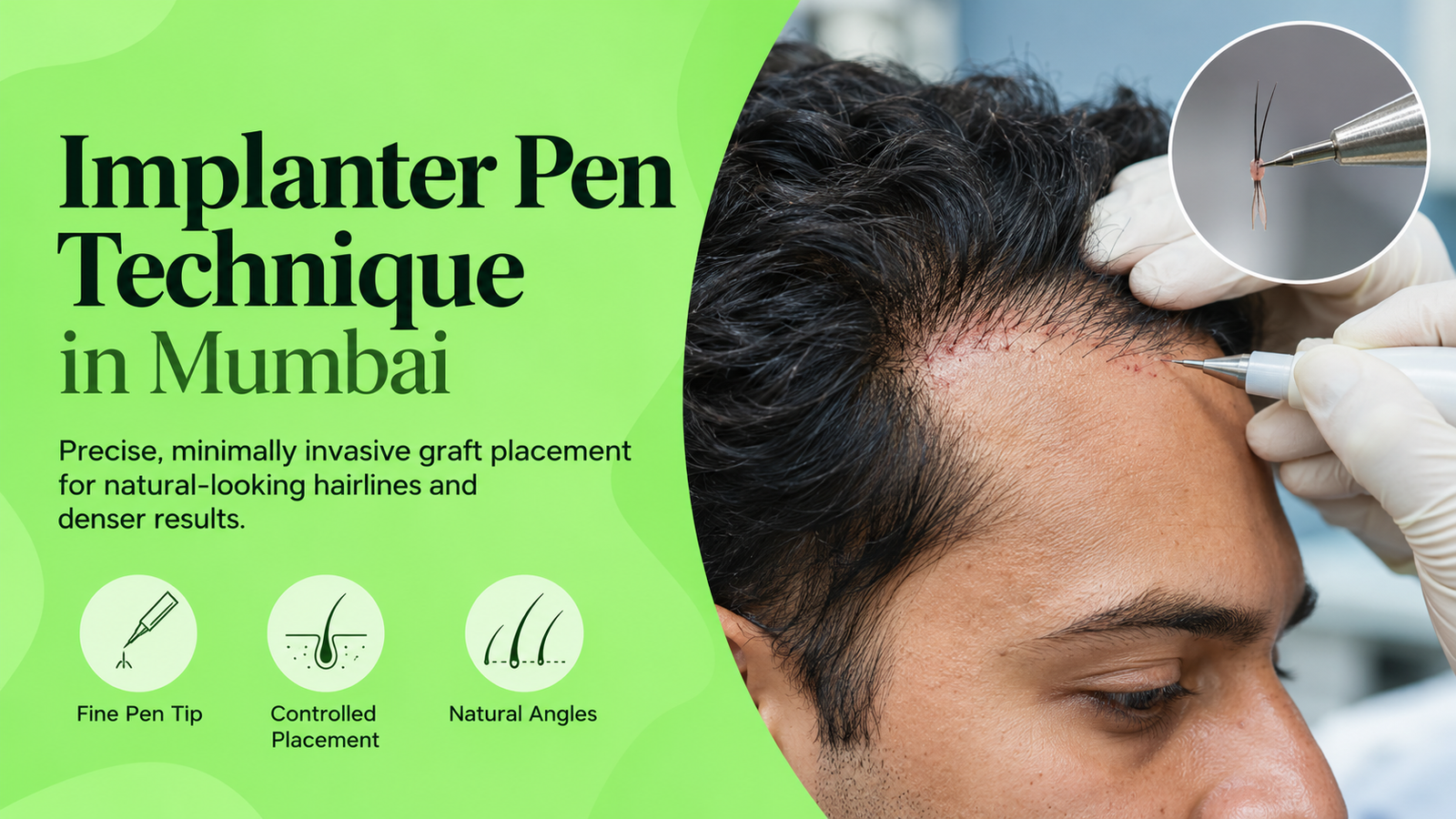
Implanter Pen Technique in Mumbai
The Implanter Pen Technique is a hair-graft placement approach in which a specialised handheld instrument is used to position extracted follicular units within the recipient scalp.
Unlike FUE, which describes how grafts are removed from the donor area, the implanter pen is concerned with how prepared grafts are placed.
The instrument may help the operator manage graft handling, insertion angle, depth and placement sequence. However, an implanter pen does not independently determine hairline design, graft quality or the final transplant result.
At Anagen Hair Transplant Clinic in Mumbai, the choice of an implantation instrument should follow individual surgical planning.
What Is an Implanter Pen?
An implanter pen is a specialised instrument designed to hold a prepared follicular unit and assist its placement into the scalp.
Some systems have a hollow sharp tip that can create a recipient opening during implantation.
Others have blunt or dull tips and are designed to place grafts into sites prepared beforehand.
The instrument must be selected and used according to the actual surgical technique.
A patient should not assume that all implanter pens operate identically.
How Does an Implanter Pen Place Hair Grafts?
A suitable follicular unit is prepared and loaded into the instrument.
The operator positions the tip according to the planned recipient direction and angle.
Depending on the type of implanter, the graft may be placed into a pre-made opening or the tip may create the opening during placement.
The graft is then released while the instrument is withdrawn.
Successful placement requires appropriate handling, instrument selection and recognition of the surrounding anatomy.
Why Are Direction, Angle and Depth Important?
Direction
Hair should follow a believable pattern across the recipient region.
Frontal, temporal, mid-scalp and crown hair do not all grow in the same direction.
Exit Angle
The exit angle affects whether newly growing hair lies naturally or projects unnaturally outward.
An appropriate angle varies according to the treatment area.
Depth
A graft placed too deeply or too superficially may produce complications or an undesirable appearance.
Spacing
Density must be designed around donor availability, scalp characteristics and neighbouring follicles.
Follicular-Unit Selection
Single-hair units may be selected for softer visible transitions, while suitable multi-hair units can contribute to coverage behind them.
These decisions belong to the overall surgical design, not to the pen itself.
Can Implanter Pens Be Used Between Existing Hairs?
Selected implanter systems may be used in areas with existing hair.
However, the operator must avoid unnecessary injury to native follicles.
The available space, angle of existing hair, recipient density and scalp condition all influence whether this is appropriate.
A pen does not automatically protect nearby hairs.
For patients considering additional coverage, Dense Packing Hair Transplant provides related information.
How Is the Implanter Pen Technique Used During Hair Transplantation?
Step 1: Patient and Donor Assessment
The surgeon assesses hair loss, donor supply, recipient requirements and medical suitability.
Step 2: Hairline and Recipient Design
The intended hairline, density pattern, graft distribution and regional direction are planned.
Step 3: FUE Extraction
Suitable follicular units are obtained from the donor area.
Step 4: Graft Inspection and Preservation
Grafts are sorted and protected under appropriate storage conditions.
Step 5: Instrument Selection
An appropriate implanter system is selected according to the graft characteristics and intended placement method.
Step 6: Graft Loading
Individual prepared units are loaded using the selected instrument’s recommended technique.
Step 7: Controlled Implantation
The operator places grafts according to the treatment map while controlling insertion and release.
Step 8: Graft Position Inspection
The team reviews the recipient region for graft alignment, depth-related concerns and visible irregularities.
Step 9: Post-Procedure Care
The patient receives instructions for protection of newly implanted grafts and scheduled review.
Implanter Pen vs DHI: Are They Different?
An implanter pen is a physical graft-placement instrument.
DHI is terminology commonly used for a direct implantation workflow, frequently involving an implanter.
The two terms therefore overlap.
A specific implanter may be used within a DHI-labelled procedure, but not every implanter-based operation should automatically be described as a proprietary DHI procedure.
Patients can read DHI Hair Transplant for the broader terminology and FUE comparison.
Advantages and Limitations
Implanter pens can offer a structured way to handle and insert follicular units.
They may be useful for selected graft-placement requirements, but effectiveness depends on proper loading, appropriate instrument choice, surgical technique and team proficiency.
Limitations include the learning curve, graft-loading demands, instrument suitability for particular graft characteristics and possible placement trauma.
A pen cannot correct poor donor selection, excessive extraction, unrealistic density planning or improper postoperative management.
Recovery and Hair Growth
Healing after implanter-based transplantation follows the normal hair-transplant recovery process.
Patients may experience redness, swelling, crusting, sensitivity and temporary shedding of implanted hair shafts.
New hair growth commonly becomes noticeable over the following months, with progressive maturation over approximately nine to twelve months or longer.
Growth cannot be accelerated or guaranteed simply by using an implanter.
Implanter Pen Hair Transplant Cost in Mumbai
Pricing depends on graft requirements, treatment area, instrument workflow, complexity, duration and the overall surgical plan.
Patients should ask what the quotation includes and whether a particular instrument offers a meaningful advantage for their individual case.
Implanter Pen Hair Transplant Results
Natural results depend on correct hair direction, graft distribution, donor quality, recipient-site planning and biological growth.
The instrument is one part of the operation.
Explore Anagen’s Hairline Results and Crown Restoration Results to understand different anatomical restoration requirements.
View hair transplant results.
Frequently Asked Questions
Is an implanter pen the same as FUE?
No. FUE describes graft extraction; the pen assists with implantation.
Is an implanter pen the same as DHI?
They overlap, but one describes an instrument and the other commonly describes an implantation workflow.
Does the pen make recipient openings?
A sharp implanter can create openings during graft placement. Dull implanters are used with pre-made sites.
Can implanter pens be used for the crown?
They may be used in selected crown cases, but careful directional planning is necessary.
Can they be used without shaving the recipient area?
Selected workflows may permit limited recipient-area shaving, but suitability depends on existing hair and the surgical plan.
Does an implanter pen guarantee better graft growth?
No. The complete surgical process determines the likelihood of a successful outcome.
Does it leave scars?
Follicular extraction and recipient implantation still create small tissue wounds. Healing and scar visibility vary.
Book an Implanter Pen Technique Consultation in Mumbai
A consultation should clarify your donor availability, graft requirement, hairline design and proposed implantation method.
The surgeon should explain the instrument’s role and whether it offers a practical advantage for your restoration needs.
Send FRONT, TOP and BACK donor photographs or contact Anagen for an assessment.