





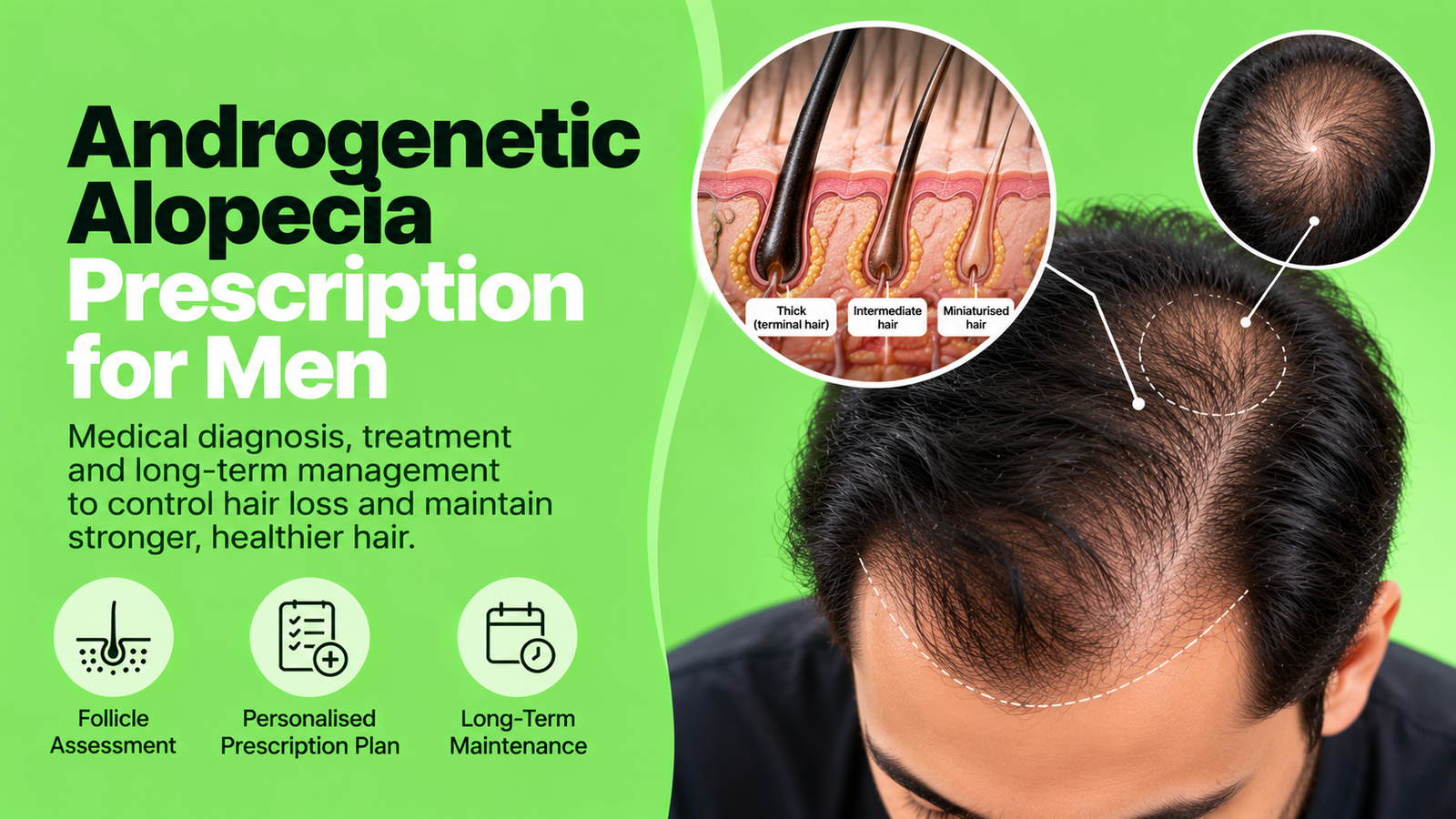
Androgenetic Alopecia Prescription for Men: Medical Diagnosis, Treatment and Maintenance
Androgenetic alopecia is a common form of progressive hair loss in men. It occurs when genetically susceptible hair follicles respond to androgen-related signals by gradually producing finer and shorter hairs.
Over time, affected scalp areas may show reduced hair density, increased scalp visibility and a characteristic pattern of frontal or crown thinning.
Although androgenetic alopecia is commonly called male pattern baldness, the medical term focuses on the underlying disease process rather than the visible shape of hair loss.
An androgenetic alopecia prescription is intended to address the diagnosed condition, help manage follicular miniaturisation and establish an appropriate long-term monitoring and maintenance plan.
There is no single medicine or treatment regimen suitable for every patient.
What Happens to Hair Follicles in Androgenetic Alopecia?
Healthy terminal hair follicles generally produce relatively thick hair shafts that grow through repeated hair cycles.
In genetically susceptible scalp follicles, androgen signalling — particularly involving dihydrotestosterone, or DHT — contributes to progressive miniaturisation.
Affected follicles may produce hair that becomes progressively finer, shorter and less visually prominent. The growth phase can shorten, and the proportion of fine hairs in an affected region may increase.
This process does not affect every follicle equally. Different scalp regions and individual follicles can respond differently.
The changes are usually gradual. A follicle producing finer hair should not automatically be described as dead or permanently incapable of responding.
Genetics, Androgens and Individual Susceptibility
Androgenetic alopecia involves a combination of inherited susceptibility and androgen-related follicular responses.
A family history can be relevant, but the condition does not follow a simple rule in which baldness must come exclusively from the mother’s or father’s side.
Men with androgenetic alopecia do not necessarily have unusually high blood testosterone levels. Follicular sensitivity and local androgen metabolism are important.
For this reason, a routine testosterone result alone cannot confirm or exclude androgenetic alopecia.
Understanding the diagnosis helps prevent inappropriate investigations and unnecessary attempts to correct normal hormone levels.
How Is Male Androgenetic Alopecia Diagnosed?
Diagnosis usually begins with a clinical history and scalp examination.
The doctor may assess:
- Distribution of hair thinning.
- Age of onset and rate of progression.
- Family history.
- Hair shaft diameter variation.
- Proportion of finer or miniaturised hairs.
- Differences between affected and relatively unaffected scalp regions.
- Scalp inflammation or signs of another disorder.
- Previous treatment and response.
Trichoscopy can support the diagnosis by identifying characteristic differences in hair thickness and other follicular findings.
When the presentation is unusual — for example, sudden widespread shedding, patchy loss, pain, redness or scarring — additional investigation may be necessary to identify another condition or a coexisting cause.
The diagnosis should not be based solely on appearance, family history or one laboratory result.
Prescription Overview
Primary Concern: Clinically diagnosed male androgenetic alopecia with progressive follicular miniaturisation.
Likely Assessment Focus: Disease pattern, progression, follicular sensitivity, hair shaft variability and other possible contributors.
Prescription Goal: Manage progression, preserve responsive native follicles and support appropriate hair growth.
Possible Prescription Categories: Topical growth-support treatment, medically appropriate androgen-pathway treatment, selected systemic therapy and treatment of coexisting scalp disease.
Supportive Care: Scalp hygiene, treatment adherence and correction of clinically established contributing deficiencies.
Monitoring: Pattern stability, shaft calibre, treatment response, adverse effects and tolerability.
Follow-Up: Ongoing medical reviews appropriate to the selected medicines and the patient’s response.
When Another Treatment May Be Considered: Persistent visible hair loss despite suitable medical management, treatment intolerance or established areas with inadequate native hair coverage.
Medical Prescription Categories for Androgenetic Alopecia
Androgen-Pathway Treatment
Finasteride is a recognised prescription medicine used in selected men with androgenetic alopecia.
It reduces the formation of DHT through inhibition of the relevant enzyme pathway. This may reduce the androgen-related contribution to progressive follicular miniaturisation.
Treatment requires individual assessment of suitability and a balanced discussion of potential benefits and adverse effects.
These include possible sexual, reproductive, breast-related and mood-related concerns. Clinicians should also consider relevant safety warnings and the patient’s medical history.
Dutasteride is another medicine affecting DHT formation, but its indication and regulatory status for hair loss vary by jurisdiction.
Hair-Growth Support
Topical minoxidil is an established treatment that may support hair growth in some patients with androgenetic alopecia.
It does not directly correct the genetic susceptibility underlying the condition.
Its potential benefit, tolerability and maintenance requirements should be explained before treatment.
Oral minoxidil may occasionally be considered by a specialist in selected circumstances. Use for hair loss is off-label in many jurisdictions and requires consideration of cardiovascular and other systemic risks.
Associated Scalp Treatment
Inflammation, seborrhoeic dermatitis or other scalp disorders may coexist with androgenetic alopecia.
Treatment should address these separately where clinically indicated rather than assuming they are the cause of the genetic condition.
Treatment Response and Long-Term Monitoring
Treatment effectiveness is assessed through changes in hair-loss progression, existing hair coverage and follicular characteristics.
Clinical photographs may be taken from standardised angles. Trichoscopy can provide additional information about hair shaft diversity and miniaturisation.
Medical review should also address adverse effects, missed treatment, scalp irritation, other medicines and whether the patient wishes to continue therapy.
A treatment that stabilises further loss may be clinically useful even when dramatic regrowth does not occur.
Patients should not judge the effectiveness of long-term treatment based on isolated daily shedding counts or photographs taken under inconsistent lighting.
Why Long-Term Maintenance Matters
Androgenetic alopecia generally remains a progressive condition even when visible improvement occurs during treatment.
Discontinuing certain effective medicines can lead to loss of the hair-growth benefits they were maintaining.
The need for treatment, however, should not be considered automatic or indefinite without clinical reassessment. Long-term medical management must balance expected benefit with safety, tolerability and patient preference.
Androgenetic Alopecia Prescription and Hair Transplantation
Hair transplantation can redistribute donor follicles into selected thinning or bald areas. It does not eliminate the underlying androgenetic alopecia affecting susceptible native hair.
A patient who undergoes hairline or crown restoration may continue to experience thinning in surrounding untreated regions.
For this reason, medical management and surgical planning should be considered together when appropriate.
The Post Hair Transplant Maintenance Prescription page should explain how native hair may be managed after restoration.
Limitations of Medical Treatment
Not every follicle will respond equally to medication.
Some patients experience stabilisation, others may see partial improvement, and some experience limited response or continued progression.
Medical treatment cannot guarantee permanent preservation of every follicle or complete restoration of advanced baldness.
Potential medicine-related adverse effects, contraindications, financial commitments and treatment preferences should remain part of shared decision-making.
Frequently Asked Questions
Is androgenetic alopecia the same as male pattern baldness?
In men, these terms generally describe the same underlying condition. Male pattern baldness is the commonly used patient-facing term.
Why do hair follicles miniaturise?
Genetic susceptibility and androgen-related signalling contribute to gradual changes in susceptible follicles, resulting in finer hair production.
Does androgenetic alopecia mean I have high testosterone?
Not necessarily. Circulating testosterone levels alone do not determine whether a man develops androgenetic alopecia.
Can androgenetic alopecia be permanently cured?
There is no established prescription that permanently removes the underlying susceptibility in every patient. Treatment usually focuses on ongoing management.
Can medical treatment stop its progression completely?
Some patients achieve meaningful stabilisation, but no prescription can guarantee that progression will stop permanently.
Is medication necessary after a hair transplant?
Not for every patient. Medical treatment may be useful in selected patients to manage susceptible native hair, depending on suitability and clinical circumstances.
Medical Consultation for Androgenetic Alopecia at Anagen
An appropriate prescription begins with confirmation of the diagnosis and assessment of the patient’s remaining hair follicles.
At Anagen, a hair prescription consultation can help clarify the role of medical management, expected treatment limitations, the need for follow-up and whether another restoration approach should be discussed.
The treatment plan should aim for realistic, sustainable management rather than a promise of permanent reversal.