




High Grade Baldness Restoration in Mumbai
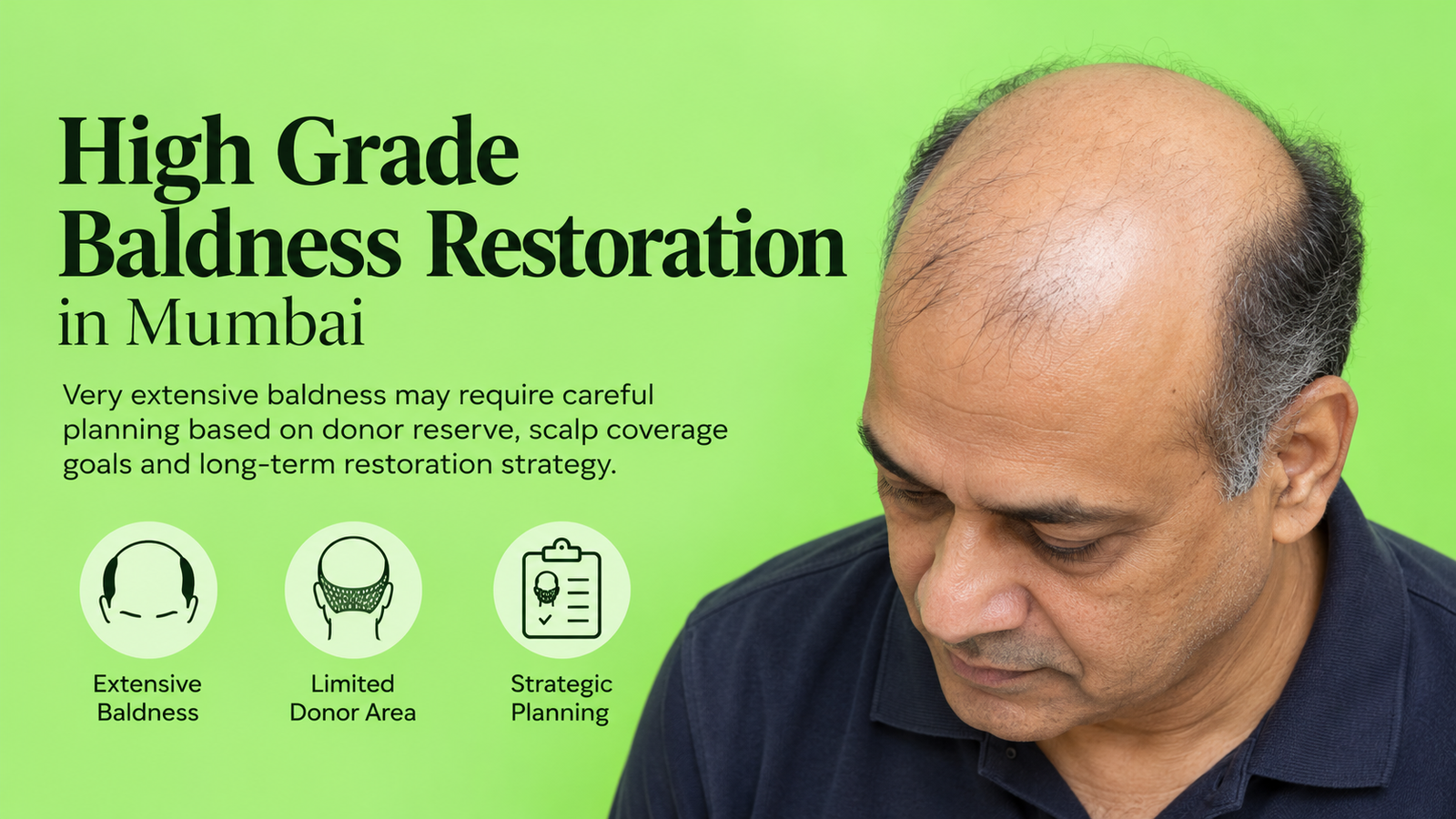
Severe baldness can leave a very large area of the upper scalp without hair while only a limited donor fringe remains at the back and sides.
In such cases, the important question is not simply how many grafts can be transplanted. It is how much meaningful cosmetic restoration can be achieved without damaging the remaining donor area or creating unrealistic expectations.
High Grade Baldness Restoration at Anagen Hair Transplant Clinic in Mumbai focuses on making the best possible use of suitable donor follicles, prioritising visually important regions and developing a realistic long-term plan.
What Is High Grade Baldness?
High grade baldness refers to very extensive hair loss in which a large recipient surface remains while the available donor supply may be relatively limited.
It is commonly associated with advanced androgenetic alopecia, although a formal diagnosis remains essential.
Some patients have near-total loss across the frontal, central and crown regions. Others also demonstrate reduced donor density or previous donor harvesting.
The degree of baldness alone does not establish whether surgery is suitable. A person with severe visible loss may have a useful donor area, while another with less recipient loss may have poor donor quality.
This page focuses on realistic restoration when donor demand considerably exceeds available supply.
Why Is Complete Restoration Sometimes Impossible?
Hair transplantation redistributes existing follicles; it does not create an unlimited supply of new scalp hair.
When the bald recipient area is very extensive, achieving the original density throughout the scalp may require more follicles than can be safely harvested.
Trying to extract excessive numbers from a weak donor area can result in visible thinning, irregular donor appearance and reduced future options.
In some high-grade cases, meaningful frontal restoration may be possible while complete mid-scalp and crown coverage remains unrealistic.
The patient should understand these limitations before undergoing surgery.
What Happens When Donor Demand Exceeds Supply?
In severe baldness, the doctor must compare the total recipient requirement with the estimated safe donor availability.
A large recipient area does not justify unlimited graft extraction.
The surgeon considers the amount of usable scalp donor hair, calibre and follicular-unit composition, possible supplementary donor regions and the patient’s priorities.
If the available donor supply is insufficient for the requested density and coverage, the plan must be adjusted.
Options may include concentrating on the frontal scalp, creating lighter central coverage, delaying the crown or deciding that surgery is unlikely to meet the patient’s goals.
Should Coverage or Density Be Prioritised?
This is one of the most important decisions in high-grade baldness restoration.
If a limited donor supply is spread across a very large scalp surface, visual density may be low.
If most grafts are concentrated in a smaller frontal region, that area may achieve better cosmetic framing, but other regions may remain visibly bald.
The doctor and patient should discuss which outcome would provide the most meaningful improvement.
For many men, reconstructing a natural frontal hairline with reasonable frontal and central coverage is more useful than attempting light transplantation across the entire upper scalp.
However, the preferred balance depends on the patient’s hairstyle, expectations and available donor characteristics.
Why Is the Frontal Hairline Usually a Major Priority?
The frontal hairline frames the face and has considerable visual importance.
In severe baldness, an excessively low or wide hairline may consume donor grafts that could otherwise support frontal density or central scalp continuity.
A conservative mature hairline can reduce the recipient area while still creating an appropriate facial frame.
The design should respect age, forehead proportions, temporal recession and expected future changes.
The leading edge should remain soft, with suitable single-hair grafts, natural irregularity and appropriate direction.
Patients interested in these principles can explore Mature Hairline Reconstruction and Natural Hairline Design.
Can Scalp, Beard and Body Hair Be Combined?
Alternative donor hair may expand restoration options for selected patients with inadequate scalp donor supply.
Scalp Donor Hair
Hair from an appropriately selected scalp donor region is generally the preferred source for creating natural scalp restoration, especially the visible frontal boundary.
Its suitability depends on density, calibre, miniaturisation and remaining safe harvesting capacity.
Beard Donor Hair
Beard follicles may be useful as supplemental donor hair in selected patients.
However, beard hair is often different from scalp hair in thickness, curl and growth characteristics. It must be distributed in appropriate recipient regions rather than used indiscriminately.
Selected Body Donor Hair
Selected body hair may be considered when scalp and beard resources remain insufficient.
Its variable growth characteristics, length and donor yield limit how predictably it can be used.
Alternative donor transplantation requires individual assessment and should not be presented as a guaranteed solution to severe donor shortage.
Can High Grade Baldness Be Restored in Multiple Sessions?
Staging may be appropriate when the available donor resources and recipient demand require careful distribution.
One possible strategy is:
First Stage: Frontal Framing and Central Coverage
The first stage prioritises an age-appropriate frontal hairline and coverage of the frontal scalp, sometimes extending into the mid-scalp.
Second Stage: Additional Coverage Where Feasible
After growth maturation and donor reassessment, further central density or selected crown work may be considered.
Additional Treatment
Some patients may need further limited procedures, while others may not have sufficient donor hair for additional surgery.
A staged treatment plan does not guarantee that complete scalp coverage will eventually be possible.
Are Mega-Sessions Suitable for Severe Baldness?
A mega-session involves a relatively large number of grafts within an appropriately planned surgical episode.
However, high-grade baldness does not automatically justify a mega-session.
The decision must account for donor safety, surgical duration, anaesthesia, medical fitness, graft handling and the recipient plan.
Attempting to harvest the largest possible number of follicles without regard to donor preservation can create long-term problems.
A carefully staged procedure may be preferable to an excessively aggressive session.
How Is High Grade Baldness Restoration Performed?
Step 1: Establish the Diagnosis and Overall Pattern
The doctor evaluates the extent of hair loss and excludes conditions that may affect surgical suitability.
Step 2: Comprehensive Donor Mapping
The scalp donor region is assessed for density, calibre, follicular-unit quality, miniaturisation and any previous harvesting.
Step 3: Alternative Donor Assessment
When appropriate, suitable beard or selected body-hair sources are evaluated.
Step 4: Define Realistic Cosmetic Goals
The surgeon and patient discuss the achievable frontal frame, central coverage and possible crown compromise.
Step 5: Develop the Lifetime Graft Strategy
The initial procedure and possible future stages are planned without relying on unlimited donor availability.
Step 6: Local Anaesthesia and Planned FUE Harvesting
Suitable grafts are harvested under appropriate medical and surgical protocols, respecting donor limits.
Step 7: Graft Selection and Recipient-Site Creation
Grafts are allocated to suitable regions, with particular attention to frontal-hairline naturalness and recipient hair direction.
Step 8: Implantation
Follicular units are implanted according to the approved coverage and density priorities.
Step 9: Long-Term Follow-Up
Growth, donor appearance, existing native-hair progression and the possibility of additional treatment are reassessed after maturation.
What If the Crown Cannot Be Fully Restored?
In very severe baldness, the crown may require more donor hair than can safely be allocated.
The doctor may recommend leaving the crown partly uncovered, treating only a selected region or postponing crown surgery.
Some patients may prefer accepting a thinner vertex in exchange for stronger frontal framing and central coverage.
This is a cosmetic planning decision, but it must remain grounded in actual donor limitations.
When Might Hair Transplantation Not Be Appropriate?
Some patients may not be suitable candidates for the level of surgery they request.
Reasons may include inadequate safe donor hair, significant donor miniaturisation, active untreated scalp disease, relevant medical contraindications or expectations that cannot reasonably be met.
Previous excessive harvesting or substantial scarring can also restrict further transplantation.
In such situations, the doctor should explain the limitations rather than recommend an unsuitable surgical procedure.
Selected patients may consider nonsurgical cosmetic alternatives, including appropriate hairstyles, hair systems or scalp micropigmentation, depending on their preferences and scalp condition.
How Much Improvement Is Realistic?
High-grade baldness restoration should aim for the greatest feasible cosmetic improvement with the follicles safely available.
A meaningful result may include a natural frontal hairline, improved frontal density and some central coverage.
The crown may remain comparatively thin or untreated.
Full restoration, original native density and uniform coverage cannot be guaranteed.
The final appearance also depends on graft growth, hair calibre, curl, skin-hair contrast and continued changes in native hair.
High Grade Baldness Restoration Results
In severe baldness, the objective is often to create the greatest possible cosmetic improvement using finite donor resources rather than attempt native density throughout the scalp.
Genuine advanced restoration cases can help demonstrate different approaches to frontal framing, central coverage and realistic crown limitations.
Explore suitable Male Hair Transplant Results and Norwood Grade Results to understand how patients with extensive hair loss may be managed.
View high-grade baldness results.
How Much Does High Grade Baldness Restoration Cost?
Cost depends on the actual treatment plan rather than the diagnosis alone.
Important factors include the size of the recipient area, number and source of grafts, donor characteristics, surgical complexity, selected technique and the number of stages required.
Additional planning may be needed for patients with limited scalp donors, previous procedures or potential beard and body donor supplementation.
A comprehensive assessment is essential before preparing a treatment quotation.
Frequently Asked Questions
Can severe baldness be completely restored?
Sometimes substantial coverage is possible, but complete restoration and original native density cannot be promised, particularly when donor hair is limited.
Can a patient with Norwood VII baldness undergo FUE?
Some patients may be candidates for partial restoration. Suitability depends on the actual donor region and treatment goals.
Can beard and body hair replace scalp donor hair?
Not completely. These sources may provide supplementary follicles, but their characteristics and clinical suitability differ from scalp hair.
Should the crown be left thinner?
In selected severe cases, prioritising the front and centre while accepting lower crown density may be appropriate.
Is a mega-session better than two smaller procedures?
Not automatically. Surgical safety, donor preservation and graft handling are more important than maximising a single-session graft count.
What if the donor area is too weak?
Surgery may need to be limited or avoided. The doctor should discuss realistic nonsurgical alternatives when appropriate.
Can future hair loss affect the appearance after surgery?
Yes. Remaining susceptible native hair may continue to thin, and further donor or recipient changes can affect the overall result.
Discuss Realistic Severe Baldness Restoration at Anagen
If you have very extensive baldness, the first step is to determine what can realistically be restored with your remaining donor resources.
Please send clear FRONT, FULL TOP, CROWN, LEFT SIDE, RIGHT SIDE and BACK DONOR photographs.
Where relevant, also provide BEARD DONOR photographs and details of previous hair transplant procedures.
Anagen can assess your overall recipient area, available scalp donor hair and whether additional donor sources or staged restoration may be appropriate.
Our doctors will discuss realistic priorities, including the possibility that complete scalp coverage may not be achievable.
ANAGEN Hair Transplant Clinic — Andheri West, Mumbai
Call / WhatsApp: +91 92222 22407