





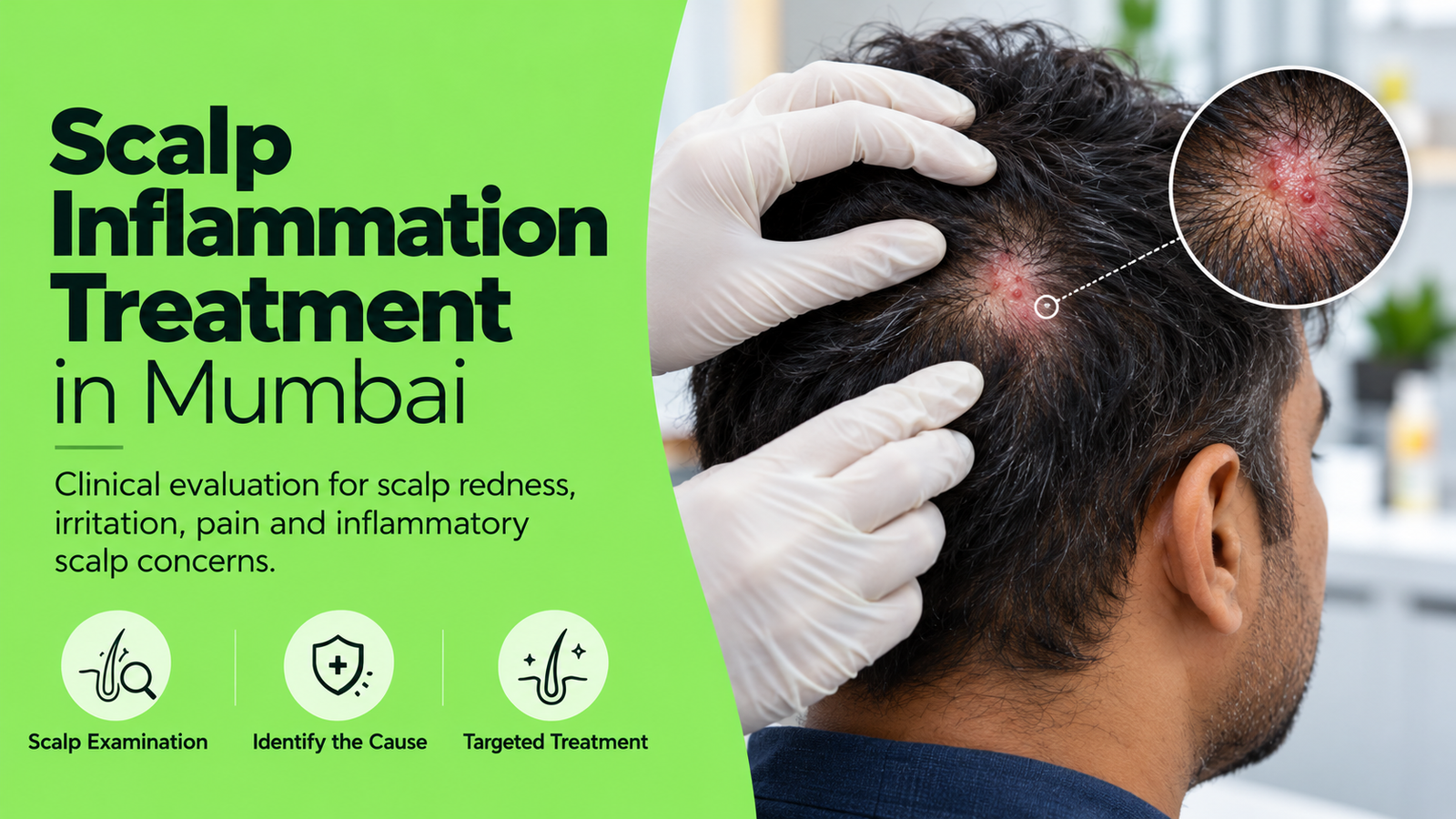
Scalp Inflammation Treatment in Mumbai — Redness, Irritation, Pain and Scalp Disorders
A scalp that remains red, itchy, tender or painful should not be treated as an ordinary hair-care problem without understanding the cause.
Inflammation can develop for several reasons, including dermatitis, infection, irritation from hair products and disorders affecting the hair follicles.
Some conditions cause temporary discomfort or shedding. Others can damage follicles if diagnosis and treatment are delayed.
The aim of scalp inflammation treatment is therefore not simply to make the redness disappear. It is to identify the underlying condition, control the disease and protect scalp and follicular health where possible.
What Is Scalp Inflammation?
Scalp inflammation occurs when the skin or structures surrounding hair follicles develop an inflammatory response.
This may result from irritation, allergy, microbial infection, immune-mediated disease or another skin disorder.
Inflammation can affect the scalp surface, the hair follicles or deeper skin structures.
It is a clinical finding rather than a single diagnosis.
Two patients may both have an itchy red scalp but require completely different treatments.
Common Symptoms of Scalp Inflammation
Symptoms can include:
- Persistent scalp redness or discolouration.
- Itching that keeps returning.
- Tenderness or pain when touching the scalp.
- Burning or stinging sensations.
- Flaking or adherent scaling.
- Small bumps or pustules around hair follicles.
- Crusting or irritated patches.
- Hair shedding or localised hair loss.
- Unusual scalp sensitivity to products.
Not every inflammatory scalp condition produces obvious redness.
On darker skin, inflammation may appear as subtle brown, purple or pink colour changes, and sometimes visible scale or tenderness is more noticeable than colour change.
The severity of discomfort does not always reflect the seriousness of the underlying disease.
What Causes Scalp Inflammation?
Several conditions may produce scalp inflammation.
Seborrheic Dermatitis
Seborrheic dermatitis can cause recurring scaling, itching and visible skin inflammation.
Patients may notice greasy flakes and periods of improvement followed by recurrence.
When this is the diagnosis, the relevant next step is seborrheic dermatitis management, including suitable treatment and ongoing care.
Scalp Psoriasis
Psoriasis can produce inflamed, scaly plaques on the scalp.
Some patients experience thick scale, itching or discomfort. Treatment needs to address the inflammatory condition rather than merely removing visible flakes.
Contact Dermatitis
Hair dyes, fragrances, shampoos, styling products and other substances may trigger irritant or allergic contact dermatitis.
Symptoms may arise after introducing a new product, although an allergic reaction can also occur to something previously tolerated.
Scalp Folliculitis
Folliculitis involves inflammation of hair follicles.
It may produce small tender or itchy bumps, sometimes with pustules or crusting.
The cause can vary, so treatment should not be selected solely from the appearance of the bumps.
Fungal Scalp Infection
Certain fungal infections, including tinea capitis, can produce scaling, broken hairs and localised hair loss.
These infections need condition-specific treatment and should not be managed as ordinary dandruff or cosmetic buildup.
Inflammatory Hair-Follicle Disorders
Some immune-mediated inflammatory scalp conditions can progressively damage follicles and cause scarring alopecia.
Such conditions require timely dermatologist assessment because delayed diagnosis may allow irreversible hair loss.
Why Proper Diagnosis Is Important
Scalp inflammation should not be treated with a random combination of shampoos, steroid lotions, oils and hair-growth serums.
Different underlying conditions require different approaches.
For example, an inflammatory reaction to hair dye may improve by identifying and avoiding the responsible ingredient, whereas a fungal scalp infection requires appropriate antifungal management.
An immune-mediated disorder affecting hair follicles may need prompt specialist treatment to reduce the risk of permanent damage.
Applying unsuitable products or delaying diagnosis can worsen symptoms or obscure the clinical picture.
The goal is to identify the cause before selecting treatment.
How Is an Inflamed Scalp Examined?
A scalp assessment begins with a detailed history and examination.
The clinician may ask when the symptoms started, whether new products were used and whether itching, pain or hair loss is progressing.
The examination may assess:
- Distribution of redness or scale.
- Hair density and pattern of shedding.
- Presence of pustules or crusts.
- Hair breakage.
- Condition of follicular openings.
- Evidence of infection or scarring.
- Involvement of other skin areas.
Magnification or trichoscopy may be useful for examining follicular and scalp-surface features.
Depending on the clinical findings, the dermatologist may recommend tests such as fungal examination, microbial sampling, relevant blood investigations or a scalp biopsy.
Not every patient needs all these tests. Investigations should be selected based on the suspected diagnosis.
How Is Scalp Inflammation Treated?
Treatment depends on the diagnosis rather than the presence of redness alone.
Managing Infection
When bacterial or fungal infection is diagnosed, appropriate medical treatment may be necessary.
The choice of treatment should depend on the suspected or confirmed organism, severity and relevant patient factors.
Reducing Inflammatory Activity
Inflammatory disorders may require doctor-directed topical or other medicines.
The treatment selected for seborrheic dermatitis is not necessarily suitable for psoriasis or inflammatory scarring alopecia.
Removing Irritating Triggers
If an allergic or irritant reaction is suspected, identifying and avoiding triggering products may form an important part of management.
Supporting the Scalp Barrier
Gentle cleansing and avoiding unnecessary chemical or mechanical irritation can help reduce additional discomfort.
Monitoring Hair Follicles
When inflammation occurs alongside hair shedding, the clinician should assess whether follicles are temporarily affected or at risk of permanent injury.
Follow-Up and Reassessment
Persistent or worsening symptoms may require a revised diagnosis, additional investigations or referral to an appropriate specialist.
Can Scalp Inflammation Lead to Hair Loss?
Yes, some inflammatory scalp disorders can be associated with hair shedding or hair loss.
However, the mechanism and long-term consequences depend on the underlying condition.
Temporary inflammatory shedding may improve when the cause is effectively managed.
Other conditions can produce scarring alopecia, in which damaged hair follicles are permanently lost.
Possible warning signs of follicular damage include progressive patchy hair loss, persistent tenderness or burning, and areas where normal follicular openings appear reduced or absent.
These findings should prompt dermatologist evaluation rather than reliance on cosmetic scalp treatments.
Treating the underlying inflammation early is particularly important when a scarring process is suspected.
When Should You Seek Medical Attention Promptly?
Certain symptoms require more urgent assessment than routine dandruff or scalp-care concerns.
Seek prompt medical evaluation for:
- Rapidly developing patches of hair loss.
- Persistent scalp pain or burning with progressive thinning.
- Pus, spreading redness or worsening crusting.
- Significant swelling or a painful lump.
- Broken hairs associated with inflamed or scaly patches.
- Smooth, scarred-looking areas where follicles seem absent.
- Persistent symptoms that do not respond to appropriate initial care.
Fever combined with spreading scalp redness, significant tenderness or swelling warrants urgent same-day medical assessment.
Progressive hair loss with possible scarring features warrants an early dermatologist appointment because follicular damage may be irreversible.
Should You Undergo Hair-Growth Treatment With an Inflamed Scalp?
The condition of the scalp should be considered before elective hair-growth procedures.
Active infection or significant inflammation may make treatments such as scalp microneedling inappropriate until the underlying problem has been assessed and managed.
Similarly, patients considering injectable therapies or hair transplantation may require treatment of active scalp disease before proceeding.
Some medical hair-loss conditions also require prescription management independent of procedural treatment.
A medical hair loss prescription may be relevant when scalp disease and hair shedding occur together, but the medication plan should follow diagnosis.
Can Scalp Detox or Dandruff Shampoo Reduce Inflammation?
Gentle cleansing may improve comfort when excess residue contributes to irritation.
Medicated anti-dandruff shampoos may help certain inflammatory conditions, including seborrheic dermatitis.
However, these approaches are not appropriate substitutes for diagnosing folliculitis, psoriasis, fungal infections or possible scarring alopecia.
The correct treatment depends on the cause.
How Long Does Scalp Inflammation Take to Improve?
Recovery varies widely.
An irritant reaction may improve after the triggering product is stopped, while chronic inflammatory skin conditions may require ongoing treatment.
Infections and immune-mediated disorders follow different treatment courses.
Patients should not expect a universal recovery timeline.
If symptoms persist, worsen or are accompanied by progressive hair loss, reassessment is important.
Scalp Inflammation Treatment Cost in Mumbai
The cost depends on whether the patient needs consultation alone, prescription treatment, diagnostic investigations or specialist evaluation.
A simple inflammatory reaction may need a different level of investigation from a patient with pustules, persistent pain or suspected scarring alopecia.
It is more useful to establish the diagnosis and necessary treatment than to purchase a generic scalp-treatment package without evaluation.
Frequently Asked Questions
Why is my scalp red and itchy?
Possible causes include dermatitis, contact irritation, psoriasis, folliculitis and infection. Diagnosis depends on the history and examination.
Can scalp inflammation cause permanent hair loss?
Some inflammatory disorders can permanently damage hair follicles. Others cause temporary symptoms or shedding. Early assessment matters when scarring hair loss is suspected.
Can I use anti-dandruff shampoo for scalp inflammation?
Some conditions respond to medicated shampoo, but others require different treatment. Persistent or unusual symptoms should be assessed.
Is scalp inflammation contagious?
Inflammation itself is not necessarily contagious. However, certain infections that cause scalp inflammation can spread between people.
Should I stop hair-growth products if my scalp burns?
If a product causes significant burning, rash or irritation, stop applying the suspected product and seek advice from the treating clinician. Do not continue using an irritating product simply to complete a treatment course.
Can I undergo microneedling while my scalp is inflamed?
Elective microneedling is generally inappropriate over active infection or significant inflammation until the condition has been evaluated and managed.
Which doctor should I consult for persistent scalp inflammation?
A dermatologist is an appropriate specialist for investigating persistent inflammatory scalp disorders, especially when pain, pustules or progressive hair loss is present.
Get the Cause of Your Scalp Inflammation Evaluated
Persistent scalp inflammation requires more than temporary symptom relief.
A clinical assessment can help determine whether the problem is ordinary irritation, a recurring inflammatory disorder, infection or a condition that may threaten hair-follicle health.
For information about scalp assessment and appropriate specialist evaluation, contact Anagen Hair Transplant Clinic in Mumbai.