





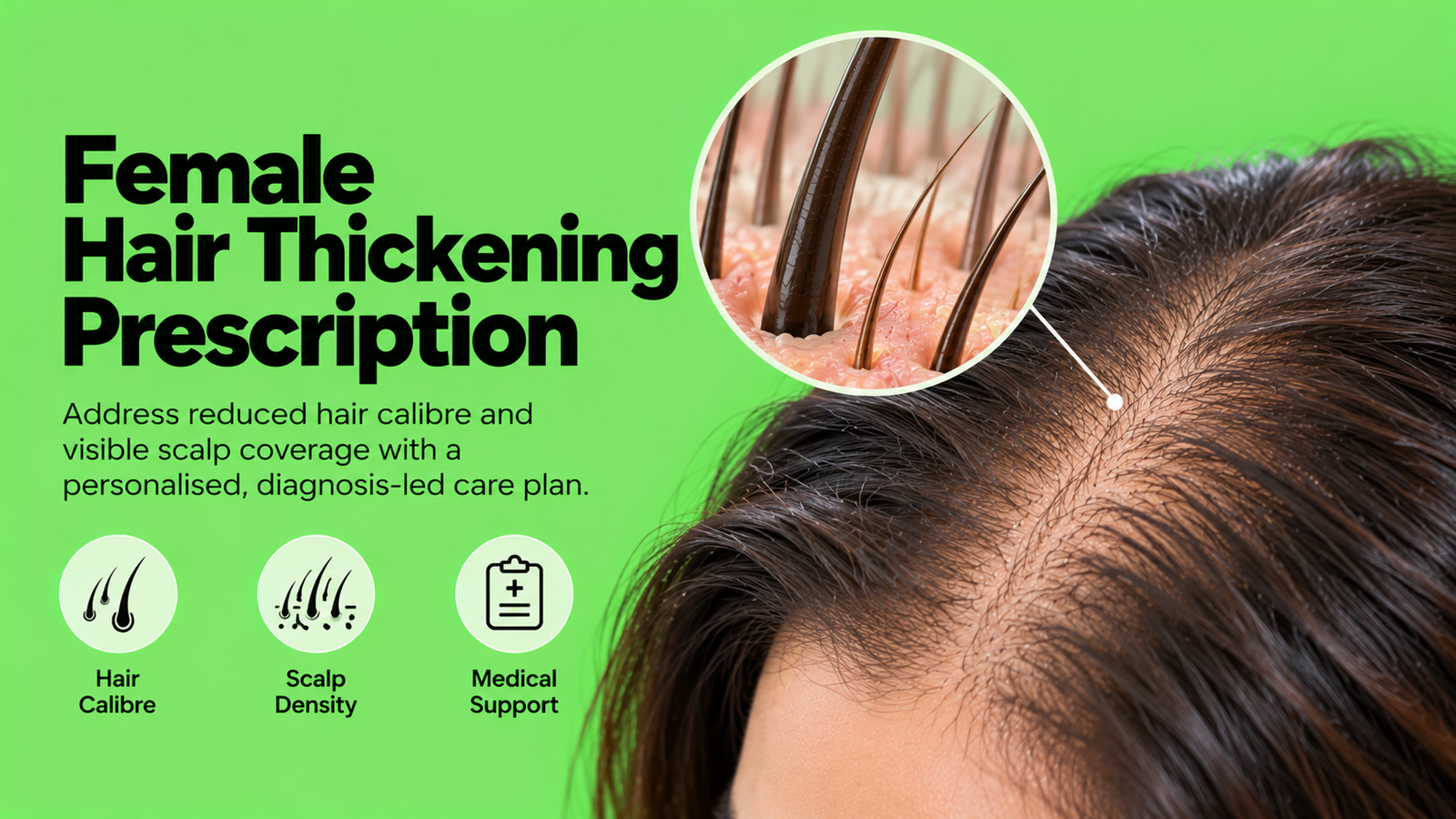
Female Hair Thickening Prescription
Has your hair become progressively finer, flatter or less voluminous even though hair is still present across most of your scalp?
Reduced hair thickness can change the appearance of density without producing completely bald areas. In some women, the problem is follicular miniaturisation; in others, excessive shedding, shaft breakage or changes in hair quality may be contributing.
A Female Hair Thickening Prescription focuses on understanding why existing hair has become finer and whether medically appropriate treatment can improve its calibre, retention or visible coverage.
At Anagen Hair Transplant Clinic, Mumbai, thickening management begins with evaluating the hair shaft and scalp rather than automatically prescribing hair-growth products.
What Does Hair Thickening Actually Mean?
Hair thickening can refer to several different changes:
- Increased diameter of an individual hair shaft.
- Improved coverage from responsive, previously miniaturised follicles.
- Reduced breakage and better retention of existing hair.
- Improved cosmetic appearance through appropriate hair-care practices.
These outcomes are not equivalent.
A woman may have many follicles producing fine hairs, while another may have fewer active follicles in the same area. Both may report reduced volume, but their treatment needs can be different.
Hair thickening does not create new follicles. Prescription treatment may improve the activity or output of some existing follicles, but it cannot reliably regenerate follicles that are permanently absent.
Why Does Female Hair Become Finer?
Hair-shaft calibre varies naturally and can also be affected by medical or structural changes.
In female pattern hair loss, susceptible follicles may gradually produce smaller-diameter hairs. In other circumstances, newly growing hairs after an episode of shedding may initially be shorter and contribute less visual volume.
Breakage from repeated heat styling, chemical processing, traction or friction can reduce perceived fullness even without follicular miniaturisation.
A clinician must distinguish these processes before choosing treatment.
How Does the Doctor Assess Hair Thickness?
A female hair-thickening assessment may consider the distribution of fine hair, progression, part width, family history, previous treatments and relevant medical history.
Trichoscopy can help identify variation in hair-shaft diameters, follicular miniaturisation and changes in follicular-unit composition.
Examination may also distinguish short new hairs from broken shafts and look for inflammation, scale or signs of scarring.
The doctor may compare central, frontal and occipital scalp regions rather than relying on one photograph.
Investigations are reserved for situations where the history or examination suggests a relevant medical, nutritional or hormonal contributor.
Prescription Overview
Primary Concern: Fine hair shafts, reduced volume and lower visible coverage despite remaining scalp hair.
Assessment Focus: Hair calibre, miniaturisation, follicular density, breakage and scalp health.
Possible Contributing Factors: Female pattern thinning, overlapping telogen effluvium, hair-shaft damage, scalp disorders or relevant medical conditions.
Prescription Goal: Preserve existing hair and improve calibre or visible fullness where responsive follicles remain.
Possible Prescription Categories: Diagnosis-specific topical therapy, selected oral medication, management of confirmed contributing conditions and scalp-directed treatment.
Supportive Care: Conditioning, reduced heat and traction, careful handling and treatment of scalp irritation where indicated.
Monitoring: Calibre changes, part width, density, hair breakage and medication tolerance.
Follow-Up: According to diagnosis, selected treatment and clinical response.
Pregnancy / Breastfeeding Considerations: Hair-thickening medicines require the same reproductive-safety review as other hair-loss medications.
When Further Investigation May Be Needed: Sudden loss of volume, significant shedding, systemic symptoms, patchy loss or scalp inflammation.
When Another Treatment May Be Considered: Selected procedural support or surgical assessment for stable structural density loss.
This page provides general prescription information and does not replace an individual clinical assessment. Treatment should be selected according to the diagnosis, medical history, reproductive status where relevant, examination and treatment goals.
Hair Thickening Versus Hair Density
Hair calibre and hair density work together to determine visible scalp coverage.
A relatively high number of thin hairs may provide limited coverage. Conversely, thick terminal hairs can create greater visible fullness even when the number of hairs is not unusually high.
A prescription aimed at follicular miniaturisation may help selected women maintain or improve shaft diameter. A hair-care plan aimed at breakage can improve retention and appearance without changing follicular density.
These differences explain why hair-thickening management should not simply copy a general hair-growth prescription.
What May Be Included in a Female Hair Thickening Prescription?
Treatment for Follicular Miniaturisation
If miniaturisation is diagnosed, an appropriate hair-growth treatment may help selected follicles produce better hair coverage over time.
Topical minoxidil is one established option for female pattern hair loss. Selected systemic treatments may be considered following individual medical assessment, but they are not routine cosmetic thickening medicines.
The choice depends on diagnosis, tolerance, medical risks and reproductive status.
Correction of Confirmed Contributors
When reduced volume reflects diffuse shedding or an underlying medical condition, treatment should address that diagnosis.
For example, investigating a relevant nutritional deficiency or endocrine concern may be appropriate when clinical findings support it. A generic prescription for “weak hair” is not a substitute for diagnosis.
Hair-Shaft Protection
Conditioning, reduced chemical processing, less thermal damage and avoiding traction can improve the appearance and survival of existing shafts.
Cosmetic products may make hair feel fuller temporarily, but that effect should not be presented as reversal of follicular miniaturisation.
Scalp Treatment Where Necessary
Inflammatory or other scalp conditions may require specific medical treatment. Treating the scalp can improve the environment for hair care and reduce associated symptoms, but will not necessarily reverse an unrelated pattern-loss process.
Female-Specific Prescription Safety
Hair-thickening treatment may involve medications with systemic or reproductive risks. Pregnancy, pregnancy planning and breastfeeding must be reviewed when relevant.
Medication selection should also consider medical conditions, potential side effects and possible interactions.
Patients should not use prescription oral hair-loss medicines simply to obtain cosmetically thicker hair without establishing the reason for thinning.
Monitoring Hair Calibre and Visual Density
Useful follow-up measures may include standardised part-width photographs, clinical scalp examination and trichoscopy where indicated.
Monitoring should consider the pattern of thinning, shaft-calibre variation, treatment adherence and adverse effects. Short-term styling changes should not be mistaken for biological improvement.
Improvement in miniaturised hair may require ongoing treatment to maintain. Where breakage is responsible, protective care may be a more important long-term measure.
Can PRP, GFC or Hair Transplantation Improve Density?
Women with an appropriate diagnosis may discuss supportive treatments such as PRP Hair Treatment and Advanced GFC Hair Treatment.
These procedures have different evidence bases, and their suitability and likely benefit should be explained without promising increased hair thickness.
When low coverage results from stable structural loss rather than fine but active hair, an assessment for Female Density Enhancement may be appropriate.
Transplantation redistributes follicles. It does not cure progressive hair loss and is not suitable for everyone, particularly where the donor region is diffusely miniaturised.
What Are Realistic Thickening Expectations?
Some women may experience improved hair calibre, reduced breakage or better visible coverage when the underlying condition responds to treatment.
Results vary with diagnosis, follicular health and adherence. Severe structural loss, scarring disorders and advanced miniaturisation can limit improvement.
No prescription can guarantee uniformly thick hair or permanently restore a previous level of density.
Frequently Asked Questions
1. Can naturally fine female hair become thicker?
Some medically affected follicles may respond to treatment, while genetically fine hair may remain naturally fine. Treatment must match the reason for the calibre change.
2. Is reduced volume the same as hair loss?
Not always. Reduced volume may arise from finer shafts, breakage, increased shedding or fewer active hairs.
3. What is follicular miniaturisation?
It is the progressive production of smaller-diameter, often shorter hairs by susceptible follicles. It is a key feature of pattern hair loss.
4. Can medication create new follicles?
Hair-loss medications primarily act on existing follicles. They do not reliably create new follicles in permanently bald or scarred skin.
5. Can shampoos make hair medically thicker?
Some products can temporarily improve shaft coating, manageability or apparent volume. This is different from treating follicular miniaturisation.
6. Will I need long-term maintenance?
If a chronic condition such as female pattern hair loss is responsible, continuing treatment may be needed to maintain benefits. Breakage-related problems may instead require continuing protective hair care.
7. When is hair transplantation considered?
Only in selected women with suitable donor hair, an appropriate pattern and sufficiently stable structural loss.
Get Your Hair Calibre and Density Assessed
Finer female hair can result from miniaturisation, shedding, hair-shaft damage or overlapping medical causes. A clinical assessment can determine whether your main issue is calibre, density, breakage or more than one process.
Anagen’s Hair Prescription Consultation can help establish whether medical thickening support, protective hair care, further investigation or another hair-restoration pathway is appropriate.