





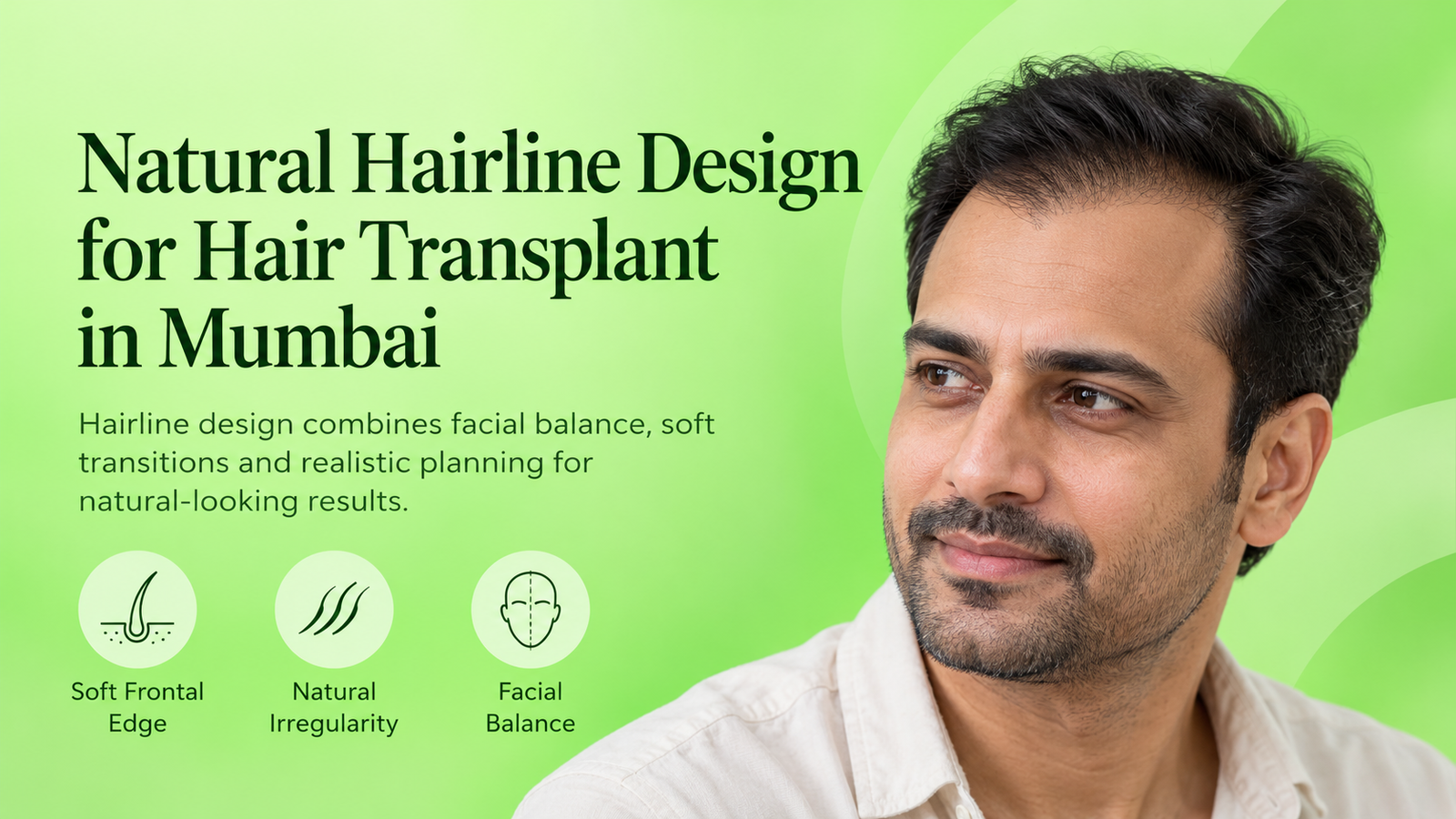
Natural Hairline Design for Hair Transplant in Mumbai
The success of a hairline transplant is not judged by density alone. A transplanted hairline must also look believable in shape, position, hair calibre, direction and the way individual hairs emerge from the scalp.
An overly straight border, thick grafts along the front or incorrect hair direction can make a transplanted hairline appear artificial, even when many follicles have grown.
Natural hairline design at Anagen Hair Transplant Clinic in Mumbai focuses on creating a soft, individualised frontal frame that complements the patient’s facial proportions and remains appropriate as he ages.
Why Is Natural Hairline Design Important?
The frontal hairline is one of the most visible boundaries between the face and scalp.
People see it during ordinary conversation, in side profiles, when the hair is wet and under different lighting conditions.
An unnaturally placed hairline may remain conspicuous despite good hair growth. Correcting poorly angled or excessively dense leading-edge grafts can also be more difficult than creating a suitable design initially.
Natural Hairline Design therefore emphasises appearance and long-term planning before graft implantation begins.
Patients who already have significant frontal recession may also need Male Hairline Restoration. This page explains the design principles used within such restoration procedures.
How Is the Hairline Shape Selected?
There is no single ideal male hairline shape.
The doctor considers forehead height, facial width, central forelock, temple points, hair calibre, curl and the existing direction of hair growth.
U-Shaped Hairline
A gentle U-shaped contour may suit some adult male facial proportions. Its curvature should remain natural rather than form a mathematically perfect semicircle.
C-Type Hairline Contour
A softer curved outline with appropriate lateral transitions may be useful in selected facial shapes and degrees of frontal recession.
Selected V-Type Hairline
A modest central projection or widow’s peak can be appropriate when it reflects the individual’s natural anatomy. A sharply pointed artificial V should not be created merely for visual novelty.
Mature Male Hairline
A more conservative hairline may retain natural frontotemporal recession. This approach can help preserve grafts and maintain facial balance over time.
The correct choice is determined by the patient’s anatomy and long-term restoration needs, not by selecting a fashionable pattern from a catalogue.
What Are Micro-Irregularity and Macro-Irregularity?
A natural hairline appears relatively organised from a distance but less uniform when viewed closely.
Micro-Irregularity
Micro-irregularity refers to tiny variations in the position and spacing of individual hairs at the leading edge.
These subtle differences help prevent the appearance of a straight line of transplanted grafts.
Macro-Irregularity
Macro-irregularity refers to broader variations in the contour, including subtle changes between the central frontal region and frontotemporal corners.
Natural asymmetry is acceptable. The objective is facial harmony, not perfect geometric symmetry.
When both scales are designed appropriately, the hairline can appear soft without looking disorganised.
Why Are Fine Single-Hair Grafts Used at the Front?
Natural frontal boundaries often contain finer individual hairs before gradually transitioning into thicker and more numerous hairs behind them.
In suitable donor regions, follicular units containing a single hair can help recreate this soft border.
Larger multi-hair units placed directly at the leading edge may appear coarse or plug-like, particularly when the patient combs the hair upwards or wears it short.
Graft selection also considers shaft thickness, curl and pigmentation. Very coarse follicles may be less appropriate for the most visible frontal edge.
How Are Hair Calibre and Density Gradually Increased?
Hair calibre is the thickness of an individual hair shaft. Density refers to the number of follicular units or hairs within a given area.
A natural-looking hairline requires both characteristics to be considered.
The foremost transition zone often benefits from fine single hairs, while the region behind can use appropriate multi-hair follicular units to increase visual density.
There should not be an abrupt change from empty forehead skin to a solid, dark wall of hair.
Graft allocation, hair shaft thickness, curl and existing hair all influence how the density gradient should be designed.
How Do Hair Direction and Exit Angle Affect Naturalness?
A transplanted follicle must be oriented so the emerging hair grows in a direction compatible with the surrounding scalp.
Across much of the frontal hairline, hairs generally emerge at relatively shallow angles rather than standing vertically.
However, direction and angulation change according to location, ethnicity, curl pattern and natural anatomy. Temple hair usually follows a different orientation from central frontal hair.
Improper angulation can make the hair difficult to style and conspicuous even when graft growth is satisfactory.
Why Is Temple Continuity Essential?
The central frontal hairline must connect naturally with the sides of the scalp.
An excessively low or dense frontal boundary combined with deeply recessed temple areas may appear disconnected.
Careful planning determines whether the existing temples should be preserved, blended or selectively reconstructed.
Temporal hair is often finer and lies flatter against the scalp. Using inappropriate graft calibre or direction can make reconstructed temple areas visibly different from surrounding hair.
What Causes an Artificial-Looking Transplanted Hairline?
An unnatural result may be associated with several design or execution problems:
- A hairline positioned too low for the patient’s face or future hair-loss pattern.
- A straight or excessively symmetrical frontal border.
- Coarse multi-hair grafts placed along the leading edge.
- Abrupt density changes without a soft transition.
- Incorrect angulation or unnatural hair direction.
- Poor continuity between the frontal scalp and temples.
- Visible pitting, cobblestoning or other recipient-site irregularities.
Patients with previously unsatisfactory hairlines may require a separate Repair Hair Transplant assessment. Some cases need staged correction rather than simply adding more grafts.
How Is Natural Hairline Design Planned Before Surgery?
The doctor evaluates the patient’s face from multiple angles and examines the existing hairline, temples, donor hair and likely progression of hair loss.
A preliminary frontal outline can be discussed with the patient. However, the final plan must remain medically and surgically appropriate rather than following an unrealistic preferred shape.
The surgeon also plans fine-hair placement, regional follicular-unit distribution and recipient-site direction.
Natural Hairline Design is therefore an essential component of suitable Male Hairline Restoration and Front Hair Transplant procedures, rather than a separate promise of guaranteed perfection.
Can a Natural Hairline Be Guaranteed?
No surgical procedure can guarantee that every graft will grow or that the final appearance will match a visual simulation exactly.
Donor-hair characteristics, surgical execution, healing, graft growth and continuing native-hair loss all influence the result.
Careful design improves the basis for a natural-looking outcome, but realistic expectations remain important.
Natural Hairline Design Results
When reviewing hairline outcomes, look beyond the total quantity of hair.
Assess the frontal outline, fine leading-edge hairs, irregularity, density transition, regional direction and relationship with the temples.
Genuine Hairline Results can help demonstrate how these features vary between patients. An individual result should be interpreted according to the patient’s starting condition and donor characteristics.
Explore natural hairline results.
Frequently Asked Questions
Which hairline shape is most natural for men?
There is no universal shape. Age, existing anatomy, facial proportions, hair type and future recession determine the appropriate contour.
Should a hairline be perfectly symmetrical?
Not necessarily. Reasonable facial balance matters more than mechanical symmetry.
Why are single-hair grafts preferred in the first row?
They can produce a softer transition when their calibre and direction are appropriate.
Can a low hairline look unnatural later?
Yes. An excessively low juvenile design may become disproportionate as a man ages or loses more native hair.
Can hairline irregularity be overdone?
Yes. Deliberate irregularity must remain subtle and organised within a believable overall contour.
Can a badly designed transplant be repaired?
Some defects can be improved, but corrective surgery is often more complex than a first procedure and depends on tissue condition and remaining donor supply.
Design Your Hairline With Anagen
A natural hairline should be planned around your individual facial structure and long-term donor resources.
If you are considering a hair transplant, send clear FRONT, BOTH TEMPLES, SIDE PROFILE, TOP and BACK DONOR photographs.
Anagen can assess your hairline shape, position, existing hair and donor characteristics before recommending an appropriate restoration plan.
ANAGEN Hair Transplant Clinic — Andheri West, Mumbai
Call / WhatsApp: +91 92222 22407