





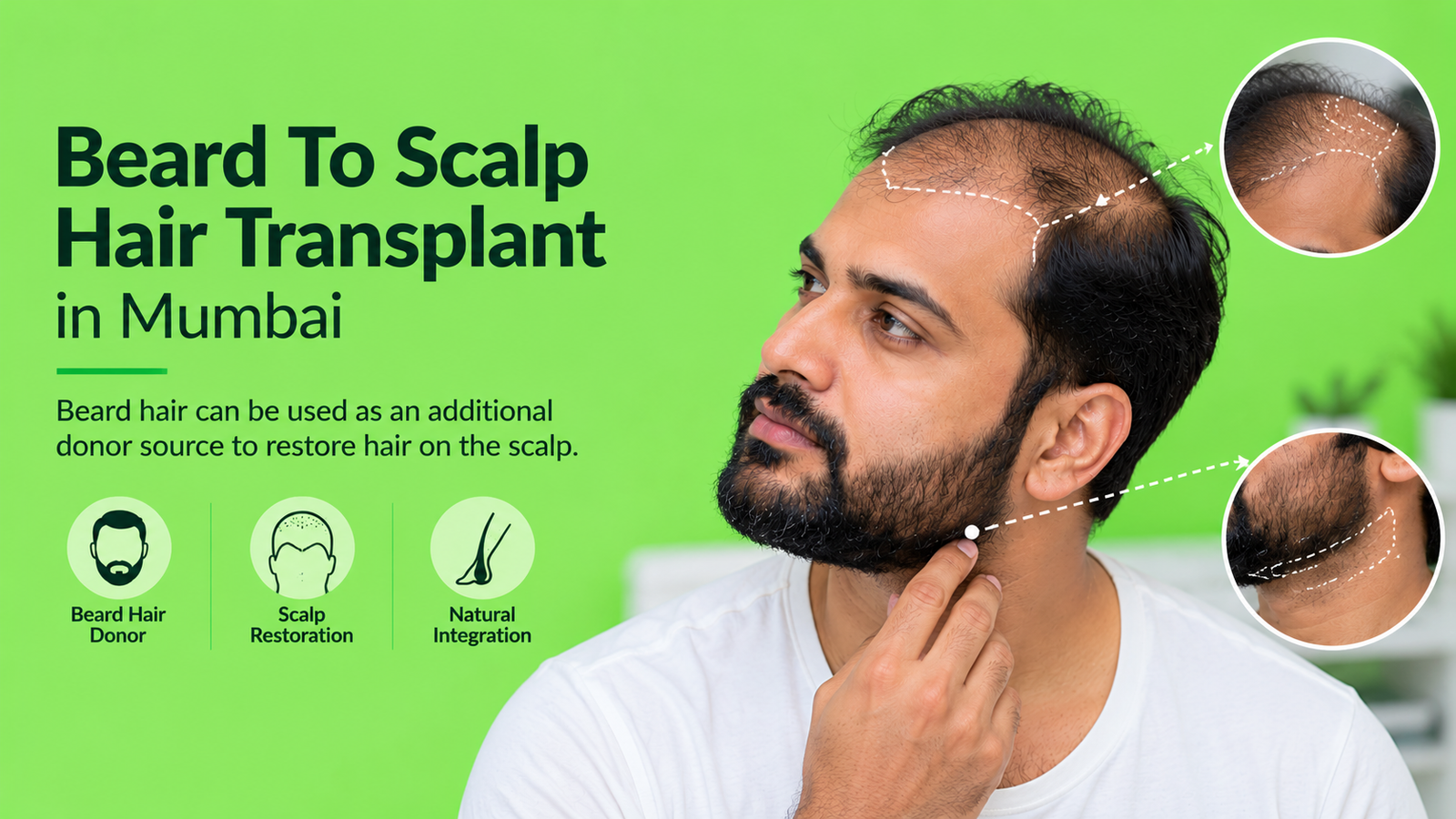
Beard To Scalp Hair Transplant in Mumbai
Beard hair can provide a valuable supplementary donor source in selected patients whose scalp donor supply is insufficient for their restoration goals.
Its potential advantage is not that beard hair is identical to scalp hair.
In fact, beard follicles are often noticeably thicker and coarser.
The value comes from using that calibre strategically—usually in areas where additional visual bulk can help—while preserving finer scalp follicles for locations where softness and natural blending are more important.
Why Can Beard Hair Be Useful for Scalp Restoration?
In selected patients, beard follicles may provide additional donor resources when scalp donor hair is restricted.
Beard hair is often:
- thicker than scalp hair
- visually robust
- different in texture
- relatively coarse
- useful for adding bulk when blended correctly
These differences are the reason beard grafts require a deliberate placement strategy.
Where Is Beard Donor Hair Usually Assessed?
The usable donor pattern differs between patients.
The clinician assesses facial-hair density, calibre, skin characteristics and which areas can be harvested without creating unwanted visible patchiness.
No fixed number of beard grafts should be promised before examining the patient.
Beard Hair vs Scalp Hair
Beard and scalp follicles should not be treated as interchangeable.
Beard hair may have a greater shaft diameter and different curl or texture.
That can provide useful visual coverage—but can also make it conspicuous if positioned badly.
Fine scalp hairs therefore remain particularly valuable around the frontal transition.
Where Can Beard Grafts Be Used on the Scalp?
Immediately Behind the Frontal Transition
Beard follicles can sometimes be blended behind fine scalp hairs to increase visual bulk without making the leading edge excessively coarse.
Mid-Scalp
The mid-scalp can be an important recipient region when additional coverage is required.
Crown
Selected beard grafts may contribute to crown restoration, but the crown’s large surface area can consume substantial donor resources.
The decision should therefore fit the patient’s overall donor strategy.
Why Very Coarse Beard Hair Should Not Dominate the First Hairline Rows
A natural frontal hairline is not a thick straight wall of hair.
It should transition gradually from the forehead into greater density.
Fine single scalp hairs are especially useful for this transition.
Putting visibly coarse beard follicles directly across the first row can make the hairline look harsh.
For more detail about frontal design, see Anagen’s Creative Hairline Design page.
How Is Beard To Scalp Hair Transplant Performed?
Step 1: Scalp Hair-Loss Assessment
Recipient areas and restoration priorities are established.
Step 2: Scalp Donor Assessment
Available conventional scalp donor hair is measured first.
Step 3: Beard Donor Assessment
Beard calibre, density and donor visibility are evaluated.
Step 4: Scalp–Beard Combination Planning
The clinician decides where scalp and beard grafts may each provide the best cosmetic value.
Step 5: Recipient-Zone Mapping
The hairline, frontal core, mid-scalp and crown are considered separately.
Step 6: Local Anaesthesia
Donor and recipient areas are numbed.
Step 7: Beard FUE Extraction
Individual follicular units are harvested according to the local exit angle and beard anatomy.
Step 8: Graft Inspection and Sorting
Beard grafts remain identifiable so they are not accidentally used in areas requiring finer follicles.
Step 9: Scalp Implantation
The selected grafts are placed according to planned angle, direction and distribution.
Step 10: Post-Procedure Care
Both facial donor and scalp recipient sites are monitored during healing.
Will Beard Extraction Be Visible?
FUE creates individual extraction sites rather than a long linear incision.
That does not mean the donor area is scar-free.
Healing pattern, skin response, extraction distribution, follicle density and grooming length can affect visibility.
Responsible harvesting should avoid concentrating extraction excessively in one small area.
How Will Beard Hair Grow on the Scalp?
Transplanted beard follicles generally retain important characteristics of their donor origin.
They do not simply convert into scalp follicles.
Growth length, calibre, curl and visual behaviour can therefore differ from surrounding scalp hair.
Strategic blending is essential.
Beard To Scalp Results
Beard grafts may contribute useful visual density when appropriately blended with scalp hair.
Their coarser characteristics mean placement strategy is particularly important around the frontal hairline.
The final appearance depends on:
- remaining scalp hair
- beard calibre
- scalp–beard blending
- recipient surface area
- growth of transplanted grafts
- progressive native hair loss
Original clinical results belong in Anagen’s Results section.
Limitations
Beard hair is not a universal solution for weak scalp donor supply.
Limitations can include:
- unsuitable beard density
- very coarse texture
- colour mismatch
- donor visibility
- extraction marks
- limited total useful follicles
- need for staged procedures
- inability to reproduce fine frontal softness with beard grafts alone
Cost of Beard To Scalp Hair Transplant
Cost depends on the complete surgical plan rather than the beard graft count alone.
Factors can include:
- scalp graft requirement
- beard graft requirement
- beard extraction complexity
- number of recipient zones
- previous transplantation
- repair requirements
- need for multiple donor sources
- one-stage versus staged surgery
Frequently Asked Questions
Is beard hair permanent after transplantation to the scalp?
Suitable transplanted follicles may provide long-term growth, but individual growth and future scalp hair loss vary.
Does beard hair become softer after being transplanted?
Do not assume that it will become identical to native scalp hair. Donor-origin characteristics remain important.
Does beard extraction leave marks?
FUE produces individual extraction sites and can leave small scars or pigmentary changes. Visibility varies.
How many beard grafts can be taken?
There is no responsible universal number. Density, distribution, skin characteristics and cosmetic donor impact need examination.
Can I use only beard hair for my scalp?
That is not automatically advisable. Scalp hair generally remains the preferred donor source where available.
Beard To Scalp Hair Transplant Consultation in Mumbai
A beard-to-scalp assessment should determine:
- remaining scalp donor capacity
- beard density and calibre
- which beard regions can be harvested responsibly
- where beard grafts could be blended
- which areas still require scalp follicles
- whether the proposed coverage is realistic
Send clear front, top, back/donor and beard photographs for an initial assessment.
Use Anagen’s Contact page for formal evaluation.