



Beard Density Enhancement in Mumbai
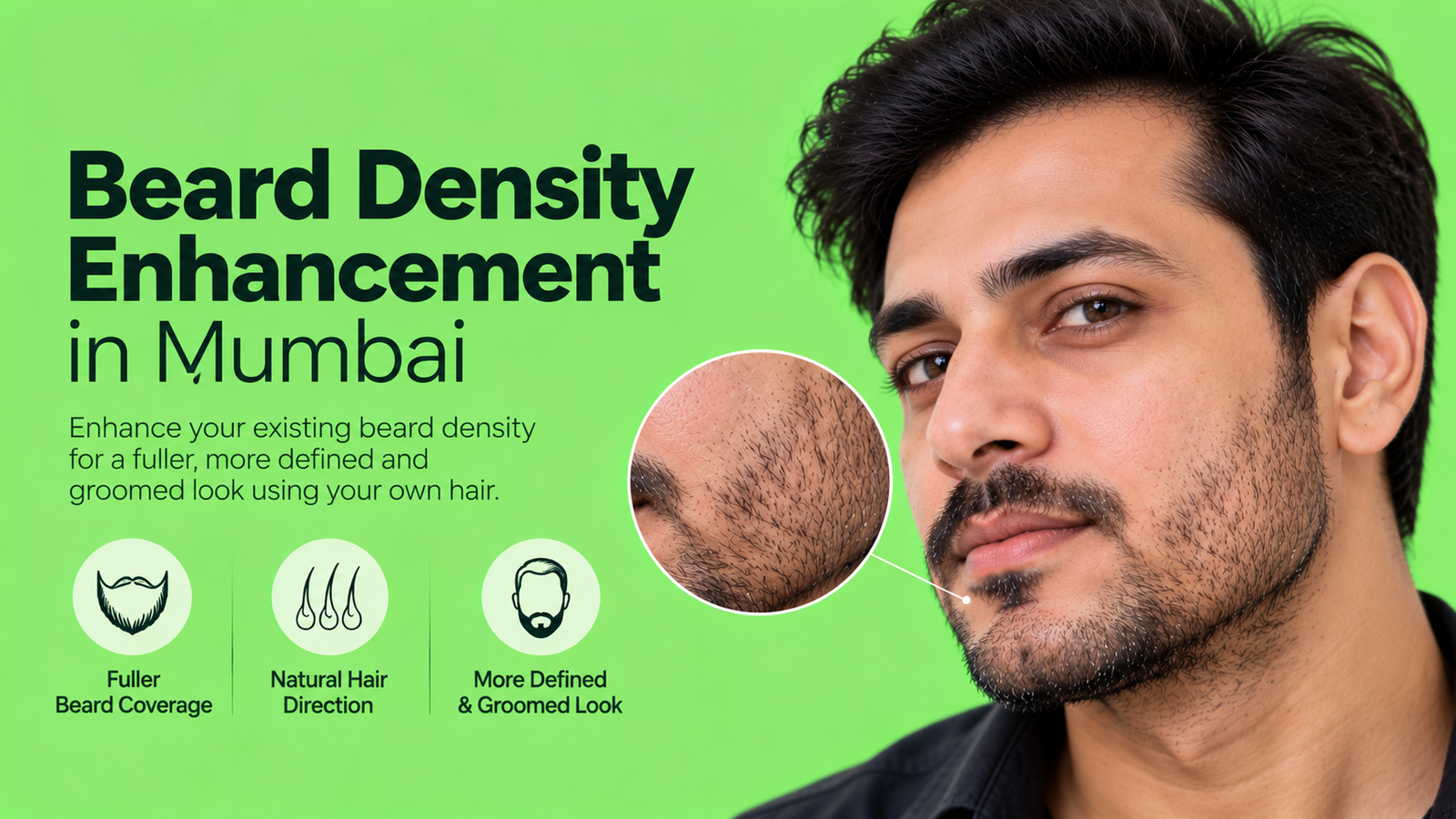
Beard density enhancement is for people who already have a recognisable beard but feel that it lacks the fullness they want. It differs from filling a clearly defined empty patch or constructing a beard across several nearly hairless facial regions.
The central question is not simply “How many grafts can be added?” It is where additional hair would create a worthwhile visual difference without disturbing the existing pattern, exhausting donor reserves or producing an unnaturally thick border.
What Is Beard Density Enhancement?
The clinician maps areas where hair is present but relatively widely spaced. Suitable donor follicular units may then be placed strategically among existing hairs to increase apparent fullness. The design follows your own growth direction and beard outline rather than replacing them.
Some men are concerned mainly about the upper cheeks; others notice thinner lower cheeks or difficulty connecting an otherwise satisfactory beard to the jawline. If only one small empty patch is visible, read about Patchy Beard Correction instead. If the cheeks are the primary problem, Cheek Beard Restoration provides region-specific information.
Do You Actually Need More Grafts?
Not always. A short beard can look thinner because fine shafts expose more skin, while a slightly longer, carefully shaped beard may appear fuller. Your desired style, beard hair calibre, pattern of coverage and whether facial growth is still maturing should be considered before surgery.
Recent change in density, itching, inflammation, scaling or a new hairless area needs evaluation for an underlying condition. Medication-based approaches are diagnosis-specific; no prescription reliably creates absent follicles in every person. A Beard Growth Prescription or dermatology consultation may therefore be a better initial step for selected patients.
How Is Existing Beard Density Measured and Planned?
The surgeon examines how close together your native hairs grow, identifies the regions you want fuller and checks how density varies naturally between cheeks, jawline, sideburns and chin. The plan should reflect the hairstyle you actually wear. If the aim is short stubble, misplaced upright hairs will be more noticeable than when surrounding hair is longer.
An effective density plan is rarely uniform. It may prioritise visibly sparse central areas and maintain softer transitions at upper cheek borders. The surgeon must also avoid disrupting native follicles with unnecessary recipient sites.
Can Transplanted Hair Match Your Existing Beard?
Matching matters more than raw follicle count. Donor hairs differ in thickness, curl, pigmentation and growth rate. Scalp follicles are often considered, but they may retain scalp-like characteristics on the face and may need frequent trimming. The donor area must also be preserved for possible future needs.
Graft selection can vary across the face. Finer or appropriate single-hair units may suit some visible transitions, while the surgeon can consider other follicular-unit characteristics where surrounding native hairs allow it. The exact choice depends on the individual rather than one rule for every beard.
How Many Grafts Are Needed for Better Fullness?
It depends on the number and size of weak areas, existing hairs per region, hair calibre, desired length and donor supply. A patient with generally thin cheeks has different needs from someone whose only concern is one short jawline connection. The clinician should explain which zones have been prioritised and why complete maximum-density packing would be unwise.
A smaller, strategically placed first procedure may sometimes be preferable to attempting maximal density immediately. A later procedure is considered only after growth can be assessed and the donor remains adequate.
How Is Beard Density Enhancement Performed?
Step 1: Examine the Native Beard
The clinician checks density, direction, follicular pattern and the condition of facial skin, including any new or active hair loss.
Step 2: Identify High-Value Enhancement Zones
The regions where added coverage may improve the chosen hairstyle are marked without redesigning the entire beard unnecessarily.
Step 3: Assess and Select Donor Hair
Suitable follicular units are selected based on availability and their potential visual match to native facial hairs.
Step 4: Provide Local Anaesthesia
The planned donor and facial treatment areas are numbed. Your team explains comfort measures and monitors you during surgery.
Step 5: Extract Follicular Units by FUE
Selected grafts are individually harvested, with attention to donor distribution and preservation.
Step 6: Sort Grafts and Plan Recipient Sites
The surgeon matches graft types to treatment zones and prepares direction-conscious sites around existing follicles.
Step 7: Implant with Gradual Density Transitions
Grafts are placed selectively; abrupt changes and unnatural straight borders are avoided.
Step 8: Provide Aftercare and Growth Review
The team explains washing, graft protection, activity restrictions and the appropriate schedule for reviewing density after regrowth.
Recovery, Growth and Maintenance
Expect the possibility of temporary redness, swelling, tenderness and small crusts in treated areas. Follow all post-procedure washing, sleeping, shaving and activity advice from your own clinical team. Do not judge density during the first few weeks: transplanted shafts commonly shed, while the pre-existing beard continues its own growth.
New graft growth may begin around three to four months. The visual effect can develop over six to nine months, with a fuller assessment often around nine to twelve months or later. Some patients will notice continued variation between native and donor hair growth rates and may prefer regular trimming or selective styling.
What Are the Risks, Limits and Cost Factors?
Risks include infection, swelling, inflammation, visible donor extraction marks, native follicle injury, uneven growth, an unsuitable colour or texture match, awkward hair direction and surface irregularity. Dense placement is not inherently better; in some circumstances it may compromise aesthetic blending or exceed what the skin and donor supply can reasonably support.
Cost varies with the number of areas selected, required grafts, donor characteristics, previous procedures and procedural complexity. A written personalised assessment is more useful than a standard price quoted for the phrase “density enhancement.”
Beard Density Enhancement Results
Density enhancement aims to improve the fullness of an existing beard while preserving its natural pattern. Anagen’s beard restoration results can help explain the different types of improvement that may be possible once relevant genuine patient cases are available on the dedicated results page. Your outcome will depend on your own native density and donor characteristics.
Frequently Asked Questions
Can I enhance only the parts that look thin?
Yes, when suitable, a selectively mapped plan may improve visible weak areas without treating the entire beard.
Will I need to remove or shave my existing beard permanently?
No. The aim is to preserve native facial hair. Temporary trimming or shaving requirements depend on the technique and your surgeon’s protocol.
Why not implant the highest possible number of grafts?
The recipient skin, existing follicles, hair direction and finite donor supply all limit responsible packing. Visual density and natural transition matter more than a maximum count.
Will my beard grow exactly like it did before?
The native beard continues to grow, but transplanted donor hair may differ in growth rate or texture and require more regular grooming.
Plan a Beard Density Assessment in Mumbai
An assessment should determine whether your concern is true diffuse sparseness, a specific localised gap or a medical hair-loss condition. Share clear front and both-side photographs showing your typical beard length. For an examination and individualised discussion, contact Anagen.