





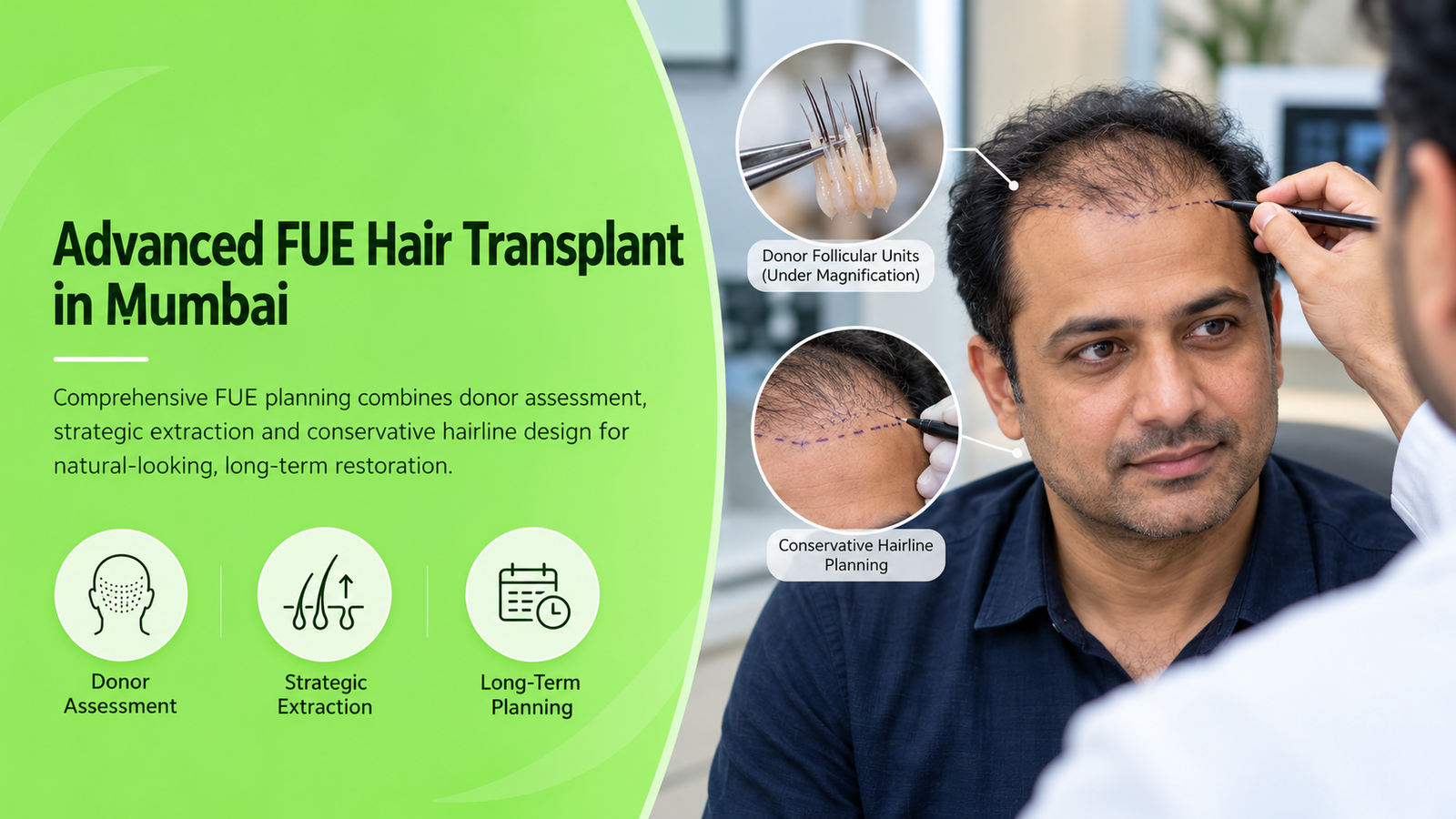
Advanced FUE Hair Transplant in Mumbai
Advanced FUE Hair Transplant refers to a detailed, individualised approach to follicular-unit hair transplantation, with particular attention to donor analysis, extraction strategy, graft quality, hairline design and long-term restoration planning.
The aim is not simply to harvest the largest possible number of grafts. It is to determine where grafts should be taken from, how they should be distributed and how the available donor reserve can support both present and future hair-restoration needs.
At Anagen Hair Transplant Clinic in Mumbai, patients considering Advanced FUE should receive an assessment that accounts for their current hair loss, existing native hair, donor characteristics and future progression.
What Is Advanced FUE Hair Transplant?
Follicular Unit Excision is a method of removing individual follicular units from a suitable donor area using small punches.
Advanced FUE is not automatically a completely different harvesting operation. It can describe a more detailed approach to planning and performing the same fundamental FUE procedure.
The clinical emphasis is on matching surgical decisions to an individual patient’s anatomy and long-term hair-loss pattern.
This may involve careful donor mapping, recognition of miniaturisation, graft selection, extraction distribution and recipient-site planning.
The label becomes meaningful only when these elements are documented as part of the actual treatment protocol.
How Is Advanced FUE Different From Basic FUE?
The difference should be explained through planning and execution, not promotional claims.
A basic description of FUE tells the patient how grafts are harvested.
An Advanced FUE assessment should also explain whether enough usable donor hair exists, which follicles can be harvested safely, where grafts are most valuable and how the design may remain natural if hair loss continues.
For example, a patient with advanced frontal and crown loss may not have enough safe donor grafts to create high density in every region.
The plan may therefore prioritise the frontal hairline and mid-scalp before considering further crown work.
This is a strategic donor-allocation decision, not a new type of follicle extraction.
Why Is Detailed Donor Mapping Important?
The donor region contains follicular units that may be suitable for transplantation. However, density and resistance to future hair loss are not identical throughout the scalp.
A detailed assessment considers hair calibre, density, follicular-unit groups, miniaturisation, previous scars and donor distribution.
Harvesting too heavily from a restricted area can produce visible thinning or patchiness.
Patients who have already undergone one or more FUE procedures may require particularly careful assessment of their remaining reserve.
An effective plan should protect donor appearance while providing adequate grafts for the recipient area.
Why Does Miniaturisation Assessment Matter?
Miniaturisation occurs when some hair follicles progressively produce finer, shorter hairs.
If a proposed donor area contains significant miniaturisation, its suitability for harvesting may be reduced.
Recipient-area miniaturisation also affects long-term planning because the surrounding natural hair may continue thinning.
A proper Advanced FUE assessment should consider these factors before committing to a graft number or designing a very low hairline.
How Is Advanced FUE Hair Transplant Performed?
Step 1: Detailed Hair Loss Evaluation
The patient’s current pattern of hair loss, progression, scalp health, medical history and aesthetic goals are assessed.
Step 2: Donor Density and Miniaturisation Assessment
The surgeon evaluates donor calibre, follicular-unit groups, density variation, miniaturisation and previous surgical changes.
Step 3: Long-Term Graft Allocation
Recipient priorities and future donor requirements are considered. The planned graft number is balanced against safe harvesting capacity.
Step 4: Hairline and Recipient-Zone Design
The hairline is designed using facial proportions, age, existing hair characteristics and expected future hair loss. Frontal, mid-scalp and crown regions are prioritised individually.
Step 5: Donor Preparation and Anaesthesia
The selected donor areas are prepared and suitable local anaesthesia is administered.
Step 6: Planned FUE Extraction
Follicular units are removed using appropriately selected punches, extraction directions and distribution patterns to minimise injury and donor depletion.
Step 7: Graft Inspection and Classification
Grafts are inspected and organised by follicular-unit characteristics so that suitable units can be allocated to the intended recipient regions.
Step 8: Recipient-Site Creation
The surgeon plans the angle, direction, depth and spacing of recipient sites, accounting for existing native hair and the natural growth pattern.
Step 9: Implantation and Distribution
Grafts are placed in accordance with the restoration plan. Single-hair units may be preferentially selected for the leading hairline, while other follicular-unit groups are distributed according to density requirements.
Step 10: Recovery and Long-Term Follow-Up
Postoperative healing is monitored. The patient receives aftercare instructions and may require continued assessment of native hair loss.
Advanced FUE for High-Grade Baldness and Revision Cases
Patients with advanced baldness may have a much larger recipient demand than the available donor reserve can support.
In these cases, the surgeon may consider staged restoration, realistic density distribution and long-term donor preservation.
Previous hair transplants introduce additional factors such as existing extraction scars, donor depletion, unnatural recipient direction or reduced scalp flexibility.
Alternative donor sources, such as selected beard or body hair, may be considered in suitable patients, but these hairs differ from scalp hair in their characteristics and should not be assumed interchangeable.
How Are Implantation Techniques Selected?
The extraction method does not determine the implantation method.
Depending on the surgical plan, the team may use pre-made recipient sites, sapphire instruments or an appropriate implanter-based approach.
A specific implantation tool should be selected for its suitability to the grafts, scalp condition and intended hair direction, rather than because it is marketed as the newest option.
Is Advanced FUE Suitable for Everyone?
Not necessarily.
The procedure remains dependent on adequate donor hair, suitable scalp conditions, realistic aesthetic goals and appropriate medical assessment.
Some patients may need to stabilise active hair loss before surgery. Others may benefit from a smaller procedure or a staged restoration plan.
Advanced planning does not overcome biological limitations or create an unlimited donor supply.
Recovery and Long-Term Results
Recovery follows the normal stages of FUE transplantation, including early skin healing, possible swelling, temporary shedding and gradual regrowth.
Final appearance depends on the grafts that grow, their hair calibre, direction, curl, distribution and the progression of any remaining native hair loss.
Long-term follow-up is particularly important when progressive hair loss may change the appearance of untreated areas.
Advanced FUE Hair Transplant Cost in Mumbai
The cost depends on the number of grafts, donor complexity, previous surgery, treatment zones, session planning and any separately selected instruments or additional procedures.
A complex case may require more assessment or surgical time. This should be clearly explained in the treatment plan rather than hidden behind a premium technique label.
View Advanced FUE Hair Transplant Results
Successful restoration depends on graft quality, surgical planning, recipient-site accuracy and individual follicular growth.
To evaluate real Anagen outcomes, view hair transplant results under the dedicated Results section.
Frequently Asked Questions
What makes FUE advanced?
The term can refer to more detailed donor evaluation, extraction planning, follicular-unit selection and long-term recipient strategy, provided these are part of the actual clinical protocol.
Is Advanced FUE a completely new operation?
No separate operation should be assumed. The core follicular-unit harvesting method remains FUE.
Is Advanced FUE suitable for Norwood Grade 6 or 7?
Selected patients may be candidates, but achievable coverage depends heavily on donor reserve and realistic expectations.
Can Advanced FUE correct a previous hair transplant?
Some revision cases may be suitable. Existing donor scars, graft availability and recipient-site problems require individual assessment.
Can Advanced FUE provide maximum density in one session?
Not automatically. Density must be balanced against donor supply, scalp characteristics and long-term planning.
Does Advanced FUE prevent future baldness?
No. Existing native hair may continue thinning and require ongoing management.
Plan Your Advanced FUE Assessment at Anagen
The consultation should establish which areas require restoration now, how many grafts can be safely harvested and what donor reserve should be preserved for the future.
At Anagen Hair Transplant Clinic, Andheri West, Mumbai, the team can review your donor quality, hairline design, previous transplant history and long-term restoration options.
Send clear FRONT, TOP and BACK donor-area photographs on WhatsApp: +91 92222 22409.