





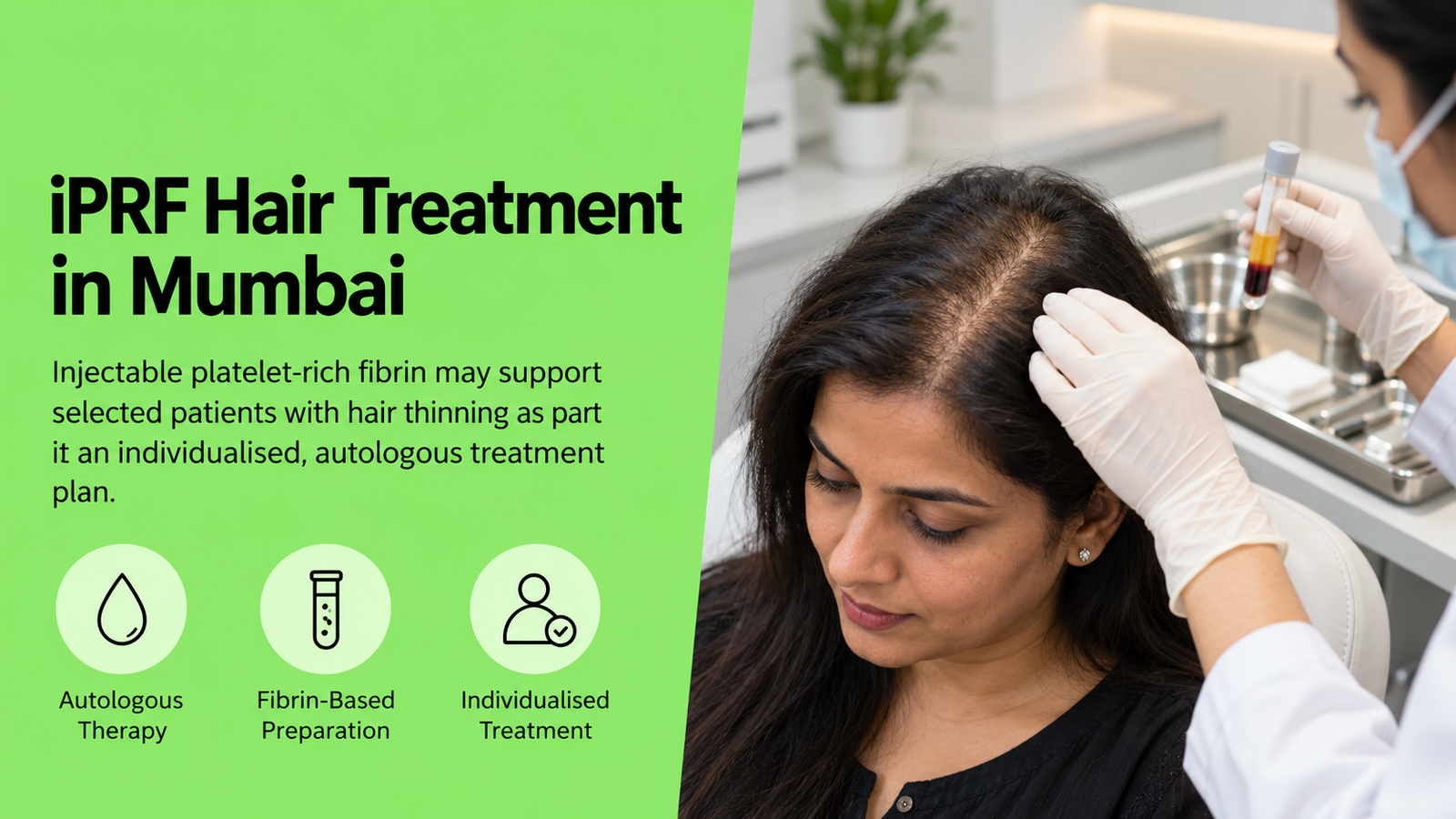
Advanced GFC Hair Treatment in Mumbai – Growth Factor Concentrate for Hair Thinning
When people compare non-surgical hair treatments, they often encounter PRP, iPRF and GFC.
All three are associated with biological preparations used in hair-restoration research and clinical practice, but their names do not describe identical products.
GFC generally refers to a growth-factor concentrate preparation. In hair-loss treatment, certain systems use blood-derived material to obtain a preparation intended to deliver biologically active components to selected scalp areas.
Advanced GFC Hair Treatment may be considered for suitable patients with thinning hair, but the exact preparation method and clinical protocol matter.
At Anagen Hair Transplant Clinic in Mumbai, suitability should be established by assessing the patient’s diagnosis, scalp condition and existing follicular activity.
How Does GFC Differ from Conventional PRP?
Conventional PRP is generally a plasma preparation containing an increased concentration of platelets relative to the source blood.
Certain GFC approaches focus on obtaining or concentrating growth-factor-containing material through additional or different processing.
The actual differences depend on the selected products and preparation systems.
A different manufacturing process does not necessarily translate into better clinical outcomes.
Comparative research has investigated PRP and growth-factor concentrate approaches, but available evidence is heterogeneous, and definitive superiority cannot be assumed.
Patients can first review the basic concept of PRP Hair Treatment before considering the differences between these treatment categories.
How May GFC Be Used in Hair-Loss Management?
Growth-factor-based hair treatment is being investigated for its potential to support follicular activity in selected hair-loss conditions.
The main area of clinical interest is pattern hair loss, where existing hair follicles gradually become smaller and produce finer hair.
Research suggests that some growth-factor concentrate approaches may improve hair-related measures in certain patients.
However, results depend on the particular preparation, underlying diagnosis, treatment course and accompanying medical care.
It is important to distinguish biological plausibility from proven individual benefit.
GFC does not create new follicles in an area where they are permanently absent.
Who May Be Suitable for Advanced GFC?
Advanced GFC may be considered for selected patients with diagnosed hair thinning and viable follicles.
Potential candidates include adults with pattern hair loss for whom a clinician considers an injectable supportive treatment appropriate.
Men with gradual frontal thinning and women with central-part thinning may have different medical needs, even when the scalp appearance seems similar.
Patient selection should include the duration and pattern of loss, medication history, scalp health and assessment of other possible causes.
If hair shedding is related to an untreated thyroid disorder, nutritional deficiency, systemic illness or another medical problem, management should address that cause.
Patients with significant blood or platelet disorders, active scalp infection, relevant bleeding risk or other contraindications require careful assessment.
What Happens During Advanced GFC Hair Treatment?
The exact treatment process depends on the verified GFC preparation system.
The following represents a general pathway for an autologous, blood-derived GFC service; it must be checked against Anagen’s actual protocol.
Step 1: Hair and Scalp Assessment
The clinician evaluates the diagnosis, degree of thinning, medical history and suitability for an injectable treatment.
Step 2: Blood Collection
If the selected system is autologous and blood-derived, an appropriate blood sample is collected using sterile medical technique.
Step 3: Preparation of the GFC Product
The blood-derived material is processed according to the validated preparation system.
The resulting formulation, processing steps and biological components depend on the actual system used.
Step 4: Scalp Preparation
The treatment area is prepared using appropriate hygiene, infection-control and comfort measures.
Step 5: GFC Administration
The verified preparation is administered to selected areas according to the treating clinician’s procedure.
Step 6: Immediate Care and Follow-Up
Patients receive aftercare instructions, and progress is reviewed according to the treatment plan.
When Can Results Be Assessed?
Any meaningful change in hair density or hair quality needs time for evaluation.
Progress may be reviewed using standardised scalp photographs, clinical examination and appropriate hair measurements.
A patient should not expect immediate restoration after one injection.
If little improvement occurs, the clinician should reassess the diagnosis and treatment strategy rather than automatically recommending additional sessions.
Does GFC Require Maintenance?
Pattern hair loss may continue progressing even after a temporary improvement from a supportive procedure.
Some patients may therefore require ongoing medical treatment or follow-up.
The role of maintenance GFC sessions is not governed by one universally established schedule.
Recovery and Possible Side Effects
If Advanced GFC is administered by scalp injection, possible temporary effects include discomfort, tenderness, redness, bruising and localised swelling.
As with other injectable procedures, infection and other complications are possible.
Risks also depend on the exact formulation and processing system.
A patient’s medical history, scalp condition and medication use should be reviewed before treatment.
GFC and Hair-Loss Prescriptions
A growth-factor treatment should not replace medical management when prescription therapy is indicated.
Patients with male or female pattern hair loss may need ongoing treatment intended to address the progressive underlying condition.
Can GFC Replace a Hair Transplant?
GFC and hair transplantation have different objectives.
GFC is considered a supportive treatment acting through existing scalp biology.
Hair transplantation transfers viable donor follicles into an area requiring hair restoration.
An extensively bald area with permanently absent follicles is not expected to respond like an area containing existing miniaturised hair.
The surgical role of GFC, where used as an adjunct, should be explained separately on the GFC-Assisted Hair Transplant page.
Advanced GFC Hair Treatment Results
The response to GFC varies between patients and depends on the underlying pattern and stage of hair loss.
Appropriate documented cases can be presented on Anagen’s dedicated GFC Results page rather than inside this treatment article.
Frequently Asked Questions
What is GFC hair treatment?
GFC generally refers to a growth-factor concentrate preparation. Its exact composition and processing depend on the system used.
Is GFC the same as PRP?
No. Some GFC systems use different processing methods, but the exact distinction depends on the specific products.
Is Advanced GFC suitable for women?
It may be considered for selected women with diagnosed hair thinning, subject to medical assessment.
Is GFC better than PRP?
A universally superior treatment has not been established. Evidence depends on the particular preparation and clinical study.
Does GFC permanently stop hair loss?
No. It should not be presented as a permanent cure for progressive pattern hair loss.
How many GFC sessions are required?
There is no single schedule for all patients. Anagen’s exact treatment protocol must be confirmed.
Discuss Advanced GFC Treatment Suitability
Before choosing between PRP, iPRF and GFC, the underlying hair-loss condition should be evaluated.
A consultation can help determine whether a supportive injectable procedure, prescription therapy or another treatment is appropriate.
For an assessment, contact Anagen Hair Transplant Clinic in Mumbai.