





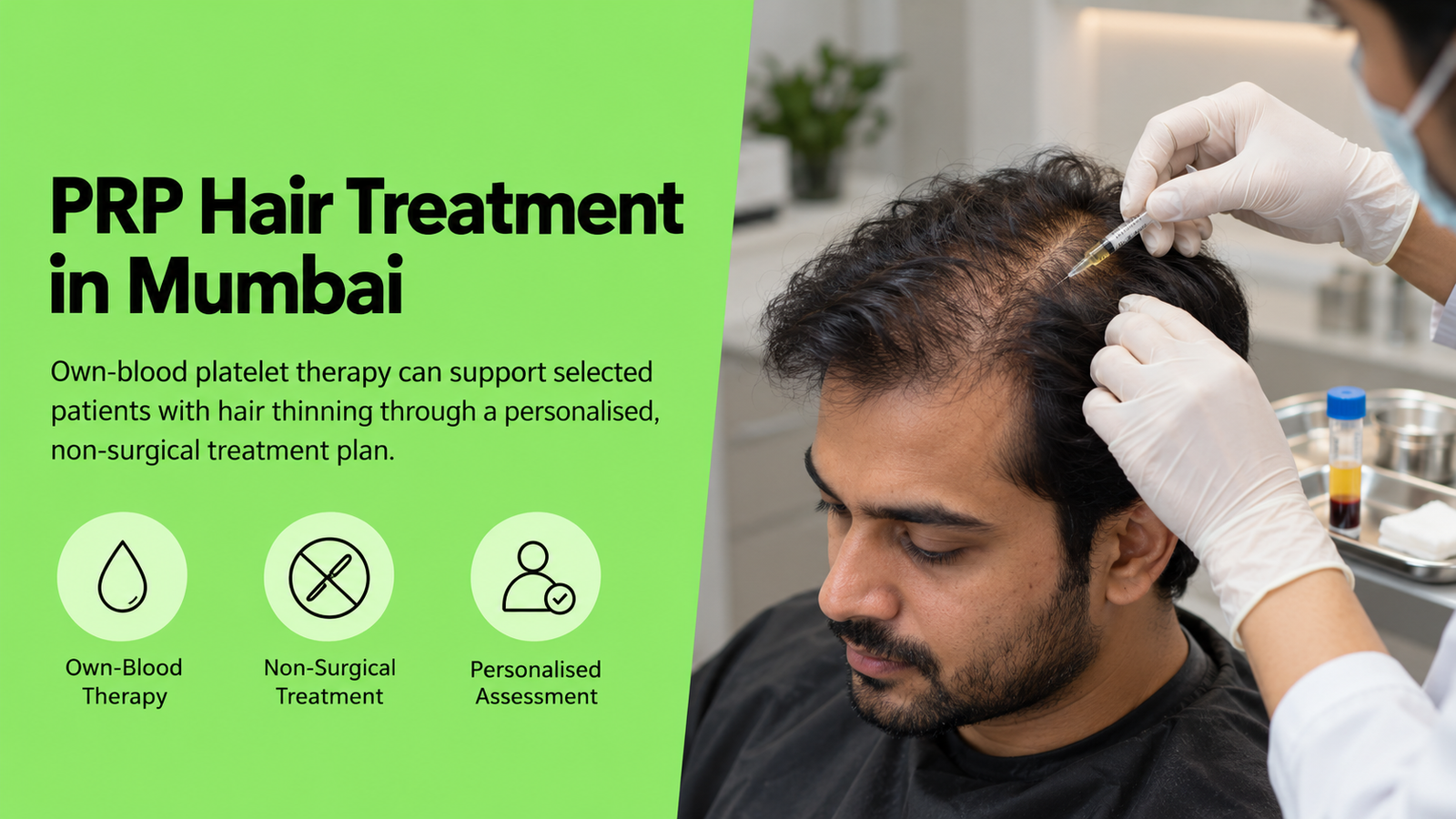
PRP Hair Treatment in Mumbai – Platelet-Rich Plasma Therapy for Hair Thinning
Hair thinning often develops gradually. A widening parting, reduced frontal density or increasing scalp visibility can occur long before an area becomes completely bald.
PRP Hair Treatment is a non-surgical procedure that uses platelet-rich plasma prepared from the patient’s own blood. It may be considered as a supportive treatment for selected forms of hair loss, particularly when functioning hair follicles remain in the thinning area.
At Anagen Hair Transplant Clinic in Mumbai, PRP treatment should be considered in the context of the patient’s hair-loss diagnosis, scalp condition, medical history and long-term treatment goals.
PRP is not a universal solution for every type of hair fall. Understanding the cause of hair thinning is essential before deciding whether the treatment is appropriate.
What Is PRP Hair Treatment?
PRP stands for Platelet-Rich Plasma.
Platelets are blood components involved in normal clotting and tissue-repair signalling. They contain biological mediators, including growth factors, that participate in several physiological processes.
PRP is prepared by taking a blood sample and separating its components using a suitable medical processing system.
The resulting platelet-enriched plasma preparation may then be administered to selected areas of the scalp.
Because the blood is collected from the same patient receiving treatment, PRP is described as an autologous procedure.
However, PRP is not one universally identical product. Its composition can vary depending on the blood-processing method, equipment and preparation protocol.
How Does PRP Work for Hair Thinning?
Researchers have investigated whether platelet-derived biological mediators can influence the environment surrounding living hair follicles.
These mediators participate in cell signalling and tissue responses that may be relevant to hair-follicle activity.
PRP has primarily been studied for androgenetic alopecia, commonly known as male or female pattern hair loss.
Some clinical studies have reported improvements in hair density following PRP treatment. However, study protocols vary, and not every patient experiences a noticeable improvement.
Importantly, PRP does not create new hair follicles in a completely bald scalp.
Its potential role is more relevant where existing follicles remain but may be producing progressively finer hair.
Who May Benefit from PRP Hair Treatment?
PRP may be discussed with selected patients who have diagnosed hair thinning and an adequate population of existing hair follicles.
Potential candidates include men with early or moderate androgenetic alopecia and women with diagnosed female pattern hair loss.
Some patients may consider PRP when seeking an additional non-surgical option alongside established medical treatment.
Suitability depends on the pattern of thinning, its duration, the health of the scalp and the patient’s expectations.
PRP should not automatically be offered to someone with recent sudden shedding, postpartum hair loss, nutritional deficiency or thyroid-related hair loss without first evaluating the underlying cause.
Those conditions may require medical assessment and treatment rather than an injectable procedure.
Who May Not Be Suitable for PRP?
Not every patient is a candidate for a blood-derived injectable procedure.
PRP may be inappropriate or require special consideration in people with certain platelet or blood disorders, significant thrombocytopenia, active infection, relevant bleeding risk or medical conditions that make the procedure unsuitable.
Patients taking anticoagulant or antiplatelet medicines require individual medical assessment. These medications should never be stopped without instructions from the prescribing doctor.
Active scalp infection or uncontrolled inflammatory disease should also be evaluated before elective injections.
Pregnancy, serious systemic illness and other patient-specific concerns require clinical review rather than automatic approval.
The decision should be based on the complete medical history and examination.
How Is PRP Hair Treatment Performed?
The following describes a general PRP treatment pathway. Specific details depend on the preparation system and Anagen’s verified protocol.
Step 1: Hair Loss and Scalp Assessment
The clinician evaluates the hair-loss pattern, existing density and scalp condition.
Relevant medical history, medications and potential contraindications are reviewed.
Step 2: Blood Collection
A blood sample is collected from the patient using appropriate sterile medical procedures.
The required amount depends on the preparation system.
Step 3: PRP Preparation
The blood is processed using centrifugation and an appropriate preparation method to obtain the platelet-rich fraction.
Different protocols can produce preparations with different platelet and cellular compositions.
Step 4: Scalp Preparation
The selected scalp areas are prepared using appropriate antiseptic and infection-control measures.
Local pain-control methods may be considered according to the patient’s needs and procedure protocol.
Step 5: PRP Administration
The prepared PRP is introduced into selected scalp treatment areas using the prescribed clinical technique.
The treatment is directed toward areas where the clinician considers follicular support appropriate.
Step 6: Immediate Aftercare
The scalp is reviewed after treatment.
Patients receive instructions regarding scalp care, washing, physical activity, medication use and symptoms that require medical attention.
Does PRP Hair Treatment Really Work?
Clinical research suggests that PRP may improve hair density in some patients with androgenetic alopecia.
However, results vary between studies and patients. Differences in PRP preparation, treatment schedules and how hair growth is measured make it difficult to predict an individual’s response.
The strongest evidence relates to selected pattern hair-loss patients. Evidence for other hair-loss disorders is less consistent or less established.
A patient with early thinning may have a different response from someone with advanced baldness.
PRP should therefore be considered a possible adjunct to an appropriate treatment plan, not a guaranteed solution.
How Many PRP Sessions Are Needed?
PRP is commonly studied and delivered through a planned course rather than assuming one session will produce permanent results.
There is no single treatment schedule appropriate for all patients.
The number of sessions, intervals and need for maintenance depend on the diagnosis, treatment response and treating clinician’s protocol.
A good treatment plan should also specify when progress will be reviewed and under what circumstances treatment would be discontinued or changed.
When Can PRP Results Be Assessed?
Hair grows slowly, so the effect of an injectable treatment cannot be judged immediately.
Clinical evaluation usually requires follow-up over several months.
Some patients may report a change in shedding or hair quality, while others may show measurable density changes or little visible response.
Standardised photographs, scalp examination and appropriate hair-density assessments help determine whether continued treatment is justified.
PRP outcomes should not be advertised through guaranteed month-by-month regrowth timelines.
PRP Alongside Hair-Loss Prescriptions
PRP does not automatically replace medical treatment.
For androgenetic alopecia, the progressive effects of follicular miniaturisation may continue without appropriate long-term management.
A clinician may recommend treatment alongside a male or female hair-loss prescription, depending on the patient’s diagnosis.
For other causes of shedding, correcting an underlying medical problem may be more important than performing PRP injections.
PRP vs iPRF vs Advanced GFC
PRP, injectable platelet-rich fibrin and growth-factor concentrates are related concepts, but their preparation methods are not identical.
PRP refers to platelet-rich plasma.
iPRF uses a different blood-processing approach and involves a fibrin-associated preparation.
Advanced GFC refers to a growth-factor concentrate system whose precise formulation and preparation method must be confirmed.
None should automatically be advertised as universally superior.
Patients wanting to understand the differences may review the dedicated iPRF Hair Treatment and Advanced GFC Hair Treatment pages.
Can PRP Replace a Hair Transplant?
PRP and hair transplantation serve different purposes.
PRP is an injectable therapy intended to interact with existing scalp and follicular biology.
Hair transplantation surgically transfers viable follicles from a suitable donor area to an area requiring restoration.
A completely bald area where functioning follicles have been lost is unlikely to respond to PRP in the same way as a thinning area with existing miniaturised hair.
Patients with established baldness may need assessment for hair transplantation in Mumbai, provided the donor area, medical suitability and treatment expectations are appropriate.
Side Effects and Recovery
PRP involves blood collection and scalp injections.
Possible temporary effects include discomfort, tenderness, redness, swelling, bruising or pinpoint bleeding.
Less common but important complications can include infection and other injection-related reactions.
Using the patient’s own blood does not eliminate all procedural risks.
Patients should follow their clinician’s aftercare instructions and seek prompt advice for worsening pain, spreading redness, fever or unusual swelling.
PRP Hair Treatment Cost in Mumbai
PRP treatment cost can depend on the preparation system, clinical assessment, number of sessions, treatment area and any separately indicated supportive therapies.
The cost should be explained together with the proposed treatment plan and follow-up requirements.
A more expensive preparation does not automatically guarantee a better result.
PRP Hair Treatment Results at Anagen
Response to PRP varies according to the hair-loss diagnosis, degree of miniaturisation, existing follicle health and overall treatment plan.
Patients who wish to review documented clinical cases can visit the dedicated PRP Results section.
Clinical photographs should be assessed with information about treatment duration, concurrent medication and follow-up.
Frequently Asked Questions
Is PRP made from my own blood?
Yes. Conventional autologous PRP is prepared from a sample of the patient’s blood.
Does PRP regrow lost hair?
It may improve hair-related measures in selected patients with pattern hair loss, but it cannot reliably restore areas where functional follicles are absent.
Is PRP painful?
Blood collection and scalp injections may cause discomfort. Pain-control options depend on the treatment plan.
Is PRP permanent?
PRP does not permanently cure androgenetic alopecia. Maintenance or additional treatments may be necessary.
Can PRP be combined with medical hair-loss treatment?
Yes, selected patients may receive PRP alongside appropriate prescription therapy after clinical assessment.
Does every patient need PRP?
No. Some patients benefit more from medical diagnosis and prescription management, while others may be unsuitable for injectable therapy.
Discuss Whether PRP Is Suitable for Your Hair Loss
PRP may be a useful supportive option for selected patients with thinning hair, but a treatment decision should follow proper diagnosis.
Anagen’s medical team can evaluate your hair-loss pattern, existing follicular density, scalp health and other available treatment options.
For an assessment, contact Anagen Hair Transplant Clinic in Mumbai.