




Limited Donor Area Hair Restoration in Mumbai
A hair transplant moves existing follicles.
It does not create an unlimited new supply of donor hair.
When the amount of usable donor hair is small compared with the amount of scalp requiring restoration, the central problem is a donor-recipient mismatch.
Limited Donor Area Hair Restoration is therefore not simply about finding more grafts.
It is about deciding where finite follicles will create the greatest visual improvement while protecting future options.
What Does a Limited Donor Area Mean?
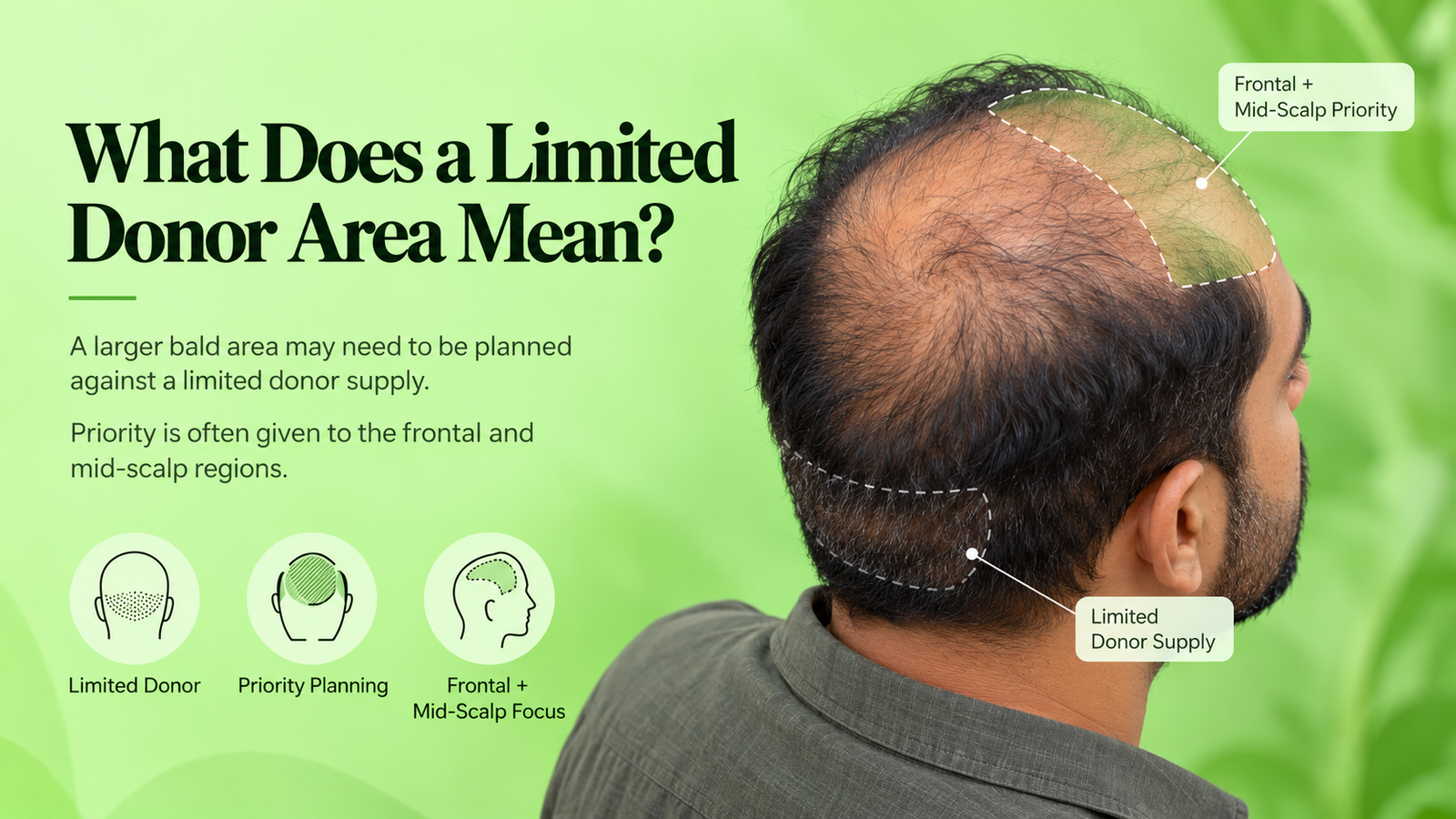
A limited donor area means that the amount of hair that can be safely harvested is insufficient to recreate high density across every area of hair loss.
Possible reasons include:
- naturally low donor density
- advanced baldness
- donor miniaturisation
- previous FUE procedures
- overharvesting
- previous strip surgery
- retrograde thinning
- diffuse donor involvement
- repair requirements
Why Donor Hair Is Finite
Even a strong donor region contains a limited number of follicles that can be removed without affecting its appearance.
The safe amount varies according to:
- density
- hair calibre
- follicular-unit distribution
- donor surface area
- miniaturisation
- hairstyle
- contrast between hair and skin
- previous harvesting
- future hair-loss risk
Therefore, a universal “safe graft number” cannot responsibly be applied to every patient.
What Happens After Previous FUE or Overharvesting?
Previous surgery changes future planning.
Extraction may already have reduced the donor density or created uneven depletion.
Simply returning to the same areas for further aggressive extraction can increase the risk of visible donor thinning.
Patients with previous transplantation should have the donor area mapped again rather than relying only on an old graft count.
Priority-Based Hair Restoration
When donor supply is limited, attempting maximum density everywhere may be a poor strategy.
The plan often needs to establish which areas matter most visually.
Frontal Hairline and Frontal Scalp
The front strongly influences facial framing.
A mature, realistic hairline can conserve grafts while providing substantial cosmetic change.
Mid-Scalp
Connecting frontal coverage into the mid-scalp may provide greater visual continuity than concentrating grafts in isolated areas.
Crown
The crown can require a large number of grafts because of its surface area and spiral hair pattern.
In some limited-donor patients, the crown may therefore receive lower density, staged treatment or no immediate transplantation.
Conservative Hairline Planning Can Preserve Grafts
A low juvenile-looking hairline usually requires more surface area and therefore more grafts.
In patients with advanced or progressive hair loss, a mature hairline can help:
- conserve follicles
- maintain facial balance
- reduce unnecessary recipient area
- preserve future options
- avoid creating an isolated frontal transplant if hair loss progresses
For detailed hairline principles, see Anagen’s Creative Hairline Design page.
Can Beard or Body Hair Help?
Alternative donor hair can sometimes supplement a limited scalp donor reserve.
The important word is supplement.
Beard or selected body hair does not remove the need for donor prioritisation.
Patients wanting to understand possible supplementary donor sources should read Alternative Donor Hair Restoration.
Staged Hair Restoration
One procedure is not always the best way to treat a donor-limited patient.
Staging can allow the team to:
- prioritise the front first
- review actual growth
- reassess residual donor density
- monitor continued hair loss
- decide whether crown treatment remains worthwhile
- preserve flexibility
What Results Are Realistic With a Limited Donor?
When donor supply is limited, the goal is usually not maximum density everywhere.
A successful plan often prioritises the areas that create the greatest visual improvement while preserving future options.
The final result depends on:
- starting donor density
- hair calibre
- recipient surface area
- previous harvesting
- alternative donor suitability
- future hair loss
- selected priorities
- graft growth
Original Anagen patient results should be reviewed in the relevant Results section.
Cost of Limited Donor Area Hair Restoration
Cost depends on the actual strategy rather than a single procedure label.
Factors may include:
- graft requirement
- number of donor sources
- prior surgery
- repair work
- extraction difficulty
- recipient zones
- staging
- overall surgical complexity
Frequently Asked Questions
Can I still have a hair transplant if my donor area is weak?
Possibly. Suitability depends on how weak the donor is, how large the recipient area is and what degree of restoration is realistic.
Can my donor become visibly thin after FUE?
Yes, particularly if too many grafts are removed or extraction is poorly distributed.
Can beard hair compensate for a weak donor?
It may supplement scalp follicles in selected patients but is not an unlimited replacement.
Should I restore the crown if my donor area is limited?
It depends on donor capacity and your overall priorities. Crown restoration can require substantial graft resources.
Will I need two sessions?
Some patients benefit from staged treatment, but the number of procedures should be individualised.
Limited Donor Area Consultation in Mumbai
A meaningful assessment should answer:
how much usable scalp donor remains
whether miniaturisation is present
what previous procedures have already removed
which recipient areas should be prioritised
whether beard or body follicles add useful options
whether treatment should be staged
what donor reserve should remain for the future
Send clear front, top and back/donor photographs, including well-lit photographs of any previously harvested donor area.
Use Anagen’s Contact page for formal assessment.