





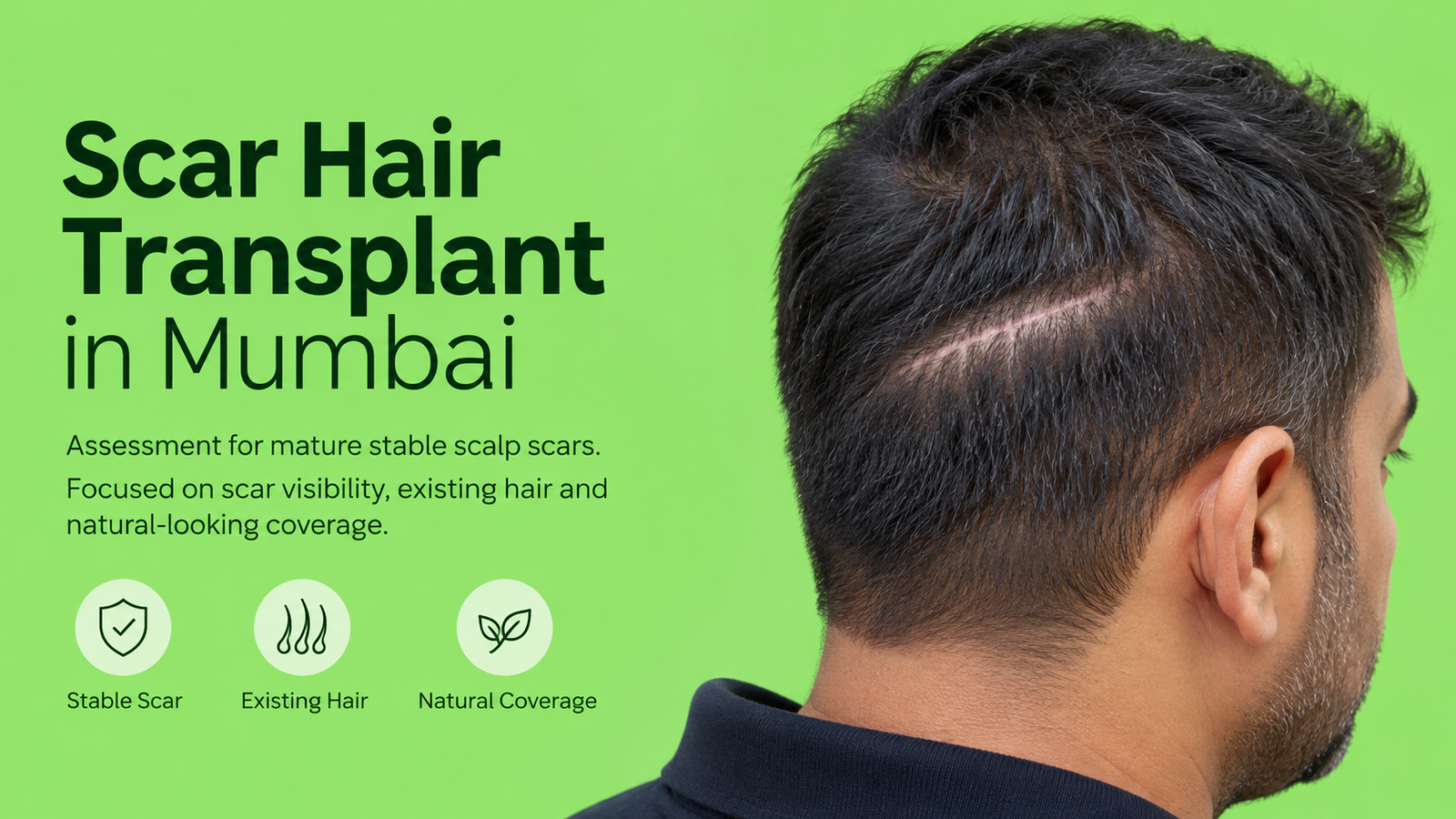
Scar Hair Transplant in Mumbai
A scar hair transplant is a specialised hair restoration procedure that may help camouflage suitable scars in previously hair-bearing areas of the scalp.
Scars following injuries, burns, previous surgery or earlier hair transplantation can leave visible regions where normal hair no longer grows. Depending on their position, these scars may become noticeable when the hair is cut short or styled in a particular direction.
Hair transplantation may help selected patients improve the appearance of such areas by placing suitable follicles into or around a stable scar.
However, scar tissue is biologically different from normal scalp. Its blood supply, thickness, elasticity and capacity to support grafts may vary considerably.
At Anagen Hair Transplant Clinic in Mumbai, scar restoration should begin with careful tissue assessment rather than an assumption that every scar can accept hair transplantation.
Can Hair Be Transplanted Into Scar Tissue?
Hair transplantation into selected scar tissue may be possible when the scar is mature, stable and has adequate tissue characteristics to support graft placement.
In normal scalp, the skin contains an established network of blood vessels and healthy tissue surrounding existing hair follicles.
A scar may contain dense collagen, altered vascularity and fewer or no functioning follicles.
These differences can affect the number of grafts that can reasonably be placed and how reliably the transplanted follicles grow.
The primary objective is usually scar camouflage, not removal of the scar itself.
What Types of Scalp Scars May Be Considered?
Scar transplantation may be evaluated for stable scars caused by previous procedures or injuries.
Previous FUT Strip Surgery
A linear donor scar from earlier follicular unit transplantation may become visible with short hair or reduced surrounding donor density.
Previous FUE Extraction
Excessively concentrated or repeated extraction can leave visible small scars or donor thinning. Additional transplantation is not always the safest correction.
Trauma or Neurosurgery
Healed injuries and surgical incisions may leave localised areas without hair.
Burns and Cosmetic Surgery
Selected stable scars may be candidates, but tissue thickness and vascularity can be particularly variable.
The cause of the scar matters because active disease or unstable tissue should not be treated as routine cosmetic transplantation.
Why Is Scar Maturity Important?
A scar must be assessed for stability before transplantation is considered.
Recently formed scars can continue to remodel, change thickness or develop altered colour and tension.
The appropriate waiting period depends on the original injury or surgery, the healing process and the condition of the tissue.
There is no universally appropriate number of months for every scar.
Active inflammation, ulceration, infection, unstable scarring or suspected inflammatory scalp disease requires diagnosis and management before elective graft placement.
How Is Scar Tissue Different From Normal Scalp?
Scar tissue can differ in several important ways.
Blood Supply
A scar may have reduced or uneven vascular support, influencing graft survival.
Tissue Thickness
Some scars are thin and tightly adherent. Others are thick, raised or fibrotic.
Elasticity
Scar tissue may be less flexible, making recipient-site creation and graft placement technically difficult.
Existing Follicles
The scar itself may contain few or no functioning follicles, while neighbouring scalp may still have normal hair.
Who May Be Suitable for Scar Hair Transplantation?
A potentially suitable candidate generally has a stable scar, realistic expectations, adequate donor hair and recipient tissue judged capable of accepting grafts.
The clinician should examine scar location, width, thickness, surrounding hair direction, skin mobility and the likely degree of camouflage.
Patients with raised, unstable or inflammatory scars may first need medical or reconstructive treatment.
Transplantation may also be inappropriate when the scar has poor tissue support or when harvesting donor hair would create disproportionate additional scarring.
Where Does the Donor Hair Come From?
Suitable donor follicles are usually selected from an appropriate scalp donor region.
Hair calibre, curl, colour and number of hairs per follicular unit affect how the new hair will blend with surrounding hair.
The available donor supply may already be reduced if the scar resulted from previous hair-transplant surgery.
In complex cases, the wider scalp and any prior extraction patterns require evaluation before choosing a donor source.
Advanced Donor Management covers long-term donor planning, especially for previously operated patients.
How Is Hair Direction Planned Across a Scar?
Hair should be implanted in a direction that blends with the surrounding native hair.
This can be challenging if the scar crosses regions with different natural hair flow.
For example, a posterior scalp scar may intersect hair growing downward or outward from the crown. A frontal scar requires particular attention to visible hairline direction.
A transplant with acceptable graft growth can still look unnatural if the orientation is incorrect.
How Is Scar Hair Transplant Performed?
Step 1: Scar and Medical History Assessment
The surgeon reviews scar cause, duration, previous treatment, healing history and relevant medical conditions.
Step 2: Tissue Quality Examination
Scar thickness, elasticity, stability, location and surrounding scalp are examined.
Step 3: Donor Evaluation
Suitable donor areas are assessed, including any previous surgical extraction or donor scarring.
Step 4: Camouflage Design
The surgeon maps the area where grafts may provide useful visual coverage and plans natural direction and conservative initial concentration.
Step 5: Local Anaesthesia
Local anaesthesia is administered after confirming an appropriate operative plan.
Step 6: Follicular Unit Extraction and Selection
Suitable grafts are harvested and inspected according to the intended placement.
Step 7: Recipient-Site Creation
Sites are created cautiously within appropriate scar tissue, avoiding excessive trauma or unrealistic density.
Step 8: Graft Implantation
The selected grafts are implanted according to the mapped direction and available tissue characteristics.
Step 9: Healing and Follow-Up
Postoperative care focuses on protecting the recipient tissue, reviewing graft growth and assessing whether further treatment may be useful.
Is a Test Session or Staged Treatment Sometimes Necessary?
Yes.
When the recipient tissue is uncertain, a limited test transplantation may help the clinician assess healing and graft growth before attempting wider coverage.
Some scars may benefit from conservative initial placement, followed by reassessment after sufficient growth.
A second session should not be assumed automatically. It depends on the response to the first treatment, remaining donor resources and whether further intervention is appropriate.
Recovery and Hair Growth After Scar Transplantation
The recipient scar may show temporary redness, tenderness, crusting or swelling after surgery.
Healing can differ from that of normal scalp because the scar’s vascularity and tissue characteristics may be altered.
Transplanted shafts may shed during the first several weeks. New growth, where successful, may begin over the following months.
The degree of useful camouflage is often assessed around twelve months or later, depending on the individual response and scar characteristics.
Patients should promptly report increasing pain, spreading redness, discharge or other signs of complications.
What Results Can Scar Hair Transplant Achieve?
The goal is to reduce the visual contrast between a scar and surrounding hair.
Successful graft growth can make a scar less noticeable at appropriate hair lengths, but the underlying scar remains present.
A very wide scar, extensive donor scarring or poor tissue quality may limit improvement.
Some patients may still need to keep surrounding hair at a suitable length to improve concealment.
Scar Hair Transplant Versus Repair Hair Transplant
Scar transplantation specifically addresses hair loss over a stable scar.
Repair Hair Transplant is more relevant when the main concern is an unnatural previous hairline, incorrect graft angle, pluggy appearance or another technical/aesthetic problem after previous transplantation.
The two treatments may overlap when an earlier procedure caused both visible scarring and an unnatural hair-restoration result.
Risks and Limitations
Potential risks include infection, bleeding, graft failure, inadequate growth, visible scarring, uneven coverage, poor hair-direction matching and further tissue disturbance.
Patients with a history of hypertrophic scarring, keloids, active skin disease or compromised wound healing require particular assessment.
A scar’s response cannot be predicted with certainty from photographs alone.
Scar Hair Transplant Cost in Mumbai
Cost depends on scar dimensions, maturity, tissue characteristics, donor requirements, previous surgery and whether limited testing or staged transplantation is advisable.
A small, stable linear scar and a large complex scar may require very different surgical plans.
Scar Hair Transplant Results
Hair transplantation may camouflage suitable stable scalp scars, but growth can vary because scar tissue differs from normal scalp.
Reviewing genuine scar-repair cases can help explain the goals and limitations of treatment.
View scar and repair hair transplant results
Frequently Asked Questions
Can hair grow in scar tissue?
Sometimes. Suitable scars may support transplanted follicles, but growth can be less predictable than in normal scalp.
How old should a scalp scar be before transplantation?
The scar should be mature and stable. The required interval depends on how it formed and how it has healed.
Will the scar disappear after a hair transplant?
No. Transplanted hair may camouflage the scar but does not remove the underlying scar tissue.
Can an FUT strip scar be treated?
Selected stable FUT scars may be suitable, depending on width, tissue quality and remaining donor supply.
Can a scar transplant be completed in one sitting?
Some cases may require only one session. Others may need conservative initial placement and later reassessment.
Book a Scar Hair Transplant Assessment in Mumbai
If you have a visible healed scalp scar following injury, surgery or a previous hair transplant, Anagen can evaluate whether follicular transplantation may help camouflage it.
A consultation should establish whether the scar is stable, whether the tissue can support grafts and what improvement is realistic.
Share close-up photographs of the scar, a wider image showing its scalp position and clear photographs of the surrounding hair and donor region.
Include the approximate age and cause of the scar, if known.
Contact Anagen Hair Transplant Clinic to arrange an individual assessment.