




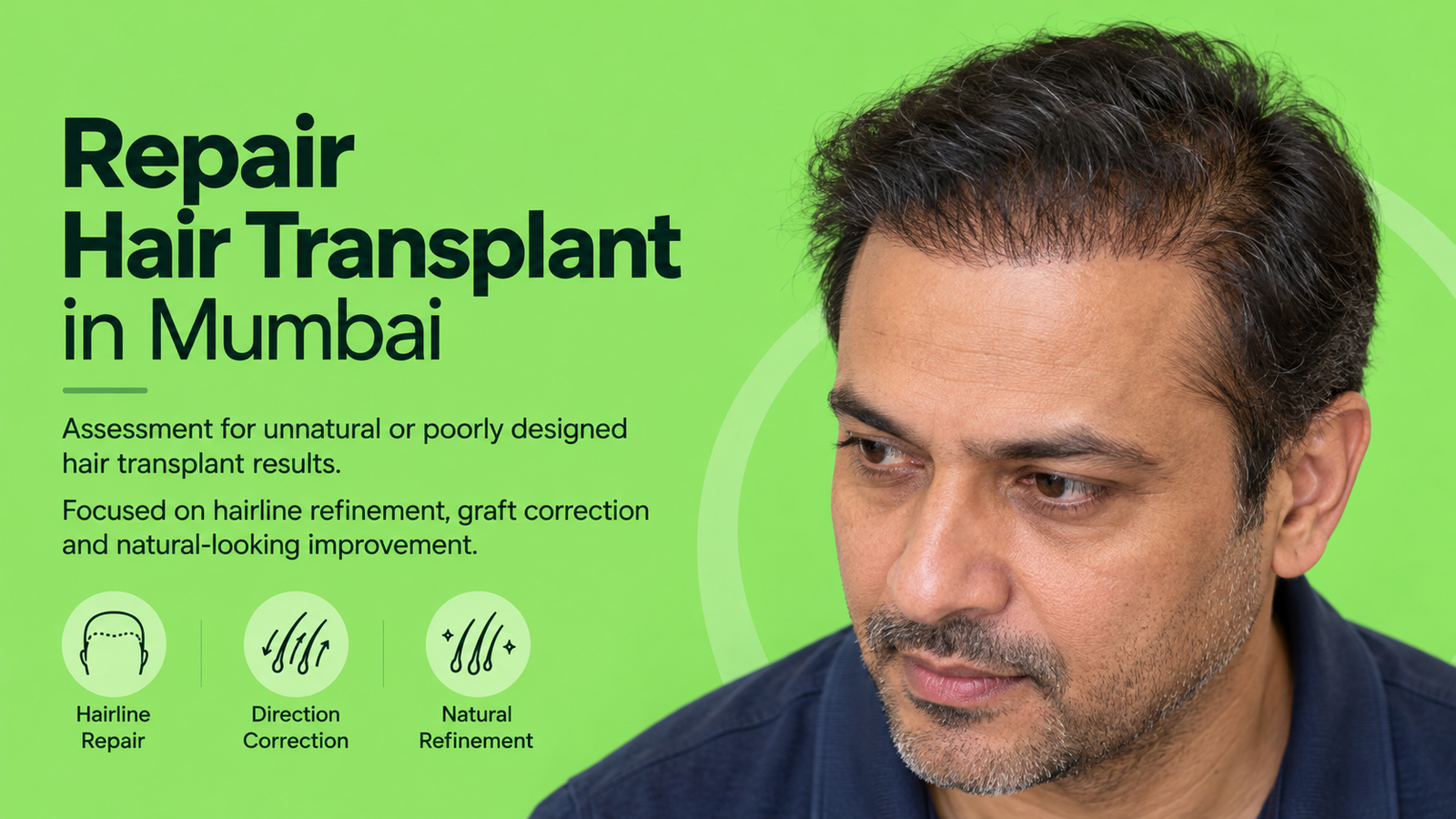
Repair Hair Transplant in Mumbai
A repair hair transplant is a specialised corrective procedure for patients who have undergone hair transplantation but are dissatisfied with the appearance, design or technical quality of the earlier result.
A previous transplant may produce acceptable hair growth yet still look unnatural because of an incorrectly positioned hairline, inappropriate graft direction, thick multi-hair grafts at the frontal edge or visible irregularities in the recipient scalp.
For these patients, simply adding more grafts may not solve the problem.
The corrective strategy may involve removing selected grafts, redesigning the hairline, improving the transition between natural and transplanted hair, changing the distribution of grafts or camouflaging specific areas.
At Anagen Hair Transplant Clinic in Mumbai, repair planning should begin with identifying the actual aesthetic and technical problem before deciding whether another transplant is appropriate.
What Is Repair Hair Transplantation?
Repair transplantation is corrective hair restoration undertaken to improve an unsatisfactory aesthetic or technical outcome from an earlier procedure.
The original transplant may have achieved reasonable follicular growth, but its appearance may not blend naturally with the patient’s facial features, existing hair or scalp anatomy.
A repair can be more complex than a first hair transplant because some grafts are already present in fixed positions and directions.
The surgeon must work around these existing follicles while considering scar tissue, previous extraction patterns and the remaining donor supply.
Importantly, not every unnatural graft can be completely removed or repositioned without risk.
What Problems Can a Repair Hair Transplant Correct?
The first task is to identify precisely what makes the existing transplant look unnatural.
Straight or Artificial Hairline
An excessively straight, regular or sharply defined frontal border may lack the natural irregularity usually seen in a mature male hairline.
Thick Multi-Hair Grafts at the Front
Double- or multiple-hair follicular units positioned at the very leading edge may create a pluggy appearance.
Incorrect Graft Angle or Direction
Hair emerging too upright, pointing against the surrounding hair flow or crossing unnaturally can be conspicuous during normal styling.
Poor Temporal Hairline Design
Temples may have been positioned too low, too straight or at unsuitable angles relative to the frontal hairline.
Cobblestoning and Pitting
Recipient-site healing or graft placement can occasionally leave raised or depressed skin contours.
Uneven Density Distribution
An overly dense patch surrounded by sparse hair may appear unnatural, even when the total number of grafts is substantial.
Donor Overharvesting
Excessive or uneven donor extraction may produce visible thinning and limit options for further correction.
Why Do Some Transplanted Hairlines Look Unnatural?
A natural hairline is a transition between the forehead and the denser scalp hair behind it.
A good design considers the patient’s age, facial proportions, frontotemporal recessions, temple position and expected future hair loss.
The leading edge generally requires careful single-hair selection and natural irregularity, with density increasing behind it.
A rigid line of uniformly thick grafts may appear artificial because natural hair does not normally emerge in an identical arrangement.
The objective of hairline repair is not simply to lower or thicken the original design. It is to restore believable shape, movement and visual balance.
Read Anagen’s Creative Hairline Design discussion for the principles of a naturally irregular transition.
Natural Hairline Design and Mature Hairline Reconstruction provide related approaches for first-time restoration and selected revision cases.
Can Incorrect Hair Angle and Direction Be Corrected?
Some incorrectly oriented grafts may be removed, selectively revised or visually camouflaged.
The appropriate strategy depends on how far the direction differs from the natural hair flow, the location and number of affected grafts, and whether surrounding hair can provide camouflage.
Hair in the frontal region usually requires a different exit orientation from hair around the temporal points or crown.
Placing more grafts does not automatically correct severe wrong-direction hairs. In some situations, the conspicuous grafts themselves must be addressed.
Can Thick Double or Triple Grafts at the Hairline Be Repaired?
Prominent multi-hair grafts at the very front can produce a conspicuous, pluggy outline.
Correction may involve selectively extracting some of these grafts, changing their placement where feasible or softening the frontal edge with carefully chosen single-hair units.
The decision depends on whether removal would create visible defects, compromise adjacent grafts or increase scarring.
A plan should also consider hair calibre. A coarse single hair at the leading edge may remain visually stronger than a finer single hair.
What Are Cobblestoning and Pitting?
Cobblestoning refers to raised, uneven skin contours around implanted grafts. Pitting refers to depressed surface irregularities that may occur when grafts or recipient sites heal at an inappropriate depth or with altered tissue response.
These changes are not all caused by the same mechanism and may vary in severity.
A mild contour irregularity may be less visible when surrounded by hair. More pronounced abnormalities can be difficult to correct and may require dermatological or surgical assessment.
A hair transplant alone may not resolve every skin-surface problem.
How Is a Repair Strategy Selected?
There is no universal correction technique.
The appropriate approach may combine more than one method.
Selective Graft Removal
Some misplaced or conspicuous grafts may be extracted when technically feasible.
Graft Redistribution or Reimplantation
Selected removed grafts may be suitable for reuse, but successful reimplantation cannot be assumed.
Hairline Softening
Fine, single-hair follicular units may be added in carefully chosen positions to create a more natural frontal transition.
Camouflage
Strategically placed grafts may help blend mild irregularities or awkward density differences.
Redesign
A new hairline or temporal plan may be needed if the original position or architecture is unsuitable.
Staged Repair
Complex cases may require one stage to address old grafts and a later stage to reassess healing and perform further restoration.
Why Is Donor Reassessment Essential?
A previous transplant may have consumed thousands of available follicular units.
The surgeon must evaluate remaining scalp donor density, previous FUE extraction distribution, any FUT scar, miniaturisation and the expected donor requirement for future hair loss.
A technically achievable repair may still be inappropriate if it uses too much of the remaining donor reserve.
Selected patients may be assessed for alternative donor sources, including beard hair, although these have different characteristics and are not interchangeable with fine frontal scalp hair.
Advanced Donor Management and Limited Donor Area Hair Restoration are important for patients with reduced donor capacity.
How Is Repair Hair Transplant Performed?
Step 1: Review of the Previous Transplant
The surgeon examines previous procedure details, graft numbers if available, healing history and the patient’s specific aesthetic concerns.
Step 2: Existing Graft Mapping
The hairline position, graft composition, angle, direction, density distribution and scalp-surface changes are documented.
Step 3: Donor and Scar Evaluation
Remaining donor capacity, extraction patterns, scars and recipient-tissue conditions are assessed.
Step 4: Corrective Hairline Design
An appropriate revised shape, transition zone, temple relationship and density distribution are planned.
Step 5: Selected Graft Removal Where Necessary
Conspicuous or incorrectly positioned grafts may be removed where feasible and clinically appropriate.
Step 6: Healing or Staging Decision
Some cases may require a healing interval before additional implantation. Other limited corrections may be combined in a carefully planned procedure.
Step 7: New Donor Graft Extraction
Additional suitable follicular units are harvested only if necessary and supported by remaining donor capacity.
Step 8: Recipient-Site Creation and Graft Selection
Sites and graft types are selected to produce more natural hairline transitions, directions and density.
Step 9: Corrective Implantation
New or suitable reusable grafts are placed according to the revised treatment design.
Step 10: Postoperative Review
The patient receives a follow-up plan to assess wound healing, growth and the need for further correction.
How Long Does Repair Hair Transplant Recovery Take?
Recovery depends on the extent of graft removal, new graft placement, recipient scars and whether treatment is staged.
Mild swelling, redness, tenderness and crusts may occur after surgery.
Some correction sites may need additional time to heal, particularly where previous surgery has altered tissue conditions.
When new grafts are implanted, the visible shafts may shed during the first weeks. New growth can begin around three to four months, while substantial visual improvement may require nine to twelve months or longer.
If the plan involves more than one stage, the total corrective process may extend beyond the usual timeline for a single transplantation.
Can Every Unnatural Hair Transplant Be Fully Reversed?
No.
Some grafts may be difficult to remove without damaging neighbouring follicles. Existing scars, altered scalp texture and poor donor availability may limit the degree of correction.
Even when a previously straight hairline is softened, the original recipient sites and skin changes cannot always be returned to their preoperative state.
A realistic repair plan should identify what can be improved, what may remain visible and whether the expected benefit justifies additional surgery.
Repair Hair Transplant Versus Failed Hair Transplant Correction
These procedures address different primary concerns.
Repair Hair Transplant focuses mainly on an unnatural appearance, incorrect design or technically unsatisfactory graft placement.
Failed Hair Transplant Correction focuses on insufficient graft growth, patchy coverage or an unexpectedly low-density result.
Some patients may have both problems. The dominant issue should determine which treatment assessment comes first.
How Much Does Repair Hair Transplant Cost in Mumbai?
Cost depends on the complexity of the original problem, graft-removal requirements, remaining donor capacity, additional graft numbers, recipient scarring and whether treatment must be divided into stages.
Repair cannot responsibly be quoted solely by multiplying a projected graft count by a standard per-graft price.
A consultation should establish the corrective objective before discussing the financial plan.
Repair Hair Transplant Results
Repair outcomes depend on the type of problem being corrected, the condition of the recipient tissue, the remaining donor hair and how much of the original transplant can be safely changed.
Reviewing genuine repair cases can help patients understand why one person’s correction may involve hairline softening while another needs graft removal, donor management or staged surgery.
View repair hair transplant results
Frequently Asked Questions
Can a straight transplanted hairline be corrected?
Selected unnatural hairlines may be improved through redesign, graft removal or carefully placed additional grafts.
Can wrong-angle grafts be removed?
Some can be selectively extracted, although removal may be difficult or carry scarring and adjacent-follicle risks.
Can thick double or triple grafts be corrected?
Often, selected prominent grafts can be assessed for removal, repositioning or camouflage, but correction is individualised.
Can cobblestoning and pitting be improved?
Some irregularities may be managed, but their treatment depends on severity and tissue condition. Hair transplantation alone may not correct the skin surface.
Is one repair session always enough?
No. Complex corrections may require separate removal, healing and reconstruction stages.
Can repair surgery damage my remaining donor hair?
Further extraction consumes additional donor resources and can produce more scarring or thinning. Donor planning is essential.
Book a Repair Hair Transplant Consultation in Mumbai
If a previous hair transplant has left you with an unnatural hairline, incorrect hair direction, thick frontal grafts or other visible irregularities, a detailed repair assessment can identify realistic correction options.
Anagen can review the existing graft arrangement, donor condition and potential strategies before recommending further surgery.
For preliminary assessment, send clear photographs of your frontal hairline, both temples, top scalp, previous transplant area and rear donor region.
If available, also provide your previous operative details and older photographs.
Contact Anagen Hair Transplant Clinic for an individual repair consultation.