





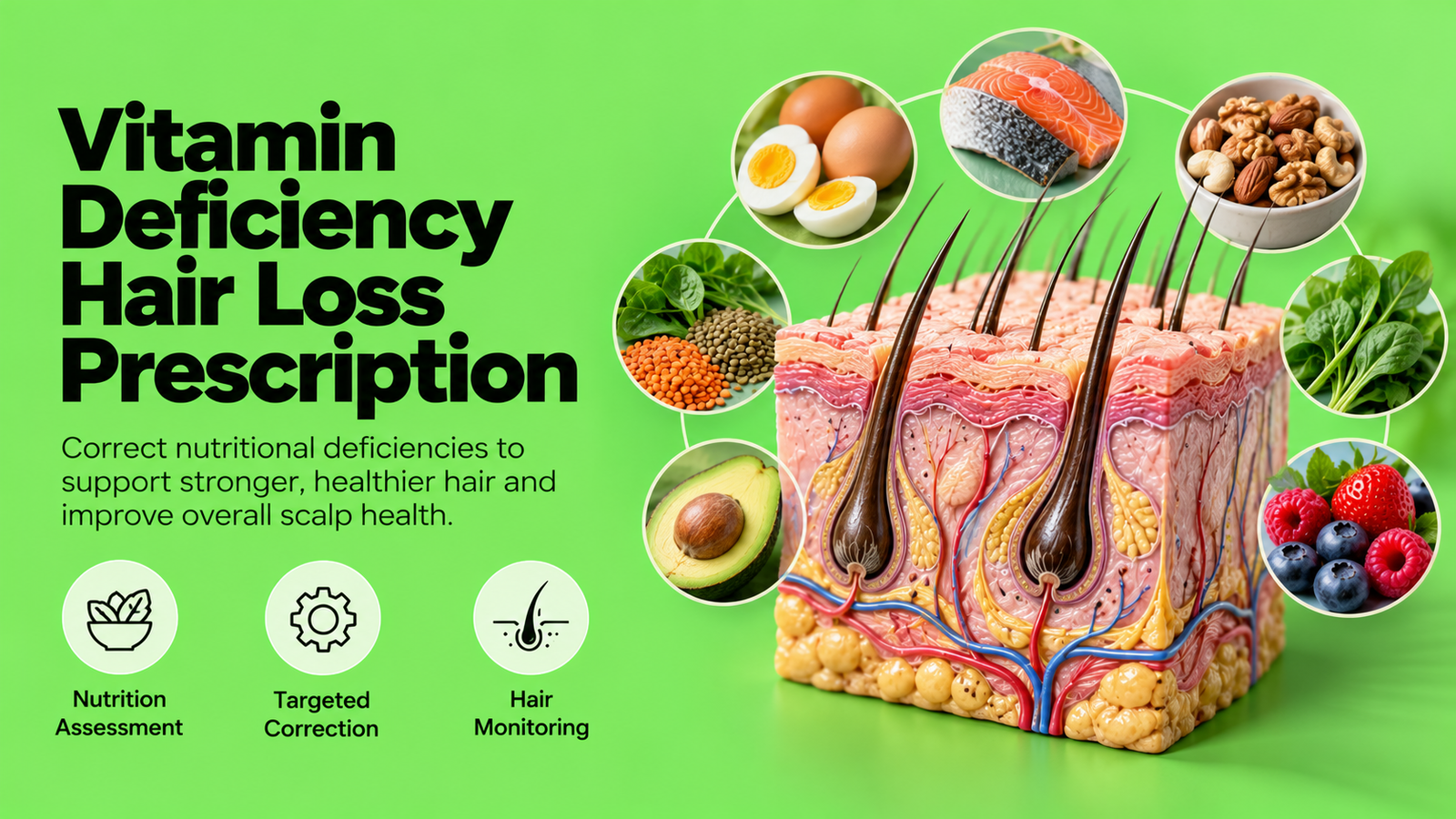
Vitamin Deficiency Hair Loss Prescription
Hair loss is frequently attributed to vitamin deficiency, but taking more vitamins does not automatically improve hair growth.
Nutritional deficiencies can contribute to hair shedding in selected patients, particularly when there is inadequate nutrient intake, restrictive dieting, certain medical conditions or impaired nutrient absorption.
However, hair loss alone cannot establish a vitamin or mineral deficiency.
A Vitamin Deficiency Hair Loss Prescription should therefore begin with an assessment of dietary history, symptoms, hair-loss pattern and clinically indicated investigations. Supplements should be selected to correct a relevant deficiency rather than prescribed indiscriminately.
At Anagen Hair Transplant Clinic, Mumbai, the objective is to distinguish nutritional hair shedding from other causes and support an appropriate, medically supervised treatment plan.
How Nutritional Deficiency May Affect Hair Growth
Hair follicles are metabolically active structures. Normal hair production depends on adequate energy intake, protein availability and a range of micronutrients.
A sustained nutritional disturbance may affect the hair-growth cycle and contribute to increased shedding or altered hair quality.
Some patients experience diffuse shedding following significant dietary restriction or weight loss. Others may have nutritional concerns alongside hereditary thinning or an unrelated scalp condition.
A nutritional deficiency should not automatically be regarded as the cause merely because a laboratory result is outside a reference range. Clinical relevance matters.
What Nutritional Factors May Be Relevant?
Iron Status
Iron deficiency can contribute to hair shedding in some patients.
Clinical assessment may consider dietary iron intake, previous anaemia, gastrointestinal symptoms and menstrual blood loss where relevant.
Ferritin may help assess iron stores, but its interpretation depends on the clinical context. A low or borderline result does not independently explain every hair-loss pattern.
Iron should not be prescribed solely because a patient reports hair fall.
Vitamin D
Vitamin D status may be relevant in selected cases, particularly when a patient has other indications for testing or suspected deficiency.
Although associations between vitamin D status and some hair-loss disorders have been studied, supplementation has not been established as a universal treatment for hair shedding.
Vitamin B12
Vitamin B12 deficiency may be considered in patients with relevant dietary patterns, gastrointestinal conditions, medication history, anaemia or neurological symptoms.
Routine B12 injections or high-dose supplements are not justified solely by a complaint of hair loss.
Protein and Overall Nutrition
Insufficient protein or total energy intake can affect hair health.
Sudden weight loss, restrictive eating patterns and prolonged inadequate nutrition may contribute to shedding even when a patient is already taking multivitamins.
Zinc, Biotin and Other Nutrients
Selected nutritional deficiencies may affect hair, but indiscriminate supplementation can be unnecessary or harmful.
Biotin deficiency is uncommon in the general population. Biotin supplements are not a standard solution for every type of hair loss, and high-dose biotin can interfere with some laboratory tests.
Excessive intake of certain nutrients, including vitamin A or selenium, may itself contribute to hair problems.
Diagnostic Assessment Before Supplement Prescription
The central question is whether a nutritional issue is present and whether it is clinically relevant to the hair-loss pattern.
Dietary and Medical History
Assessment may include:
- Usual meals and sources of protein.
- Vegetarian or vegan dietary patterns and nutritional adequacy.
- Recent crash dieting or rapid weight loss.
- Appetite changes, prolonged illness or gastrointestinal symptoms.
- Previous anaemia or confirmed nutrient deficiency.
- Heavy menstrual bleeding where relevant.
- Pregnancy, postpartum history and other physiological changes.
- Current supplements and their ingredients.
- Medications that may affect nutritional status.
- Duration and distribution of hair shedding.
The clinician should also assess whether the pattern is consistent with Telogen Effluvium Prescription, female pattern hair loss, androgenetic alopecia or another diagnosis.
Examination and Selective Investigations
Clinical scalp examination may include hair-density assessment, trichoscopy or evaluation of shaft fragility.
Laboratory tests should be chosen according to history and examination. A fixed package of thyroid, iron, vitamin and hormone tests is not required for every patient.
Where results have already been obtained, reviewing existing reports may be preferable to repeating them without indication.
Prescription Overview
Primary Concern: Hair shedding potentially associated with inadequate nutrition or a suspected nutrient deficiency.
Possible Underlying Cause / Trigger: Confirmed or clinically suspected iron, vitamin or other nutritional deficiency, inadequate protein intake, restrictive eating, impaired absorption or another medical condition.
Assessment Required: Dietary and medical history, scalp examination, review of supplements and selective investigations when indicated.
Prescription Goal: Establish nutritional relevance, correct an identified problem and support normal hair-cycle recovery.
Possible Treatment Categories: Dietary correction, targeted supplementation when medically indicated, treatment of an underlying medical cause and management of coexisting alopecia.
Supportive Hair / Scalp Care: Balanced nutrition, gentle handling, suitable cleansing and avoidance of unnecessary products.
Monitoring: Symptoms, nutritional correction where relevant, hair shedding, hair density and treatment tolerability.
Follow-Up: Based on the diagnosed deficiency, recommended reassessment and observed hair changes.
When Referral / Further Investigation May Be Needed: Significant anaemia, gastrointestinal symptoms, suspected malabsorption, unexplained weight loss, persistent deficiency or another systemic concern.
When Another Hair-Restoration Treatment May Be Considered: Only when an additional confirmed diagnosis supports separate hair-directed treatment.
Important: This page provides general prescription information and does not replace an individual medical assessment. The cause of hair loss should be confirmed before medicines, supplements or procedures are selected.
Prescription Management for Nutritional Hair Loss
1. Correct the Confirmed Deficiency
When a relevant deficiency is identified, its correction should be planned according to severity, medical history and the underlying reason.
A clinician may recommend dietary changes, an appropriate supplement or further investigation depending on the condition.
The exact formulation, dose and duration require individual medical assessment.
2. Address the Reason for the Deficiency
Repeatedly prescribing supplements without identifying why a deficiency exists may be inadequate.
Persistent deficiency may require evaluation of dietary intake, ongoing blood loss, gastrointestinal disorders or other medical factors.
3. Avoid Unnecessary High-Dose Supplements
More supplementation is not necessarily better.
Combining multiple hair supplements may lead to overlapping ingredients, excessive intake and avoidable adverse effects.
Patients should disclose all current supplements and medications.
4. Assess Other Hair-Loss Diagnoses
Correcting a nutritional problem will not necessarily reverse genetic miniaturisation, scarring alopecia or other independent conditions.
Hair-directed medication should be selected only where the diagnosis supports it.
Supportive Hair and Scalp Care
A nutritionally balanced diet is generally preferable to relying on cosmetic hair supplements.
Patients should also minimise traumatic brushing, excessive tension, harsh chemical processing and other practices that may cause shaft breakage.
Suitable Hair Shampoo, Hair Conditioner and Hair Care Routine guidance may improve hair manageability, but such products do not correct an internal nutritional deficiency.
The Hair Supplements page may provide additional information about supplement categories, but individual selection should remain clinically justified.
Monitoring, Follow-Up and Expected Recovery
Nutritional correction and visible hair recovery occur on different timescales.
A deficiency may improve before the hair visibly appears denser because follicles require time to progress through their normal growth cycle.
Follow-up may involve reviewing symptoms, dietary adherence, relevant laboratory results and changes in shedding.
Persistent thinning should prompt reconsideration of the diagnosis rather than simply increasing supplement doses.
When Further Medical Evaluation Is Needed
Patients with unexplained persistent shedding, substantial weight changes, suspected eating disorders, anaemia, gastrointestinal symptoms or other systemic complaints may require assessment by an appropriate physician.
A patient with persistent patterned thinning may instead need evaluation for androgenetic alopecia or female pattern hair loss.
A scalp showing inflammation, patchy loss or possible scarring requires a different diagnostic approach.
Are Biologix Procedures or Hair Transplantation Necessary?
Nutritional deficiencies are not corrected by PRP, GFC, exosomes or hair transplantation.
These procedures should not replace diagnosis and appropriate medical treatment.
In selected patients with a separate diagnosed hair-loss disorder, the role of adjunctive treatments may be evaluated independently.
Frequently Asked Questions
Which nutritional deficiencies can affect hair?
Iron deficiency and inadequate protein or energy intake are recognised contributors in appropriate circumstances. Other micronutrient deficiencies may be relevant in selected patients.
Should everyone with hair fall take biotin?
No. Biotin is not a universal treatment for hair loss, and unnecessary high-dose supplementation can interfere with laboratory testing.
Can low iron contribute to hair shedding?
Yes, in some patients. The significance of iron results must be interpreted alongside medical history and other findings.
Should I start supplements without blood tests?
Not automatically. A clinician should determine whether dietary correction, testing or targeted supplementation is appropriate.
Does vitamin D supplementation always improve hair growth?
No. Correcting a medically significant deficiency may be appropriate, but this does not guarantee regrowth or treat every type of alopecia.
How long does hair take to improve after nutritional correction?
Visible recovery varies. The deficiency may improve before noticeable changes in hair density appear.
Vitamin Deficiency Hair Loss Consultation at Anagen, Mumbai
Hair shedding linked to nutritional concerns requires more than choosing a hair-growth supplement.
A Hair Prescription Consultation at Anagen can help assess whether nutritional deficiency, telogen effluvium, pattern hair loss or another disorder may explain the symptoms.
The objective is targeted diagnosis, appropriate correction and monitored hair care rather than unnecessary supplement use.