




Patchy Beard Correction in Mumbai
An existing beard can look incomplete when one or two areas remain visibly sparse. The most useful treatment depends on why those gaps developed. A lifelong, stable patch may be suitable for targeted transplantation; a recently developed or changing patch may need a medical diagnosis first.
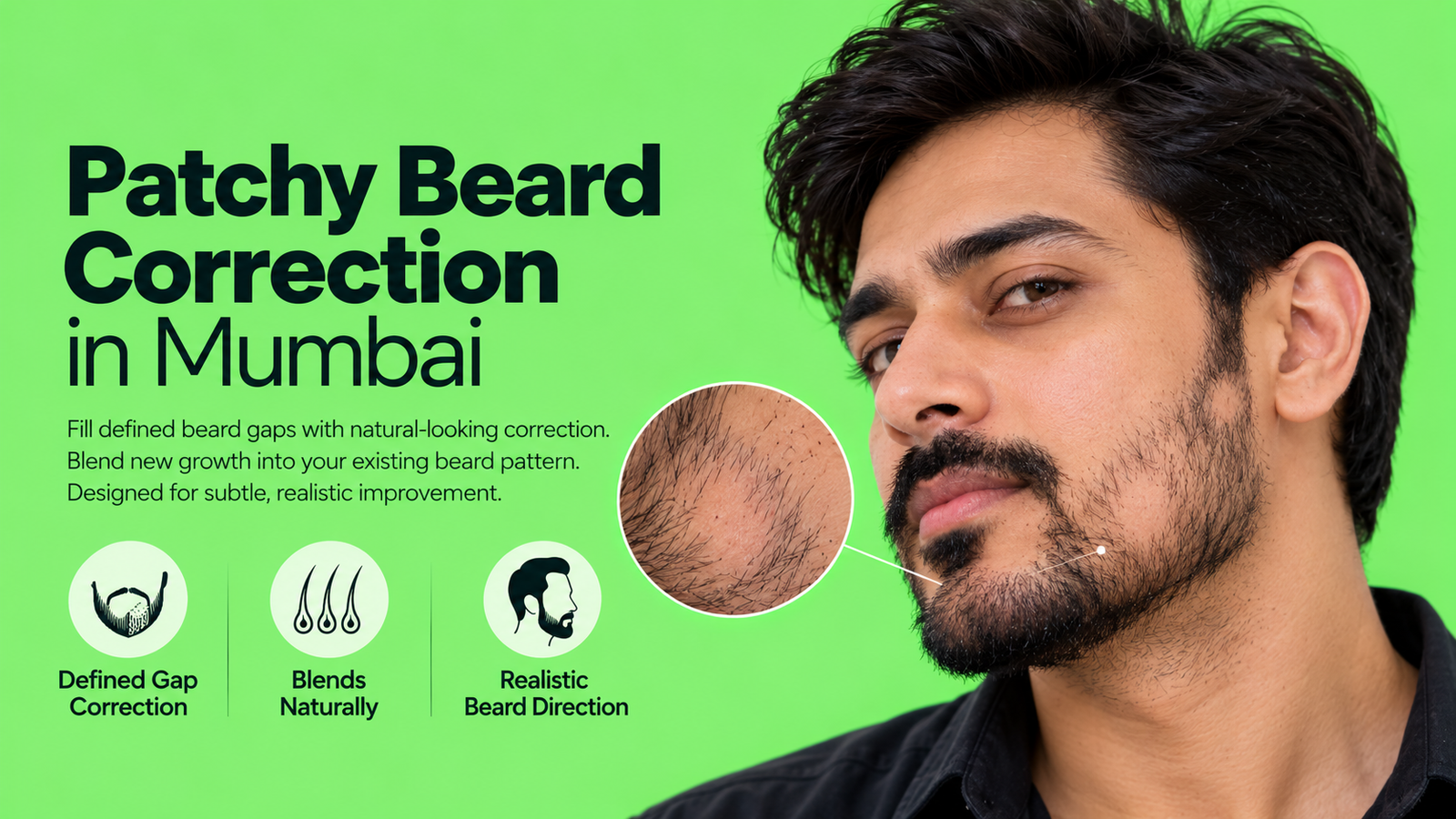
Patchy beard correction is designed around your existing beard, not a completely new beard shape. When surgery is appropriate, the objective is to improve continuity by adding carefully selected follicles into defined areas while preserving the direction and appearance of surrounding native hair.
What Counts as a Patchy Beard?
A patchy beard has identifiable interruptions in an otherwise recognisable beard pattern. The interruption might appear on one cheek, close to a sideburn, along a short portion of the jawline or between the chin and nearby beard hair. One side may differ from the other. Some patches have always been present; others appear after inflammation, a skin condition, injury or previous treatment.
This is not the same as generalised beard thinness. If you have relatively even facial hair throughout but want more fullness, Beard Density Enhancement is a separate option. If you have little hair across most facial zones, Full Beard Hair Transplant addresses extensive coverage.
Why Do Beard Patches Develop?
Possible explanations include genetically uneven growth, still-developing facial hair, alopecia areata affecting the beard, previous inflammatory skin disease, a healed injury or scar, and prior procedures. These causes are not interchangeable. A scar can lack follicles because the skin has been damaged; alopecia areata may affect follicles without producing the same kind of scar.
If the area appeared suddenly, is enlarging, comes with similar scalp patches or is associated with redness, scaling, itching or other skin changes, a dermatological evaluation should come before a cosmetic graft plan. Active alopecia areata is not a routine indication for transplantation. Even after a disease becomes inactive, recurrence risk and candidacy require individual review.
For a patch directly over a stable scar, Beard Scar Repair explains why scar thickness and blood supply change the plan. For recent unexplained gaps, discuss a Beard Growth Prescription or dermatologist-led assessment first.
When Might a Small-Area Beard Transplant Be Appropriate?
Potential candidates have a stable, well-defined gap, reasonable expectations, healthy recipient skin or an appropriately assessed mature scar, and suitable donor hair. The doctor examines the surrounding native beard closely because the edge of a gap is as important as its centre.
The plan can be conservative. In some cases, a small gap becomes much less noticeable when grooming is adjusted or neighbouring hair is allowed to grow. Surgery should be considered only if the benefit justifies the donor use, operative risks and aftercare.
How Are Grafts Blended with Existing Beard Hair?
A good patch-correction design begins outside the patch. The surgeon studies the direction, curvature, colour and calibre of native hairs at each border, then decides where additional hairs could appear without forming a visibly dense island. Hairs may point differently even within one cheek. Border grafts often require careful selection, particularly when the patient keeps very short stubble.
Where Does the Hair Come From, and How Many Grafts Are Needed?
A small number of suitable donor follicular units may be harvested from the scalp for selected patches, subject to colour and texture matching. The required count depends on patch area, native hair at its edge, shaft calibre, the desired trimming length and whether the problem involves normal skin or a scar. Photographs help preliminary planning, but a close examination is needed before giving a personalised estimate.
Donor preservation remains important even for a small treatment. Additional unnecessary grafts can make a patch appear unnaturally dense and use follicles that might be needed elsewhere.
How Is Patchy Beard Correction Performed?
Step 1: Identify the Cause
The clinician confirms whether the gap appears stable and non-inflammatory. A newly formed patch may require diagnosis or treatment instead of surgery.
Step 2: Examine the Existing Beard Pattern
The edges of the gap, the growth direction on both sides, nearby skin and your usual trimming style are assessed.
Step 3: Map Only the Necessary Area
The proposed treatment boundary and transition density are marked. The surgeon avoids automatically expanding treatment into healthy native beard.
Step 4: Select Donor Follicles
Suitable follicular units are identified on the basis of calibre, appearance and donor reserves.
Step 5: Administer Local Anaesthesia and Perform FUE
The donor and recipient areas are numbed. Selected donor follicles are carefully harvested, leaving small donor healing sites.
Step 6: Prepare Direction-Matched Recipient Sites
Small sites are created with the local native hair direction, low exit angle and surrounding follicle locations in mind.
Step 7: Implant and Blend
Grafts are placed to soften the gap and its margins without producing an abrupt block of new hair.
Step 8: Protect and Review
The team explains cleaning, graft protection, activity restrictions and follow-up. The initial pattern is reviewed after sufficient regrowth rather than immediately adding more grafts.
What Happens During Recovery?
Small crusts, redness, swelling or tenderness may occur at the treated patch and donor area. Follow the team’s washing and friction-avoidance instructions; do not pick crusts or shave directly over new grafts until cleared. If you notice increasing redness, discharge, worsening pain or fever, contact your treating team.
The implanted shafts may shed over the first several weeks. New growth often starts around three to four months, followed by gradually more visible coverage over subsequent months. Many clinicians judge maturation around nine to twelve months, although individual timelines differ. The surrounding natural beard remains present while the transplanted follicles pass through their growth cycle.
Risks, Limits and Cost Factors
All surgery has risks. Patch correction can produce infection, temporary inflammation, graft loss, visible differences in hair texture or direction, scarring or an uneven surface. Correct diagnosis matters: active medical hair loss may continue even if a separate area is grafted. Price depends on the mapped area, donor preparation, hair matching and whether any scar or additional condition changes the plan; no fixed patch-price applies to everyone.
Where Can I View Beard Correction Results?
Patchy beard correction aims to fill selected gaps while maintaining the natural direction and appearance of surrounding facial hair. Explore Anagen’s beard transplant results to understand the range of targeted restoration approaches, while remembering that an individual case cannot predict your own result.
Frequently Asked Questions
Can you correct a patch on only one cheek?
Potentially. The surgeon should still examine both sides to understand natural asymmetry and decide whether one-sided grafting is appropriate.
If a new round patch appears, should I book surgery?
Book a medical assessment first. A recent patch may represent an active condition such as alopecia areata, which requires a different approach.
Will correction affect the beard hairs around the gap?
The plan should minimise disturbance to native follicles, but operating between existing hairs demands careful placement and still carries procedural risks.
Does a small patch need the same number of grafts as a full beard?
No. Patch correction is limited to mapped missing areas and their transition edges. The requirement is calculated after examination.
Arrange a Patchy Beard Assessment in Mumbai
Clear photographs of both cheeks, the chin and the jawline can help explain the distribution, but the most important detail is whether the patch has always been present or has changed recently. Contact Anagen for an assessment focused on diagnosis first and selective restoration only when suitable.