





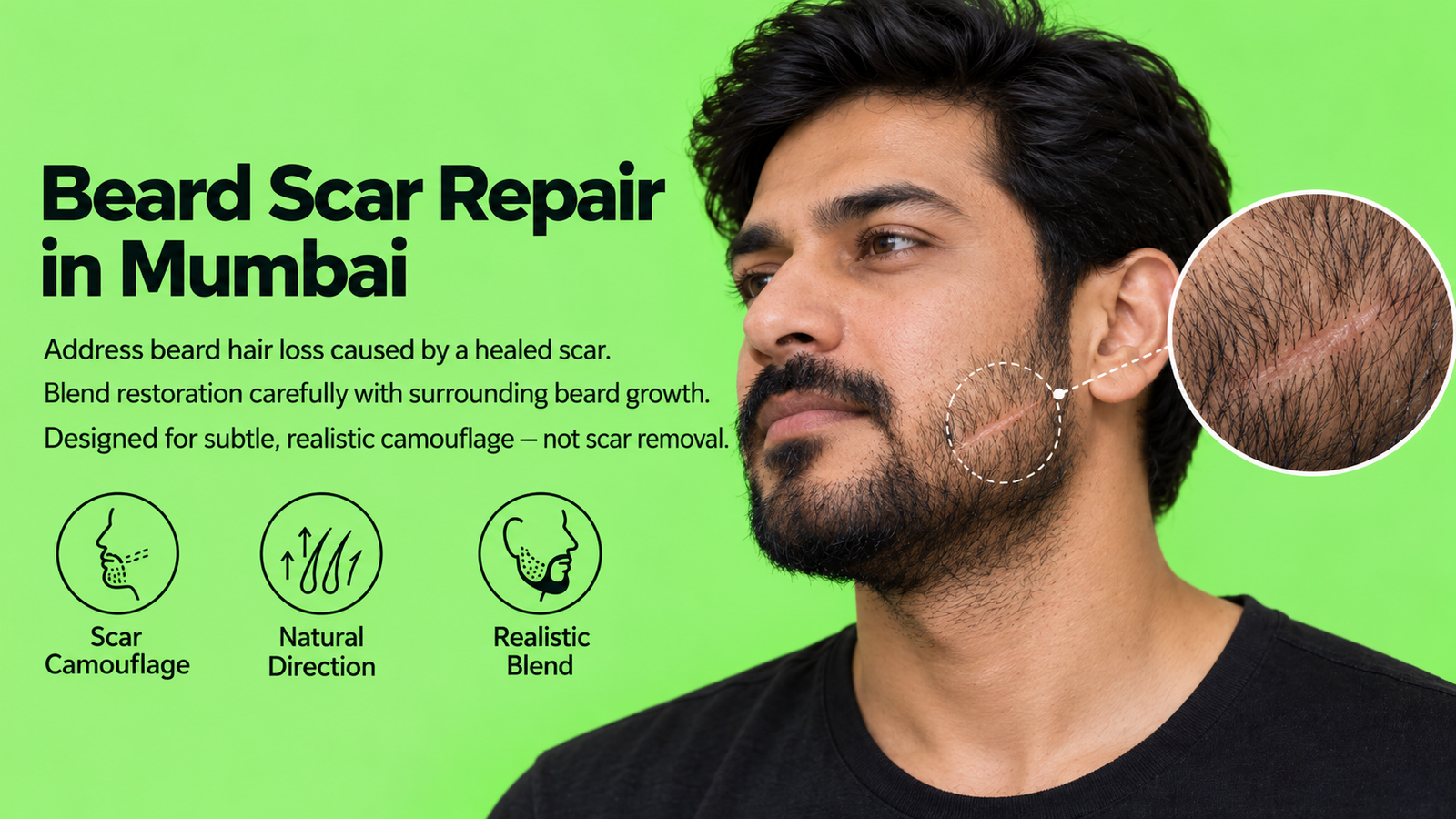
Beard Scar Repair in Mumbai
A scar can interrupt beard growth even after the skin has healed. An injury, burn, surgery or another process may damage follicles in part of the beard, leaving a line or patch with less hair than the surrounding area. For selected stable, mature scars, hair transplantation may improve coverage and make the interruption less conspicuous.
However, scarred skin behaves differently from normal beard-bearing skin. The important questions are whether the scar is suitable for implantation, how reliable growth may be in that tissue and whether camouflage—not scar removal—is a realistic goal.
Can Beard Hair Be Transplanted into a Scar?
Sometimes, yes. A qualified surgeon may transfer suitable hair follicles into or around selected healed scars, usually using an individually planned FUE-based approach. The aim is to introduce growing hairs into the affected area and blend them with the patient’s native beard.
A transplanted follicle does not remove the underlying scar. A thick, tight, unstable, poorly supplied or actively inflamed scar may not be an appropriate recipient area. Some scars require management by a dermatologist or reconstructive surgeon before hair transplantation can even be considered.
If your facial-hair interruption is not scar-related, Patchy Beard Correction may be the relevant pathway. If the injury has disrupted extensive facial-hair regions or involves major reconstructive requirements, see Beard Reconstruction.
What Types of Facial Scars May Need Assessment?
A person may seek beard scar repair after a healed injury, previous facial surgery, a burn, a traumatic laceration, some stable acne-related scars or a prior cosmetic procedure. Their suitability can differ considerably even when the surface gaps look similar.
A narrow, soft, well-healed linear scar with healthy surrounding skin is a different surgical problem from a broad burn scar with tissue tightness and an uncertain blood supply. Previous skin grafting, repeated operations or signs of active scar disease change the evaluation. Scars involving the upper lip are anatomically different; read Moustache Scar Repair when the main interruption lies in the moustache rather than the beard.
Why Do Scar Maturity, Thickness and Blood Supply Matter?
Successful follicular growth depends on the condition of the receiving tissue. The surgeon assesses whether the scar has stabilised, whether it is flat or raised, its softness or tightness, its thickness, surrounding hair, previous operations and any signs of impaired healing. Normal-looking skin over a scar does not establish that graft survival will be predictable.
An actively changing scar, an inflamed condition or unstable scarring alopecia may require observation, diagnosis or medical treatment. In uncertain cases, a clinician may discuss scar treatment first, a conservative grafting approach, a test area or staging. These are options based on examination, not a standard promise that all scars can be transplanted safely.
How Is Natural Hair Direction Planned Across Scarred and Normal Skin?
The new hairs need to blend with the beard on both sides of the scar. The surgeon studies local direction, hair thickness and the three-dimensional surface, then considers how scar firmness might affect recipient-site creation and hair emergence. A technically surviving graft placed upright or across the surrounding direction can make the interruption more obvious instead of less obvious.
The aim is usually a soft, believable transition, not a packed rectangle over the scar. Border graft choices and the amount of coverage must reflect the condition of the scar and the surrounding native beard.
Where Will Donor Follicles Come From?
Potential donor sites, commonly the scalp, are examined for available follicles, shaft calibre, texture, colour and long-term needs. The surgeon may prefer a conservative number of appropriately matched grafts instead of forcing dense placement in tissue with uncertain capacity. A test region or staged treatment can sometimes help assess response when clinically appropriate, but even a successful test does not guarantee identical growth everywhere.
Scalp-derived hair may grow longer or differently than the native beard and can require trimming. Donor extraction also leaves small healing sites. Any previous beard or scalp transplant must be considered when estimating remaining donor capacity.
How Is Beard Scar Repair Performed?
Step 1: Scar History and Stability Review
The clinician records the cause, approximate age, prior treatment and behaviour of the scar and checks for active inflammation or ongoing disease. Additional specialist assessment may be appropriate.
Step 2: Examine Tissue and Native Beard
Scar width, flexibility, thickness, vascularity-related concerns and surrounding hair direction are evaluated. The surgeon considers whether non-transplant scar management or a test area should come first.
Step 3: Explain a Realistic Camouflage Plan
The proposed treated area, limits of scar coverage, possibility of uneven growth and potential need for staged procedures are discussed before consent.
Step 4: Assess and Select Donor Hair
Suitable donor follicles are identified according to availability, calibre and how they might blend with the patient’s existing beard.
Step 5: Administer Local Anaesthesia and Perform FUE
The planned regions are numbed, and selected donor units are individually extracted. FUE leaves small healing sites and is not scar-free.
Step 6: Prepare Scar-Specific Recipient Sites
The surgeon adapts recipient-site planning to the scar’s characteristics and surrounding natural hair direction. Excessively dense or poorly positioned placement is avoided.
Step 7: Implant and Blend Carefully
Grafts are placed in or around suitable tissue according to the agreed conservative plan. A multi-stage approach may be chosen when the receiving conditions justify it.
Step 8: Protect, Review and Reassess
Aftercare covers cleanliness, friction avoidance, warning signs and follow-up. The doctor assesses healing and later hair growth before deciding whether any refinement is appropriate.
What Can Recovery and Growth Be Like in Scar Tissue?
The recipient and donor areas may develop swelling, mild redness, tenderness and small crusts. Existing scar tissue can affect healing and growth differently from normal skin, so your surgeon’s wound-care and follow-up plan is especially important. Worsening redness, increasing pain, discharge or fever requires prompt review.
Early implanted shafts may shed. Growth can begin in the following months, often around three to four months in uncomplicated cases, but the rate and amount of growth over scarred skin are less predictable. A meaningful assessment commonly takes many months and may extend to around a year or beyond. In selected cases, a further session may be discussed after response and tissue condition are assessed.
What Are the Risks and Reasons Not to Proceed?
General transplant risks include bleeding, infection, swelling, folliculitis, altered sensation, donor scarring or thinning, uneven growth and conspicuous hair angle. Scarred recipient skin adds uncertainty about graft survival, surface irregularity and whether additional sessions would be effective. If a scar is unstable, poorly suited or part of ongoing disease, transplantation may be deferred or not recommended.
For some patients, management of the scar itself, acceptance of the current beard style or a non-surgical camouflage approach may be more appropriate. A careful consultation should explain the limits rather than guaranteeing complete concealment.
How Much Does Beard Scar Repair Cost?
Costs depend on scar size and quality, its location, any specialist assessment or preparation, donor availability, the number of grafts that can safely be considered and whether treatment is staged. A flat short linear scar and a large post-burn facial deficit should not be marketed as equivalent procedures or given the same automatic graft estimate.
Beard Scar Repair Results
Hair transplantation may help improve coverage over selected facial scars, although scar tissue influences graft growth and final appearance. Relevant genuine beard restoration cases may help explain the possibilities and limitations once Anagen’s dedicated beard results gallery is published. No patient photo should be presented as proof that the scar itself disappears.
Frequently Asked Questions
Will transplant surgery remove my beard scar?
No. It may introduce hair to suitable scarred or surrounding skin to improve camouflage. The scar remains beneath the hair.
How old must my scar be before surgery?
There is no universal calendar threshold appropriate for every scar. Your surgeon must assess stability, maturity, texture and the underlying cause.
Why might I need more than one session?
Some scarred areas cannot responsibly receive dense graft placement in a single procedure, and growth is less predictable. A second stage is an individual clinical decision, not a promise.
Is a new red or inflamed scar suitable?
Not automatically. Active inflammation or unstable scarring requires medical evaluation and often treatment or observation first.
Can a scar crossing my moustache be treated in the same way?
The general assessment principles overlap, but upper-lip anatomy and moustache direction require distinct design; see Moustache Scar Repair.
Arrange a Beard Scar Assessment in Mumbai
Share a clear close-up of the fully healed scar, front and side photographs showing nearby beard hair, and information about the injury or previous surgery. The priority is to establish whether grafting is appropriate at all and, if so, what degree of camouflage is realistic. Contact Anagen to discuss a scar-specific consultation.