




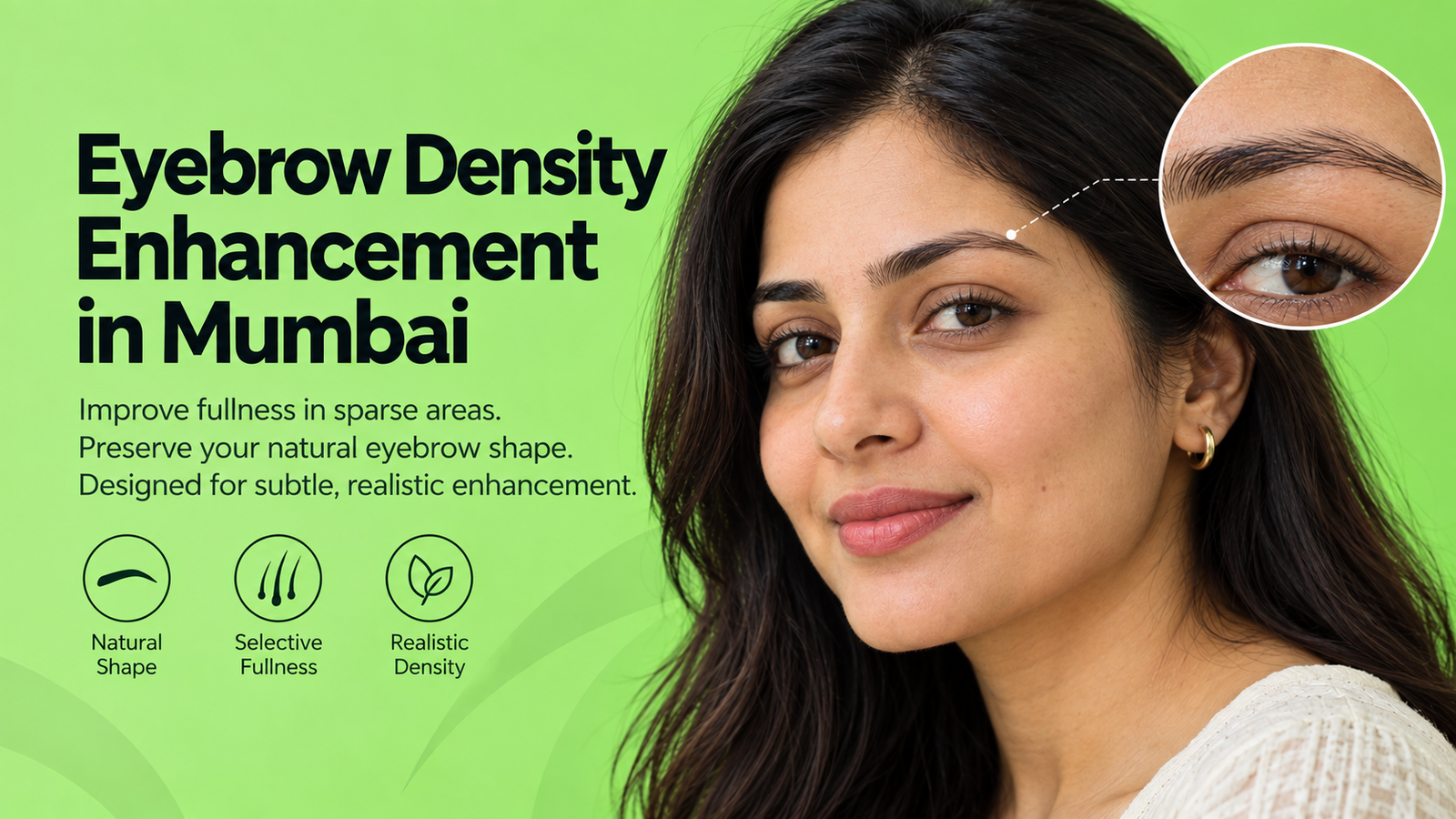
Eyebrow Density Enhancement in Mumbai
Not everyone with thin eyebrows needs complete eyebrow reconstruction.
Many people have naturally established eyebrows but experience reduced fullness, uneven hair distribution or small gaps that affect their appearance.
Eyebrow density enhancement focuses on carefully improving selected areas while preserving the patient’s existing eyebrow shape and natural hair-growth pattern.
At Anagen Hair Transplant Clinic in Mumbai, the first step is understanding why the eyebrows appear sparse and whether surgical treatment is appropriate.
The objective is to improve fullness without unnecessarily changing the original eyebrow.
What Is Eyebrow Density Enhancement?
Eyebrow density enhancement is a targeted approach to improving fullness in eyebrows that already contain existing hair.
When transplantation is appropriate, carefully selected hair follicles can be placed between existing eyebrow hairs to improve coverage.
Unlike extensive reconstruction, density enhancement generally works within the patient’s established eyebrow borders.
The surgeon evaluates existing density, hair direction, donor-hair compatibility and the precise regions where additional coverage may be beneficial.
The number of grafts required depends on the individual rather than a standard density target.
Who May Benefit From Eyebrow Density Enhancement?
Density enhancement may be considered for patients with:
- Naturally sparse but established eyebrows.
- Small gaps within the eyebrow.
- Uneven density between the two eyebrows.
- Reduced fullness following excessive plucking.
- Localised areas with insufficient eyebrow coverage.
The presence of thin eyebrows alone does not establish a need for surgery.
Sudden thinning, progressive eyebrow loss, inflammation or patchy shedding may indicate an underlying medical condition.
In such situations, diagnosis and appropriate treatment should come before cosmetic transplantation.
Patients with extensive eyebrow absence may require Eyebrow Reconstruction rather than limited density enhancement.
When Is Medical Treatment More Appropriate?
Eyebrow thinning can occur for several reasons.
Repeated grooming or longstanding naturally sparse growth may produce a relatively stable appearance. Other causes, including inflammatory conditions, alopecia areata and thyroid-related disorders, may require medical investigation.
When underlying disease is suspected, transplantation should not be the first step.
Patients may benefit from dermatological assessment, investigation of relevant medical causes and an individualised treatment plan.
Medical treatment should be selected according to the diagnosis rather than started simply because the eyebrows look thin.
Where appropriate, patients can also explore the planned Eyebrow Growth Prescription service for guidance on medical assessment and non-surgical management.
How Are Existing Eyebrows Assessed?
The surgeon examines the existing eyebrow outline, the distribution of native hair and the areas where additional density may improve appearance.
The assessment includes:
- Existing hair density and natural gaps.
- Hair thickness, texture and direction.
- Shape and position of the eyebrow borders.
- Differences between the two eyebrows.
- Suitable donor-hair characteristics.
The goal is to determine where additional grafts may be useful and where the existing eyebrow should remain undisturbed.
Why Conservative Graft Placement Matters
The goal of density enhancement is not to place the maximum possible number of grafts.
Existing eyebrow hairs already contribute to the appearance, direction and texture of the eyebrow.
Additional grafts should be planned around these hairs rather than introduced without regard for existing anatomy.
Excessive or poorly oriented implantation can create an unnatural appearance, disturb the intended hair pattern or compromise the treatment plan.
Careful spacing also matters because the recipient area has limited room between existing follicles.
A conservative approach prioritises natural blending and the health of the recipient tissue.
Maintaining Natural Eyebrow Borders and Density Gradients
Natural eyebrows do not have identical density across every region.
The head may require a softer transition. The central body usually contributes substantial fullness, while the tail gradually narrows.
Adding excessive density to the eyebrow borders can create a sharply outlined appearance.
The surgeon must also match the direction of the existing eyebrow hairs so that newly transplanted hair does not appear disconnected from the native eyebrow.
For a more detailed explanation of eyebrow shape and orientation, see Natural Eyebrow Design.
How Is Eyebrow Density Enhancement Performed?
Step 1: Clinical Assessment
The surgeon examines the existing eyebrows, identifies areas of reduced density and considers any underlying medical causes.
Step 2: Density Mapping
Selected areas for possible enhancement are marked while preserving the existing eyebrow outline.
The plan considers natural density gradients and the direction of native hair.
Step 3: Donor-Hair Selection
Suitable donor follicles are selected according to thickness, texture and compatibility with the patient’s existing eyebrow hair.
Step 4: Local Anaesthesia
The selected donor and recipient areas are prepared under appropriate local anaesthesia.
Step 5: Follicular Unit Extraction
Suitable follicles are individually extracted from the donor region.
Step 6: Graft Preparation
The extracted follicles are assessed and prepared for selective implantation.
Step 7: Recipient-Site Planning
Recipient sites are planned within the selected gaps, taking care to account for nearby native follicles and their natural growth directions.
Step 8: Selective Implantation
The prepared grafts are implanted into the planned regions.
Placement is intended to improve fullness while maintaining natural hair direction and eyebrow borders.
Step 9: Aftercare
The patient receives postoperative care instructions and a follow-up plan to monitor healing and growth.
Recovery and Hair Growth
After eyebrow density enhancement, temporary redness, mild swelling and small crusts may occur.
Some transplanted hair shafts may shed during the first few weeks.
Gradual growth then develops over the following months.
Because existing eyebrow hairs remain present, changes in appearance may be subtle during the early growth period.
A more meaningful assessment of the developing result is generally made over approximately 9–12 months, depending on individual growth and healing.
Expected Results and Maintenance
The objective of density enhancement is to improve fullness while retaining the natural character of the existing eyebrows.
Final appearance depends on the distribution of native hair, donor-hair compatibility, individual healing and growth.
A limited improvement may be appropriate for some patients, while others may require a different restoration strategy.
Transplanted scalp hair may also require periodic trimming.
You can explore Anagen’s eyebrow restoration results to understand the types of improvements that may be achievable in appropriately selected patients.
View eyebrow density enhancement results
Eyebrow Density Enhancement Cost in Mumbai
Treatment cost depends on the number and distribution of areas requiring enhancement, the estimated graft requirement and the complexity of integrating transplanted hair with existing eyebrow hair.
An assessment is necessary to determine whether transplantation is appropriate and establish an individual treatment estimate.
Frequently Asked Questions
Can I have eyebrow density enhancement if I already have eyebrow hair?
Yes. Selected patients with existing but unevenly distributed eyebrow hair may be suitable for conservative density enhancement.
Does every patient with sparse eyebrows need surgery?
No. Medical evaluation may identify a treatable cause. Some patients may prefer non-surgical management or may not be suitable for transplantation.
Will my existing eyebrow shape change?
Density enhancement generally aims to preserve the existing shape while selectively improving fullness.
Is more density always better?
No. The appropriate density depends on natural eyebrow anatomy, the distribution of existing hairs, recipient-space limitations and the desired appearance.
Book an Eyebrow Density Assessment in Mumbai
If your eyebrows are naturally sparse or contain small gaps, an individual consultation can help determine whether density enhancement is suitable.
The assessment focuses on your existing eyebrow hair, possible medical causes, donor-hair suitability and realistic treatment expectations.
Contact Anagen Hair Transplant Clinic to arrange your consultation.