





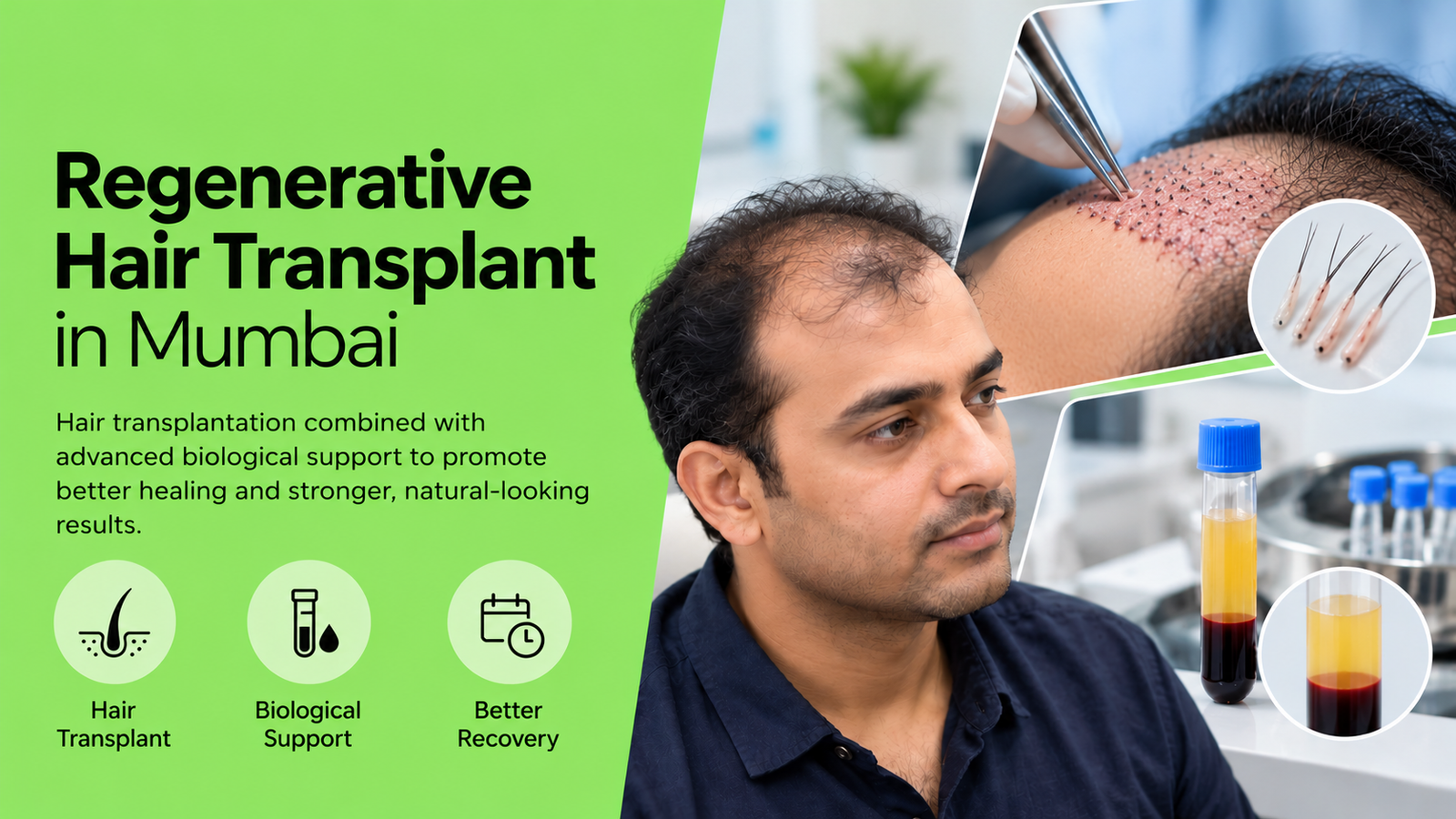
Regenerative Hair Transplant in Mumbai
Regenerative Hair Transplant describes an approach in which surgical hair transplantation is combined with selected biological or regenerative-support treatments according to the patient’s needs.
The surgical component transfers viable donor follicles into areas requiring hair restoration.
The supportive component may involve appropriately selected autologous blood-derived preparations, such as PRP, iPRF or GFC, when there is a reasonable clinical indication.
Regenerative Hair Transplant does not mean that entirely new follicles are created, that donor hair becomes unlimited or that every transplanted graft will survive.
The objective is to develop an individualised restoration plan that considers the recipient area, available donor follicles, surrounding native hair, scalp condition and long-term maintenance.
At Anagen Hair Transplant Clinic in Mumbai, the decision to combine surgery with biological adjuncts should be based on clinical assessment rather than the assumption that more treatments automatically produce a better outcome.
What Is Regenerative Hair Transplant?
Regenerative Hair Transplant is a broad descriptive term for a surgical hair-transplant procedure accompanied by selected biological support.
It is not one universally standardised operation.
The term can refer to different combinations of surgical methods and adjunctive treatments depending on the clinic and the protocol.
For patients, the most important distinction is between the structural and supportive components.
Surgical Hair Restoration
A hair transplant transfers viable donor follicular units to selected recipient sites.
These grafts form the basis of the new transplanted hair coverage.
Biological Support
Selected autologous blood-derived therapies may be considered for biological support around the scalp or remaining follicles.
Their benefits, limitations and scientific evidence vary.
Long-Term Native-Hair Management
The patient may also require ongoing evaluation and treatment of surrounding native hair.
Progressive pattern hair loss can continue after transplantation.
A comprehensive plan should therefore consider future hair loss as well as the immediate surgical result.
Regenerative Hair Transplant vs Conventional Hair Transplant
The surgical foundation of both approaches is the transfer of suitable donor follicles.
The term regenerative generally indicates that an additional biological-support component is being considered.
| Treatment Component | Conventional Hair Transplant | Regenerative Hair Transplant Approach |
|---|---|---|
| Donor assessment | Required | Required |
| Follicular extraction | Required | Required |
| Recipient implantation | Required | Required |
| Hairline design | Essential | Essential |
| Biological adjuncts | May or may not be included | Selected adjuncts considered under a defined protocol |
| Native-hair maintenance | May be necessary | May be incorporated into the broader plan |
| Guaranteed superior growth | No | No |
The inclusion of extra treatments does not independently establish a better outcome.
Which Biological Treatments May Be Considered?
Different blood-derived and regenerative approaches have been investigated in hair medicine.
Their use should be guided by clinical suitability, evidence and actual availability.
PRP — Platelet-Rich Plasma
PRP is a blood-derived preparation that has been studied as a supportive treatment for hair loss and as an adjunct to transplantation.
Some controlled transplantation studies report potentially useful outcomes, but preparation and outcome differences limit universal conclusions.
Read PRP-Assisted Hair Transplant.
iPRF — Injectable Platelet-Rich Fibrin
iPRF is an injectable, fibrin-forming blood-derived preparation.
Its biological properties have attracted interest in tissue-related applications, but stronger transplant-specific clinical evidence is required before claiming superior graft growth.
Read iPRF-Assisted Hair Transplant.
GFC — Growth Factor Concentrate
GFC refers to a blood-derived growth-factor concentrate approach.
The exact formulation and processing system matter.
Evidence from one product or preparation should not automatically be applied to another.
Read GFC-Assisted Hair Transplant.
Other Regenerative Approaches
Other therapies, including certain plasma derivatives, extracellular-vesicle-based products and experimental cellular approaches, are subjects of ongoing clinical investigation.
They are not interchangeable with PRP, iPRF or GFC.
Any Anagen-specific use of plasma lysate, autologous exosome preparations, FBM or another biological component must be verified individually for regulatory status, safety, processing standards, clinical indication and supporting evidence.
These approaches should not be presented as routine or proven components merely because they are described as regenerative.
What Is the Difference Between Transplanted Hair and Native Hair?
Understanding this distinction is essential for realistic expectations.
Transplanted follicles are physically moved from a donor area.
Native follicles are already present in the recipient or surrounding scalp.
A patient may have significant baldness in one region and miniaturised but living native follicles in another.
The two regions may need different treatment approaches.
Areas With Missing Follicles
Where follicular structures are no longer capable of producing meaningful hair, biological injections cannot reliably replace surgical donor-hair transplantation.
Areas With Miniaturising Native Hair
Some thinning areas still contain follicles producing progressively finer hairs.
These areas may benefit from diagnosis and appropriate medical treatment. Selected supportive therapies may also be considered.
Mixed Hair-Loss Patterns
Many patients have both bald and thinning areas.
The treatment plan may combine transplantation in selected zones with nonsurgical management of surrounding native hair.
Who May Be Considered for a Combined Surgical and Biological Plan?
A combined plan may be discussed for selected patients who need surgical restoration and also have separate concerns involving surrounding native hair or scalp condition.
However, not every patient requires an adjunct.
Relevant considerations include:
- Cause and stability of hair loss.
- Donor-hair quality and remaining supply.
- Extent of established baldness.
- Degree of native-hair miniaturisation.
- Previous hair transplants.
- Scalp inflammation or other skin disease.
- Medical conditions and medications.
- Patient expectations and long-term budget.
Some patients may benefit more from conventional transplantation with appropriate medical maintenance than from adding multiple biological treatments.
Other patients may not be suitable for transplantation at all.
A diagnosis and careful treatment plan should precede package selection.
How Is Regenerative Hair Transplantation Planned?
Step 1: Complete Hair-Loss Assessment
The clinician reviews the cause of hair loss, scalp condition, progression, medical history and previous treatments.
Step 2: Donor-Hair Evaluation
The available donor supply is assessed for density, hair characteristics, safe extraction and long-term preservation.
Step 3: Recipient-Area and Hairline Planning
The restoration plan identifies the appropriate hairline, distribution, density objectives and realistic surgical coverage.
Step 4: Selection of the Surgical Approach
The surgeon chooses a suitable method of follicular extraction and implantation.
Step 5: Assessment of Biological Adjuncts
The need for any PRP, iPRF, GFC or other verified therapy is considered individually, with attention to evidence, safety, cost and expected limitations.
Step 6: Follicular Unit Extraction
Viable donor follicles are obtained according to the selected surgical technique.
Step 7: Graft Preparation and Implantation
The harvested follicles are protected, sorted and placed in planned recipient positions.
Step 8: Biological Support Where Indicated
Any selected adjunct is administered according to the clinic’s verified protocol. Its timing and method are not assumed to be identical for every patient.
Step 9: Postoperative Healing and Monitoring
The patient follows the necessary wound-care instructions and attends postoperative reviews.
Step 10: Long-Term Hair-Loss Management
The clinician assesses transplanted growth and considers appropriate management of ongoing native-hair thinning.
Does Regenerative Hair Transplant Improve Graft Survival?
This question requires careful interpretation of the available evidence.
Some studies of platelet-derived therapies report potentially beneficial hair-related outcomes.
However, evidence varies across different products, techniques, patient populations and clinical endpoints.
More importantly, a study reporting improved native-hair density after an injection does not automatically prove improved survival of transplanted grafts.
The final outcome is influenced by donor characteristics, graft handling, recipient-site preparation, vascular supply, medical conditions and individual growth.
No regenerative adjunct can guarantee that every transplanted graft will survive.
Can Regenerative Hair Transplant Create New Hair Follicles?
Not as a clinically established outcome of the adjuncts discussed here.
PRP, iPRF and GFC should not be advertised as proven methods of creating entirely new human hair follicles in bald scalp.
Hair transplantation transfers existing viable follicles.
Biological support may be considered for selected tissue or existing follicle-related objectives, but it does not provide an unlimited substitute for donor hair.
Can Regenerative Treatment Eliminate the Need for Another Hair Transplant?
Not necessarily.
Patients with extensive baldness, limited donor supply or progressive future hair loss may still require staged surgical planning.
A supportive biological treatment does not increase the number of safely harvestable donor follicles.
For patients with substantial restoration needs, Advanced Donor Management and High Grade Baldness Restoration may provide more relevant planning information.
Recovery After Regenerative Hair Transplant
Postoperative healing remains primarily related to the surgical procedure.
Temporary redness, crusting, swelling, sensitivity and shedding of transplanted hair shafts may occur.
New visible growth often starts around three to four months, with increasing coverage over subsequent months.
A more meaningful surgical result is commonly assessed around nine to twelve months, although maturation can continue longer.
Biological adjuncts do not remove the normal growth cycle.
The patient’s recovery instructions must be based on the actual surgical and supportive procedures performed.
Risks and Limitations
Regenerative Hair Transplant remains a surgical hair-restoration procedure.
Potential complications include bleeding, infection, folliculitis, swelling, temporary numbness, scarring, donor-area thinning, graft failure, poor hair direction and cosmetic dissatisfaction.
Biological adjuncts may introduce additional considerations related to blood collection, scalp injections, processing methods, medical suitability and treatment-specific safety.
The strength of evidence varies between adjuncts.
Unnecessary combinations may increase cost and treatment burden without demonstrating proportionate benefit.
Patients should ask which specific component is being recommended, why it is necessary and what evidence supports its inclusion.
Regenerative Hair Transplant Cost in Mumbai
The total cost depends on the number of grafts, extraction and implantation technique, complexity of the restoration, selected adjuncts and any planned postoperative sessions.
A proper quotation should distinguish the essential surgical procedure from optional supportive treatments.
Patients should not assume that the most expensive combination is the most medically appropriate.
Regenerative Hair Transplant Results
A regenerative hair transplant should be evaluated through the complete restoration result.
Important considerations include believable hairline design, natural direction, donor preservation, graft growth, existing hair maintenance and realistic long-term coverage.
Results cannot be attributed solely to PRP, iPRF, GFC or another biological preparation.
Explore Anagen’s genuine Male Hair Transplant Results, Female Hair Transplant Results, Hairline Results, Crown Restoration Results or Repair Hair Transplant Results.
View hair transplant results.
Frequently Asked Questions
What is a regenerative hair transplant?
It generally means surgical hair transplantation combined with selected biological or regenerative-support therapies under an individualised plan.
Is regenerative transplantation different from FUE?
FUE describes the follicular extraction method. Regenerative terminology refers to additional supportive treatment considerations.
Can regenerative treatment create completely new hair follicles?
That is not an established clinical benefit of PRP, iPRF or GFC.
Is PRP, iPRF and GFC used together in every procedure?
No. The combination must be clinically justified. More adjuncts do not automatically produce better outcomes.
Does regenerative transplantation guarantee better density?
No. Final density depends on donor availability, graft growth, distribution and other surgical and biological factors.
Can regenerative treatment stop future baldness?
It cannot guarantee prevention of progressive pattern hair loss. Long-term management may still be required.
Can patients with extensive baldness choose regenerative transplantation?
Some may be candidates for surgical restoration, but suitability depends heavily on donor availability, recipient requirements and achievable coverage.
Book a Regenerative Hair Transplant Consultation in Mumbai
Choosing a regenerative treatment should begin with a clear surgical assessment.
The consultation should establish whether transplantation is necessary, how many grafts can safely be used, what coverage can realistically be achieved and whether any additional biological support is appropriate.
At Anagen, the objective should be a personalised restoration plan with clear clinical reasons for every proposed treatment component.
Send clear FRONT, TOP and BACK donor photographs for an initial assessment or contact Anagen Hair Transplant Clinic in Mumbai.