





Male Hair Thickening Prescription: Medical Options for Fine and Thinning Hair
Hair thickening and hair growth are related, but they are not identical.
Some men retain a substantial number of hairs across the scalp but notice that individual strands have become finer. The hair may appear flatter, scalp visibility may increase and previously dense areas may begin to look sparse.
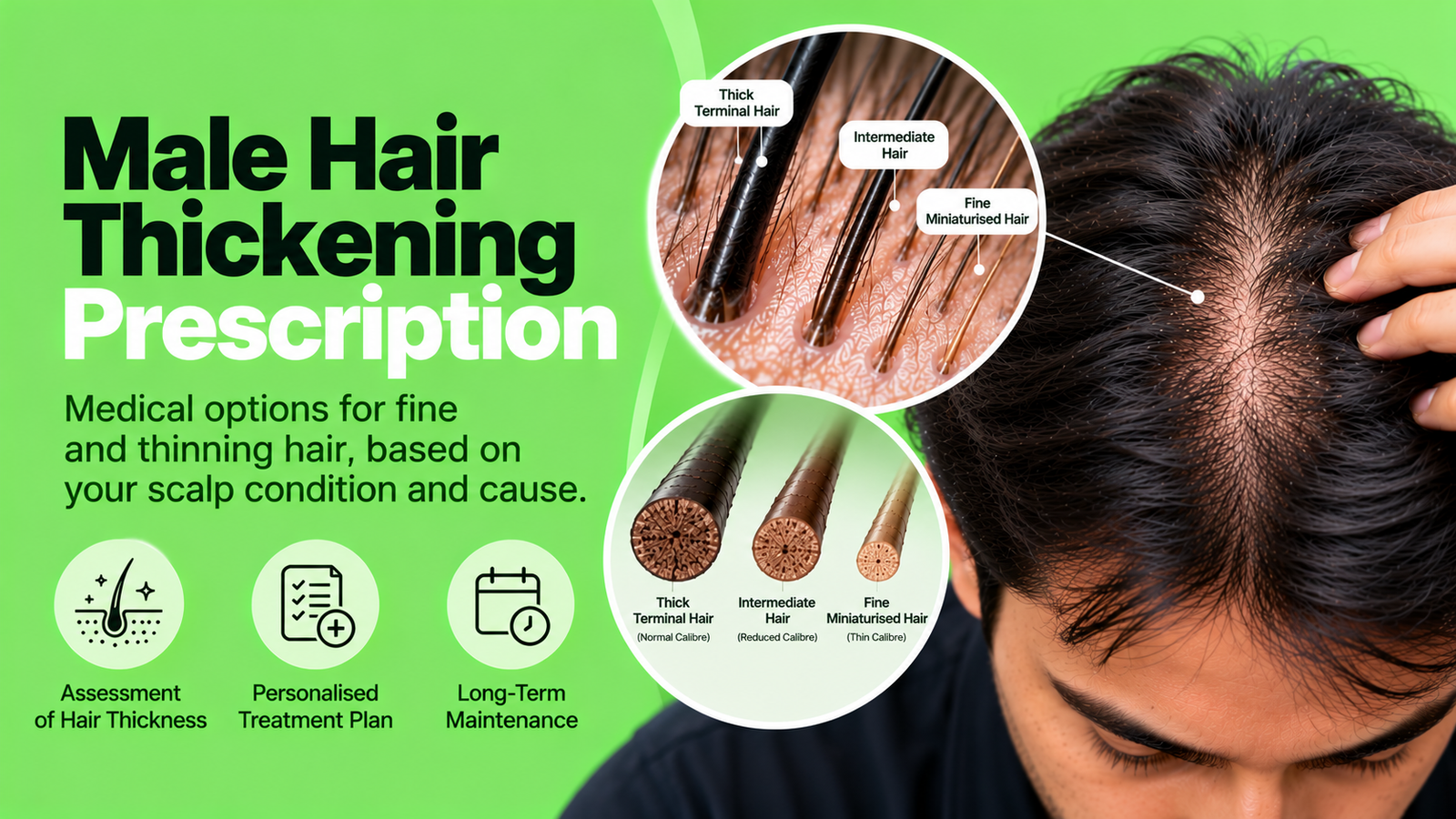
This change can occur when follicles progressively produce thinner hair shafts, a process known as follicular miniaturisation. However, fine-looking hair may also reflect natural hair characteristics, breakage or other conditions.
A male hair thickening prescription focuses on identifying why existing hair has become finer and determining whether medical treatment may help preserve or improve hair shaft calibre.
Hair thickening does not mean creating new hair follicles. Where follicles remain biologically responsive, an improvement in hair calibre may increase the appearance of density without increasing the number of follicles.
Why Does Male Hair Become Thinner?
Hair can appear thinner for several reasons.
Follicular Miniaturisation
In androgenetic alopecia, susceptible follicles may progressively produce finer hairs. This can reduce scalp coverage even before an area becomes visibly bald.
Naturally Fine Hair
Some men naturally have smaller hair shaft diameters. Fine hair is not automatically abnormal or evidence of disease.
Hair Shaft Damage
Repeated chemical exposure, excessive heat or mechanical damage may weaken or break the hair shaft, making overall hair volume appear reduced.
Increased Hair Shedding
When more hairs than usual are shed, the scalp may appear less dense even when remaining hair shafts are not significantly miniaturised.
Scalp or Medical Conditions
Certain inflammatory disorders, nutritional deficiencies and medical conditions can contribute to hair changes and should be assessed where suspected.
The appropriate prescription depends on which process is responsible.
Understanding Hair Calibre and Visual Density
Hair calibre describes the thickness of an individual hair shaft.
Hair density generally refers to the number of hairs within a given scalp area. Visual density is influenced by both hair count and hair characteristics.
A scalp with relatively thicker hair shafts may appear better covered than one with a similar number of much finer hairs.
Hair colour, curl, length, distribution and contrast with scalp colour also influence how much scalp remains visible.
Medical treatment may improve the calibre of some responsive miniaturised hairs, but the result depends on the underlying diagnosis and remaining follicular activity.
How Doctors Assess Fine and Thinning Male Hair
The doctor may examine the frontal scalp, mid-scalp, crown and relatively unaffected regions.
Relevant findings include:
- Variation in hair shaft thickness.
- Presence of progressively finer hairs.
- Hair density and scalp visibility.
- Distribution of thinning.
- Hair shaft breakage.
- Evidence of inflammation.
- Family history and rate of change.
- Previous treatments and medical conditions.
Trichoscopy may help identify a mixture of thick and fine hairs consistent with miniaturisation.
When hair has become finer predominantly at the frontal scalp or crown, androgenetic alopecia may be considered.
When the problem is mainly broken hair rather than follicular miniaturisation, a different management plan may be required.
Prescription Overview
Primary Concern: Existing male scalp hair becoming finer, with reduced visual density or increasing scalp visibility.
Likely Assessment Focus: Hair shaft calibre, miniaturisation, hair distribution, breakage and associated medical or scalp conditions.
Prescription Goal: Preserve existing responsive follicles and support appropriate improvement or maintenance of shaft calibre.
Possible Prescription Categories: Diagnosis-specific hair-growth medicines, androgenetic alopecia management where indicated and treatment of associated scalp or medical conditions.
Supportive Care: Gentle hair care, suitable scalp cleansing, management of shaft damage and correction of identified deficiencies.
Monitoring: Changes in hair calibre, scalp visibility, progression, treatment adherence and adverse effects.
Follow-Up: Clinical reassessment with appropriate scalp photographs or trichoscopy.
When Another Treatment May Be Considered: Extensive miniaturisation, limited remaining follicular activity or inadequate coverage despite suitable medical management.
What May Be Included in a Male Hair Thickening Prescription?
Treatment for Androgenetic Miniaturisation
When fine hair results from male androgenetic alopecia, established treatments such as topical minoxidil or selected prescription androgen-pathway medicines may be considered.
Some patients may experience improvement in the calibre or appearance of existing hair, while others may mainly experience reduced progression.
The choice of medicine requires review of suitability, adverse effects and long-term maintenance expectations.
Treatment for Hair Shaft Damage
When apparent thinness is caused by breakage, management may focus on reducing physical or chemical damage.
Conditioning products and appropriate hair-care practices may improve shaft manageability and reduce breakage. These measures do not create new follicles or treat progressive androgenetic alopecia.
Correction of Relevant Medical Factors
If an underlying medical disorder or nutritional deficiency contributes to reduced hair quality, clinically appropriate management may be necessary.
Supplements should not be presented as universal hair thickening medicines.
Management of Scalp Inflammation
Clinically significant dandruff, dermatitis or other scalp inflammation should be treated according to diagnosis.
Reducing inflammation can support scalp comfort and help address associated problems, but it should not be equated with reversing every cause of thinning.
How Is Hair Thickening Different From Hair Regrowth?
Hair regrowth generally refers to renewed or increased production of visible hair by existing follicles.
Hair thickening refers to an increase in the diameter or apparent fullness of existing hairs.
A patient may show some improvement in shaft calibre without developing substantial new visible coverage in an advanced bald region.
Similarly, increased growth after a temporary shedding condition does not necessarily mean individual hairs have become thicker.
The Male Hair Growth Prescription page addresses the broader goal of supporting hair production, while this page specifically addresses calibre and visual density.
Monitoring Changes in Hair Thickness
Monitoring should ideally use comparable scalp views and, where suitable, magnified measurements or examination.
The doctor may assess:
- Changes in the proportion of fine and thick hairs.
- Progression of scalp visibility.
- Whether shaft breakage continues.
- Stability of the thinning pattern.
- Treatment adherence and tolerance.
- Patient satisfaction with the appearance of existing hair.
Lighting, hair length and styling can substantially change how dense the scalp appears. Follow-up photographs should therefore be standardised where possible.
Long-Term Maintenance and Realistic Expectations
The treatment goal should be based on what is biologically achievable.
Some miniaturised follicles may respond to appropriate medical treatment, but others may have limited capacity for meaningful calibre improvement.
If androgenetic alopecia is responsible, long-term management may be needed to maintain treatment benefit.
When fine hair is mainly related to natural hair characteristics, a cosmetic hair-care strategy may be more relevant than prescription medicine.
No treatment can guarantee restoration of a patient’s original native hair thickness or density.
When May Biologix Therapy or Transplantation Be Considered?
Selected procedures such as PRP or GFC may be discussed for suitable patients with diagnosed hair thinning, with the limitations and quality of evidence explained.
These are not substitutes for identifying the underlying disorder.
Hair transplantation may be considered when medical management cannot provide adequate coverage and the patient has suitable donor follicles.
A transplant redistributes hair follicles; it is not a medicine that increases the calibre of existing native hairs.
Frequently Asked Questions
Can naturally fine male hair become thicker?
Naturally fine hair is not necessarily a medical disorder. Some disease-related miniaturised hairs may improve with suitable treatment, but normal genetically fine hair cannot be guaranteed to become thick.
Is hair thinning the same as hair loss?
Not always. Thinning may reflect reduced shaft calibre, fewer hairs, increased shedding or shaft breakage.
Can prescription medicine increase the number of hair follicles?
Established hair-loss medicines generally work through existing follicles. They do not reliably create a new population of follicles.
Can thickening treatment improve scalp coverage?
In some patients, improvement in existing hair calibre may increase apparent density. Results depend on diagnosis and treatment response.
Is miniaturisation always reversible?
No. The potential for improvement varies, and severe or prolonged miniaturisation may respond poorly.
Does hair thickening treatment require maintenance?
If progressive androgenetic alopecia is the cause, continuing appropriate management may be needed to maintain benefit.
Male Hair Thickening Consultation at Anagen
Hair that appears thin may be naturally fine, damaged, affected by increased shedding or progressively miniaturising.
Anagen’s hair prescription consultation can help distinguish these possibilities and determine whether medical thickening support, scalp treatment or another approach is appropriate.
A useful prescription should address the cause of reduced calibre rather than promise to create new follicles or restore original density.