





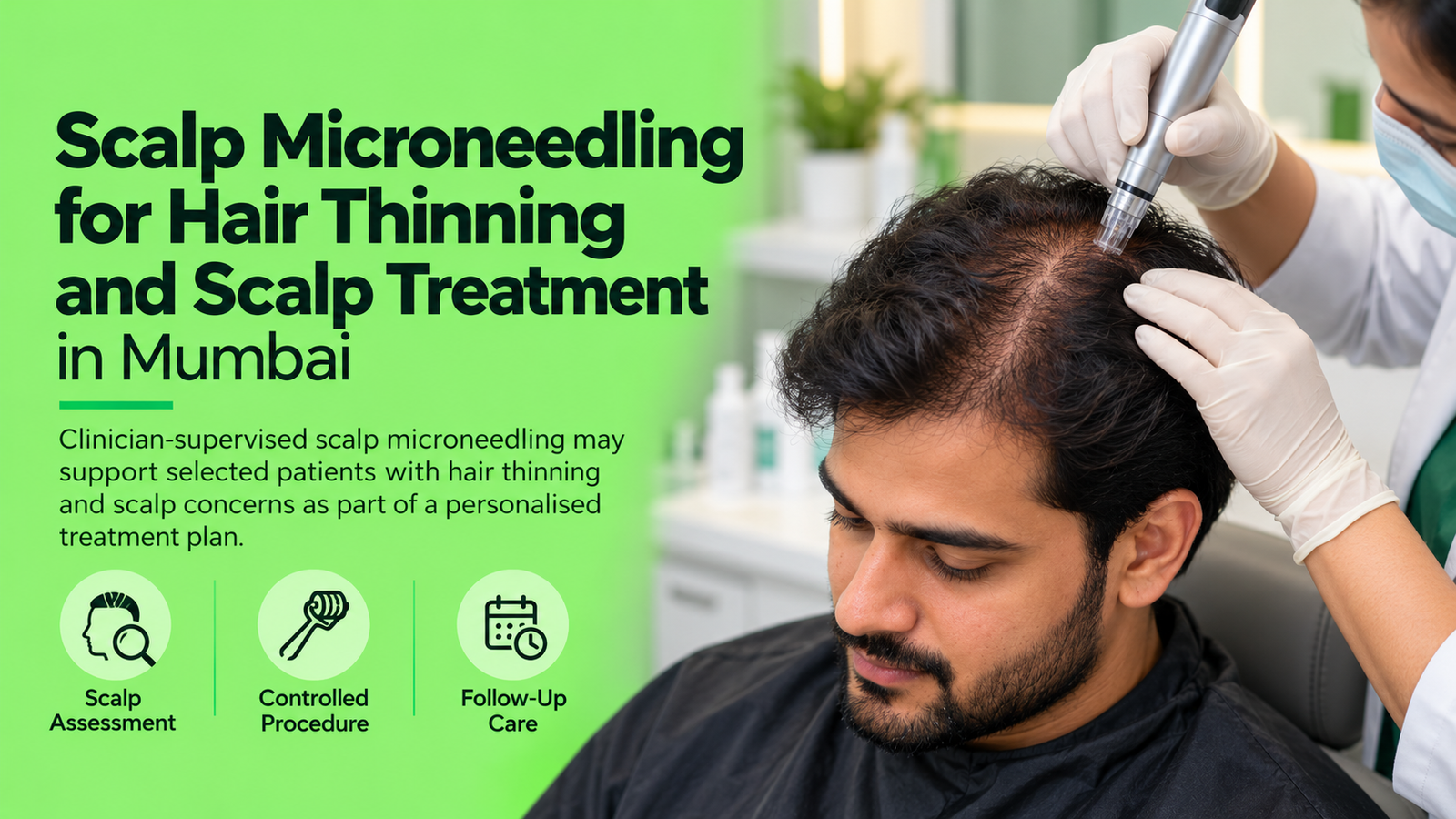
Scalp Microneedling for Hair Thinning and Scalp Treatment in Mumbai
Scalp microneedling is sometimes considered when patients are looking for additional treatment options for hair thinning. However, it is not a routine solution for every person experiencing hair fall.
The procedure uses controlled, small punctures in the scalp surface. Its potential benefit depends on the underlying hair-loss diagnosis, treatment technique and whether it is combined with other appropriate medical care.
At Anagen Hair Transplant Clinic in Mumbai, deciding whether scalp microneedling is suitable should begin with an assessment of both the hair follicles and the scalp skin.
What Is Scalp Microneedling?
Scalp microneedling is a minimally invasive procedure in which fine needles create small, controlled channels in the skin.
These micro-injuries initiate a local wound-healing response. Researchers have investigated whether this response can support hair-growth treatment, particularly in people with androgenetic alopecia.
Microneedling may also change how substances applied to the scalp penetrate the skin. That does not mean every medication, serum or biologic product is safe or appropriate to apply immediately after the procedure.
Device selection, needle settings, technique and use of additional treatments require individual clinical planning.
How Does Scalp Microneedling Work?
The procedure creates controlled micro-injuries rather than removing hair follicles or implanting new ones.
The response to these micro-injuries involves tissue repair and cell-signalling pathways. Research has examined their possible effect on follicular function and hair-growth treatment.
Some clinical studies suggest that microneedling combined with established medical therapy may provide additional benefits for selected patients with pattern hair loss.
However, research protocols differ, and evidence does not establish that every microneedling approach or combination is equally effective.
Who May Be a Suitable Candidate?
Scalp microneedling may be considered for selected adults with a confirmed hair-loss diagnosis, particularly those with pattern thinning and a clinically healthy scalp.
The assessment should consider:
- The type and stage of hair loss.
- Whether viable follicles remain in the treatment area.
- Existing scalp inflammation or sensitivity.
- Previous treatment responses.
- Skin-healing ability and medical history.
- Medication use and any increased bleeding or infection risk.
- Whether additional hair-loss treatment is necessary.
Microneedling may not be appropriate for patients with active scalp infections, open wounds, significant dermatitis, unexplained painful lesions or certain disorders affecting healing.
If a patient has persistent redness, scaling or itching, those symptoms should be investigated before proceeding.
Patients with these symptoms may first need scalp inflammation treatment or medical management of a diagnosed condition.
What Happens During Scalp Microneedling?
The procedure should follow a planned clinical sequence.
1. Scalp Examination
The treating clinician assesses the scalp, hair-loss pattern and areas proposed for treatment. Active infection or significant inflammation may require postponement.
2. Preparation
The scalp is prepared according to the clinical protocol, including appropriate hygiene and infection-control precautions. Pain-control measures, if required, are determined individually.
3. Controlled Microneedling
A suitable device is used over selected areas of the scalp. Technique and settings are chosen according to the treatment objective and patient factors.
4. Immediate Assessment
The scalp is examined after treatment, and instructions are provided for protecting the treated skin while it heals.
5. Follow-Up
Further sessions, if appropriate, are planned according to recovery, treatment response and clinical goals.
Microneedling Alone or With Other Hair Treatments?
Microneedling is often discussed as an adjunct to medical hair-loss treatment rather than an automatic replacement for it.
For selected patients, a clinician may consider it alongside a hair growth prescription or established topical treatment.
Patients may also ask whether it can be combined with PRP hair treatment, iPRF or mesotherapy.
These combinations should not be treated as interchangeable. Their evidence, practical protocols and safety considerations differ.
In particular, puncturing the scalp can increase absorption of subsequently applied substances. Patients should not independently apply concentrated serums, medications or cosmetic products to freshly needled skin.
Whether Anagen offers microneedling with biologic adjuncts requires confirmation.
Recovery and Aftercare
Temporary redness, sensitivity, discomfort and pinpoint bleeding may occur after microneedling.
The degree and duration of these effects depend on the procedure and individual skin response.
Patients should follow the treating clinician’s instructions regarding cleansing, physical activity, topical medication, sun exposure and when to resume normal scalp products.
Avoid scratching, harsh exfoliation and unsupervised application of potentially irritating substances while the scalp is recovering.
Increasing pain, spreading redness, pus, fever or unexpectedly prolonged irritation requires prompt medical advice.
When Can Results Be Expected?
Microneedling does not produce immediate hair growth.
For patients receiving it as part of hair-loss treatment, any meaningful assessment requires repeated observation over a period suited to the hair-growth cycle.
Treatment response may be influenced by the hair-loss diagnosis, concurrent therapy, individual healing and consistency of care.
Some patients may not experience a noticeable cosmetic benefit.
Progress should be reviewed rather than assuming that further sessions are always necessary.
How Many Microneedling Sessions Are Needed?
There is no single session schedule that suits all patients.
Research studies have used different treatment intervals and techniques, making it inappropriate to promise a universal number of sessions.
The treating clinician should decide whether repeat sessions are needed and whether sufficient recovery has occurred between treatments.
Scalp Microneedling Cost in Mumbai
Pricing may depend on the treatment area, equipment, procedure complexity, clinician involvement, follow-up and whether an additional therapy is clinically indicated.
The consultation should clarify what is included and whether the quoted treatment is microneedling alone or a combination package.
Frequently Asked Questions
Is scalp microneedling the same as a dermaroller?
Both involve fine needles, but devices, treatment precision, settings and clinical procedures can differ.
Does microneedling work for every type of hair loss?
No. Evidence is more relevant to selected pattern hair-loss patients, particularly when microneedling is used with appropriate medical treatment.
Is scalp microneedling painful?
Discomfort varies according to the device, technique, treatment area and individual sensitivity. Some patients require pain-control measures.
Can I perform scalp microneedling at home?
Professional scalp procedures require proper patient selection, hygiene and control of treatment settings. Unsupervised needling carries avoidable risks, including infection and injury.
Can I apply hair-growth serum immediately after microneedling?
Not without explicit instructions from the treating clinician. Skin penetration and irritation risk can change after needling.
Is microneedling suitable for dandruff or an inflamed scalp?
Active inflammatory or infectious scalp conditions should be assessed and managed before considering elective microneedling.
Book a Scalp Microneedling Suitability Assessment
Scalp microneedling may be useful within a carefully selected hair-loss treatment plan, but the procedure should not be recommended without understanding the patient’s scalp condition and diagnosis.
For an assessment of hair thinning and available treatment options, contact Anagen in Mumbai.