





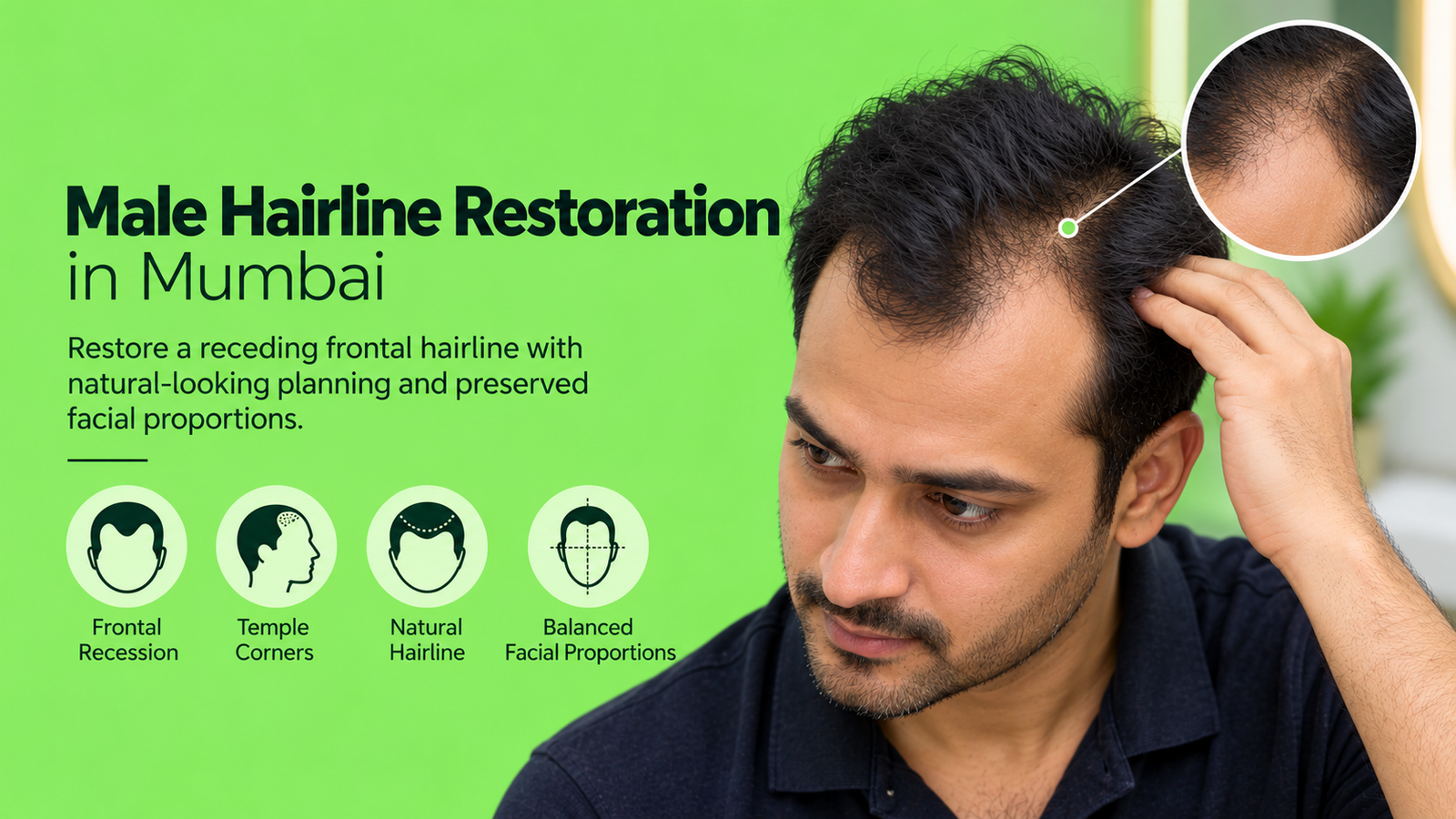
Male Hairline Restoration in Mumbai
A receding hairline can change the appearance of the forehead, temples and overall facial frame. For some men, recession is limited to the frontal corners. Others gradually lose the central hairline and develop thinning behind it.
Male hairline restoration is a focused hair transplant procedure designed to reconstruct lost frontal hair while maintaining natural facial proportions.
At Anagen Hair Transplant Clinic in Mumbai, the objective is not simply to create a lower hairline. It is to establish a position and shape that suit your face, age, existing hair and potential future hair loss.
What Is Male Hairline Restoration?
Male hairline restoration is the surgical reconstruction of a partially or extensively receded frontal hairline using suitable follicular units harvested from a donor area.
The recipient area generally includes the central frontal border and one or both frontotemporal corners. The treatment may also extend a short distance behind the hairline if the remaining frontal hair is thin.
The aim is to recreate a believable transition from forehead skin into growing hair. This requires more than filling an empty area with grafts.
Patients seeking broader restoration behind the frontal boundary may also benefit from understanding Front Hair Transplant planning.
Why Does the Male Hairline Recede?
Frontal recession commonly occurs because of androgenetic alopecia, although a change in the hairline does not automatically mean severe baldness.
Genetic susceptibility causes selected follicles around the temples and frontal scalp to miniaturise over time. The corners may gradually move backwards while the central forelock remains intact.
Some adult men also develop a mature hairline without extensive progressive baldness.
Before recommending surgery, the doctor needs to distinguish stable mature recession from actively progressing hair loss, as the future pattern may influence where the reconstructed hairline should be positioned.
How Is the Correct Hairline Position Decided?
A suitable hairline position depends on the relationship between the forehead, eyebrows, temples and remaining scalp hair.
The lowest possible position is not necessarily the most natural or sustainable.
An excessively low hairline can consume additional donor grafts and become difficult to maintain aesthetically if further hair loss occurs behind it.
During planning, the doctor examines facial proportions from frontal, oblique and profile views. Hairline height, central contour, frontal corners and the proposed density are considered together.
The planned boundary should also respect the patient’s age and likely progression. Men specifically interested in a more conservative adult pattern can read about Mature Hairline Reconstruction.
What Makes a Restored Hairline Look Natural?
A convincing hairline depends on several technical and aesthetic decisions.
Soft Leading-Edge Hairs
Appropriately selected single-hair follicular units are commonly positioned at the visible frontal boundary. They help create a softer transition than thick multi-hair grafts placed at the foremost edge.
Gradual Density
Hair density should generally increase behind the first transitional zone. A uniformly dense first row can produce an artificial appearance.
Natural Direction and Angle
New hairs should follow the expected regional growth pattern. The frontal scalp, frontal corners and temples do not all share the same direction.
Subtle Irregularity
A natural frontal border usually contains small variations in individual hair positions instead of a rigid continuous line.
These principles are explained in greater technical and visual detail in Natural Hairline Design.
How Are the Temples and Frontal Corners Planned?
The temporal transition is particularly important because it determines how the reconstructed frontal line joins the existing side hair.
The frontal corners should not be treated as isolated empty triangles without considering the direction, calibre and recession of the temples.
In some patients, only the frontal corners need reconstruction. In others, limited temple-point work may be considered to create appropriate continuity.
Temple transplantation requires careful donor-hair selection and very precise directional planning. Reconstructing temples too aggressively can produce an unnatural result and use donor hair that may be needed later.
How Is Male Hairline Restoration Performed?
Step 1: Recession and Donor Assessment
The doctor assesses frontal recession, existing hair density, donor supply and the likely progression of hair loss.
Step 2: Hairline Position and Shape Planning
The desired frontal position, central outline and frontal corners are discussed and marked conservatively.
Step 3: Graft Requirement and Distribution
The recipient area is measured, and graft requirements are estimated according to the width of recession, intended coverage and existing native hair.
Step 4: Local Anaesthesia and FUE Extraction
Suitable grafts are harvested from the planned donor region under appropriate anaesthesia and clinical supervision.
Step 5: Graft Selection
Fine single-hair follicular units are identified for the leading edge, while other grafts are allocated according to the planned density transition.
Step 6: Recipient-Site Creation
Sites are created with attention to natural direction, angle, spacing and the presence of surrounding native follicles.
Step 7: Implantation
The selected follicular units are placed to produce a soft frontal transition with appropriate regional density.
Step 8: Post-Procedure Review
The patient receives recovery instructions and follow-up advice, including information about temporary shedding and later growth.
How Many Grafts Are Needed for Male Hairline Restoration?
Graft requirements vary considerably.
Limited frontotemporal corner work may require fewer grafts than reconstruction of an entire receded frontal border. An illustrative range for some focused hairline cases may be approximately 800–2,000 grafts, but substantially smaller or larger requirements are possible.
A precise estimate requires scalp photographs, direct recipient-area measurement and donor assessment.
The important consideration is not simply achieving a large graft number; it is using suitable follicular units in the correct locations while preserving donor reserve.
Hairline Transplant Recovery and Growth
Following FUE, small crusts and redness are common during early healing. Swelling and temporary sensitivity may also occur.
Transplanted hair shafts frequently shed in the first few weeks. This does not necessarily indicate failure.
Visible new growth commonly begins around three to four months. Frontal improvement generally becomes more apparent between six and nine months, with maturation often assessed around 12 months or later.
Male Hairline Restoration Results
A natural hairline should complement a patient’s face, age and existing hair pattern rather than follow a fixed design template.
Genuine Hairline Results can help demonstrate different frontal shapes, hairline positions and temple transitions. When reviewing results, examine the leading edge and side views, not just the central frontal density.
View hairline restoration results.
What Does Male Hairline Restoration Cost?
The cost depends on the extent of recession, recipient-area measurements, graft requirements, donor characteristics and complexity of the hairline and temple design.
Restoring two limited frontal corners may require a different plan from reconstructing a broad frontal boundary with additional thinning behind it.
A personalised estimate is provided after suitable assessment.
Frequently Asked Questions
Can a receding hairline be brought forward?
In suitable patients, hair transplantation can establish a new frontal boundary. The amount it can be advanced depends on facial proportions, donor availability and long-term planning.
Will the hairline look natural when I cut my hair short?
The intended appearance should remain natural at different viewing angles and reasonable hair lengths, but results depend on graft selection, direction, healing and growth.
Should both temples be filled completely?
Not necessarily. Complete closure of temporal recession may be inappropriate in mature hairline designs or patients with limited donor reserves.
Can I restore only the frontal corners?
Yes, in selected cases. The central hairline, donor reserve and future pattern still need assessment.
What if my remaining hair continues to recede?
Medical maintenance or further treatment may be required. This possibility should influence the original hairline position.
Can a previously unnatural hairline be corrected?
Some cases can be improved through Repair Hair Transplant planning, although correction may involve graft removal, redistribution or staged reconstruction.
Plan Your Male Hairline Restoration at Anagen
If your frontal corners are receding or your original hairline has moved backwards, a focused hairline assessment can help determine what should be restored and what should be preserved.
Send clear FRONT, LEFT TEMPLE, RIGHT TEMPLE, TOP and BACK DONOR photographs.
Anagen can review your existing hairline and discuss a suitable position, likely graft requirement and options for natural-looking restoration.
ANAGEN Hair Transplant Clinic — Andheri West, Mumbai
Call / WhatsApp: +91 92222 22407