





Male Pattern Baldness Prescription: Diagnosis, Medical Treatment and Long-Term Hair Loss Management
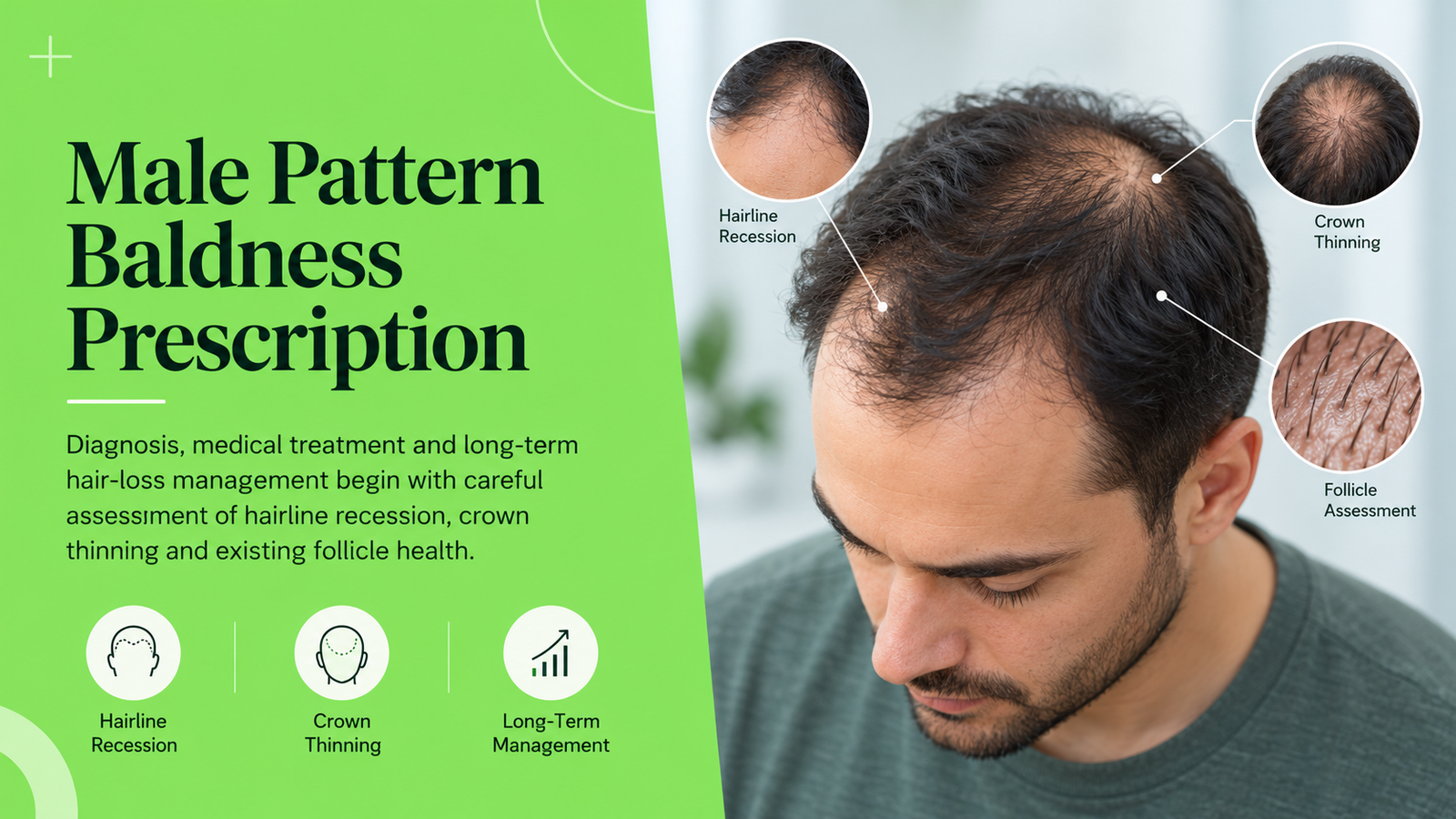
Male pattern baldness commonly begins with gradual recession at the temples, thinning around the frontal hairline or reduced hair density at the crown. In some men, these changes progress slowly over many years. In others, visible thinning develops earlier or advances more rapidly.
A male pattern baldness prescription focuses on identifying the underlying condition, evaluating the remaining hair follicles and selecting medical treatment that may help preserve existing hair or improve thinning hair where biologically possible.
Prescription management is different from hair transplantation. Its primary purpose is generally to manage the progression of hair loss and support existing follicles rather than replace hair that has already been lost.
The appropriate treatment depends on the patient’s hair-loss pattern, medical history, degree of follicular miniaturisation, scalp condition and individual treatment goals.
Recognising the Pattern of Male Baldness
Male pattern baldness, medically known as male androgenetic alopecia, usually affects specific areas of the scalp.
Common patterns include:
- Temple recession: Gradual movement of the frontal hairline backwards at one or both temples.
- Frontal thinning: Reduced hair density behind the anterior hairline.
- Crown thinning: Progressive visibility of the scalp around the vertex.
- Combined thinning: Hair loss affecting the frontal scalp, mid-scalp and crown.
- Advanced patterned hair loss: More extensive reduction of hair coverage across the upper scalp.
Hairline recession does not always indicate active disease. A naturally mature hairline may remain stable. Clinical assessment helps distinguish a stable hairline from progressive follicular miniaturisation.
Clinical Assessment Before Prescribing Treatment
The first step is establishing whether the patient has androgenetic alopecia or another condition that resembles it.
During consultation, the doctor may examine:
- Age when hair thinning began.
- Family history of patterned hair loss.
- Rate and distribution of hair loss.
- Hairline, temple, mid-scalp and crown density.
- Hair shaft calibre and variation in thickness.
- Evidence of follicular miniaturisation.
- Scalp inflammation, dandruff or irritation.
- Previous medicines and hair-loss treatments.
- Medical conditions, supplements and other relevant factors.
Clinical photographs and trichoscopy may be used to document the baseline condition.
Trichoscopy is a magnified examination of the hair and scalp. It can help identify differences in hair shaft thickness, the proportion of finer hairs and other findings associated with particular hair-loss disorders.
Blood investigations are not automatically necessary for every man with typical pattern baldness. They may be considered when the medical history or examination suggests another contributing condition.
Prescription Overview
Primary Concern: Progressive male-pattern hairline recession, temple thinning, frontal thinning or crown hair loss.
Likely Assessment Focus: Hair-loss distribution, progression, follicular miniaturisation, remaining hair density and scalp condition.
Prescription Goal: Reduce further hair loss where possible, preserve existing hair and support the growth or calibre of responsive follicles.
Possible Prescription Categories: Topical hair-growth medicines, selected oral medicines, androgen-pathway management where appropriate and treatment for associated scalp disorders.
Supportive Care: Suitable scalp cleansing, management of inflammation and nutritional correction when a deficiency is identified.
Monitoring: Standardised clinical photographs, scalp examination, treatment tolerance, visible progression and treatment response.
Follow-Up: Clinician-planned reviews to assess tolerability, adherence, response and the need for treatment adjustment.
When Another Treatment May Be Considered: When medical treatment provides inadequate cosmetic coverage, when established bald areas have limited remaining follicular reserve or when selected adjunctive treatment may be useful.
What May Be Included in a Male Pattern Baldness Prescription?
1. Topical Hair-Growth Treatment
Topical minoxidil is an established treatment option for male androgenetic alopecia. It may help maintain or improve growth in some patients with responsive hair follicles.
Its suitability depends on the diagnosis, scalp condition, previous treatment response and the patient’s ability to follow the recommended regimen.
Possible problems include scalp irritation, unwanted hair growth outside the intended area and an initial change in shedding. Patients should discuss concerning symptoms with their clinician.
2. Oral Medical Treatment
Finasteride is a recognised prescription option for male androgenetic alopecia. It acts on androgen metabolism and may help slow progression in appropriately selected men.
Its use requires consideration of sexual adverse effects, breast symptoms, mood changes, reproductive concerns, medical history and patient preferences. Mood changes, including depression and suicidal thoughts, are particularly important safety considerations.
Other systemic options may sometimes be discussed by a specialist, but their regulatory status, evidence, contraindications and monitoring requirements differ.
3. Management of Associated Scalp Conditions
A patient may have androgenetic alopecia together with dandruff, seborrhoeic dermatitis or another inflammatory scalp disorder.
When clinically significant, these conditions should be assessed and treated appropriately. Scalp treatment may improve comfort and reduce associated inflammation, but it does not automatically reverse genetic hair loss.
4. Correcting Identified Deficiencies
Nutritional supplements should not be prescribed routinely as a substitute for diagnosis.
If a clinically relevant deficiency is suspected and confirmed, appropriate correction may form part of the overall treatment plan.
How Should Prescription Treatment Be Used?
Correct treatment use is an important part of managing progressive hair loss.
Patients should follow the prescribed instructions regarding the selected formulation, administration method, schedule and precautions. Medicines should not be changed, combined or stopped without discussing relevant concerns with the treating clinician.
More medicine does not necessarily produce better results, and inconsistent treatment can make response difficult to assess.
The exact medicine, formulation, frequency and duration should be selected according to the patient’s diagnosis, medical history, tolerance and treatment plan.
Monitoring Hair-Loss Progression and Treatment Response
A medical prescription should include a method for evaluating whether the treatment is helping.
The doctor may compare baseline and follow-up photographs of the hairline, temples, mid-scalp and crown. Where appropriate, magnified examination can help assess the proportion of thicker and finer hairs.
Useful indicators include reduced progression, stability of existing hair, changes in shaft calibre and the patient’s tolerance of treatment.
Hair growth is gradual, and an early photograph cannot establish final treatment effectiveness. A clinician should set an appropriate assessment interval rather than promising an immediate visible change.
Long-Term Maintenance of Existing Hair
Male androgenetic alopecia is generally a progressive condition.
Some medicines help maintain their benefit only while treatment continues. If treatment is discontinued, supported hair may gradually lose the benefit obtained during therapy.
Long-term maintenance may therefore be relevant, especially in younger men with ongoing hair loss and substantial native hair coverage.
A maintenance plan should be reviewed periodically for effectiveness, safety, tolerability, adherence and changes in treatment goals.
When May Biologix Therapy or Hair Transplantation Be Considered?
Prescription management is not the only option for every patient.
Selected adjunctive approaches, including PRP Hair Treatment, iPRF Hair Treatment or Advanced GFC Hair Treatment, may be discussed after diagnosis. Their indications and supporting evidence are not identical, and they should not be presented as mandatory substitutes for established medical treatment.
Hair transplantation may be considered when an area has insufficient native hair coverage and the patient has an appropriate donor supply, stable expectations and a suitable long-term restoration plan.
The Male Pattern Baldness Hair Transplant, Male Hairline Restoration and Crown Hair Transplant pages should address surgical planning in greater detail.
Even after transplantation, medical management may remain relevant for progressive loss of the patient’s existing native hair.
Realistic Expectations From Prescription Treatment
Prescription treatment may help some men maintain existing hair, slow progression or improve the appearance of thinning areas.
However, treatment cannot guarantee complete regrowth, permanently cure male pattern baldness or restore every follicle to its previous condition.
Men with earlier-stage miniaturisation may have different treatment potential from those with long-established smooth bald areas.
Treatment choice should account for the likely benefit, potential adverse effects, financial commitment and maintenance requirements.
Frequently Asked Questions
Can male pattern baldness be treated with prescription medicine?
Yes. Established medical treatments may help slow progression or improve hair growth in appropriately selected men. Results vary, and the underlying diagnosis should be confirmed first.
Can medication regrow a completely bald hairline?
Medical treatment has limited potential where there is little remaining responsive follicular activity. Completely bald areas may require consideration of other restoration strategies.
Does male pattern baldness treatment need to continue?
Some treatments require continued use to maintain their benefits. The treatment plan and duration should be reviewed with the prescribing clinician.
Can prescription treatment help crown thinning?
Some patients with crown thinning and responsive follicles may benefit from medical treatment. The extent of miniaturisation and remaining hair coverage influence expectations.
Should I start prescription medication before considering a transplant?
Medical management may be appropriate before surgery, but this depends on the patient’s diagnosis, age, progression, donor characteristics and objectives.
Can medicine and hair transplantation be combined?
Yes, in selected patients. Surgery redistributes suitable donor hair, while appropriate medical management may help address ongoing hair loss in native hair.
Hair Prescription Consultation at Anagen, Mumbai
Receding temples, crown thinning and frontal hair loss require an individualised assessment rather than a universal prescription.
Anagen’s hair prescription consultation can help determine whether the priority is preserving existing hair, treating progressive miniaturisation, addressing an associated scalp condition or assessing suitability for hair restoration.
The objective is to develop a clinically appropriate plan with realistic expectations and defined follow-up requirements.