





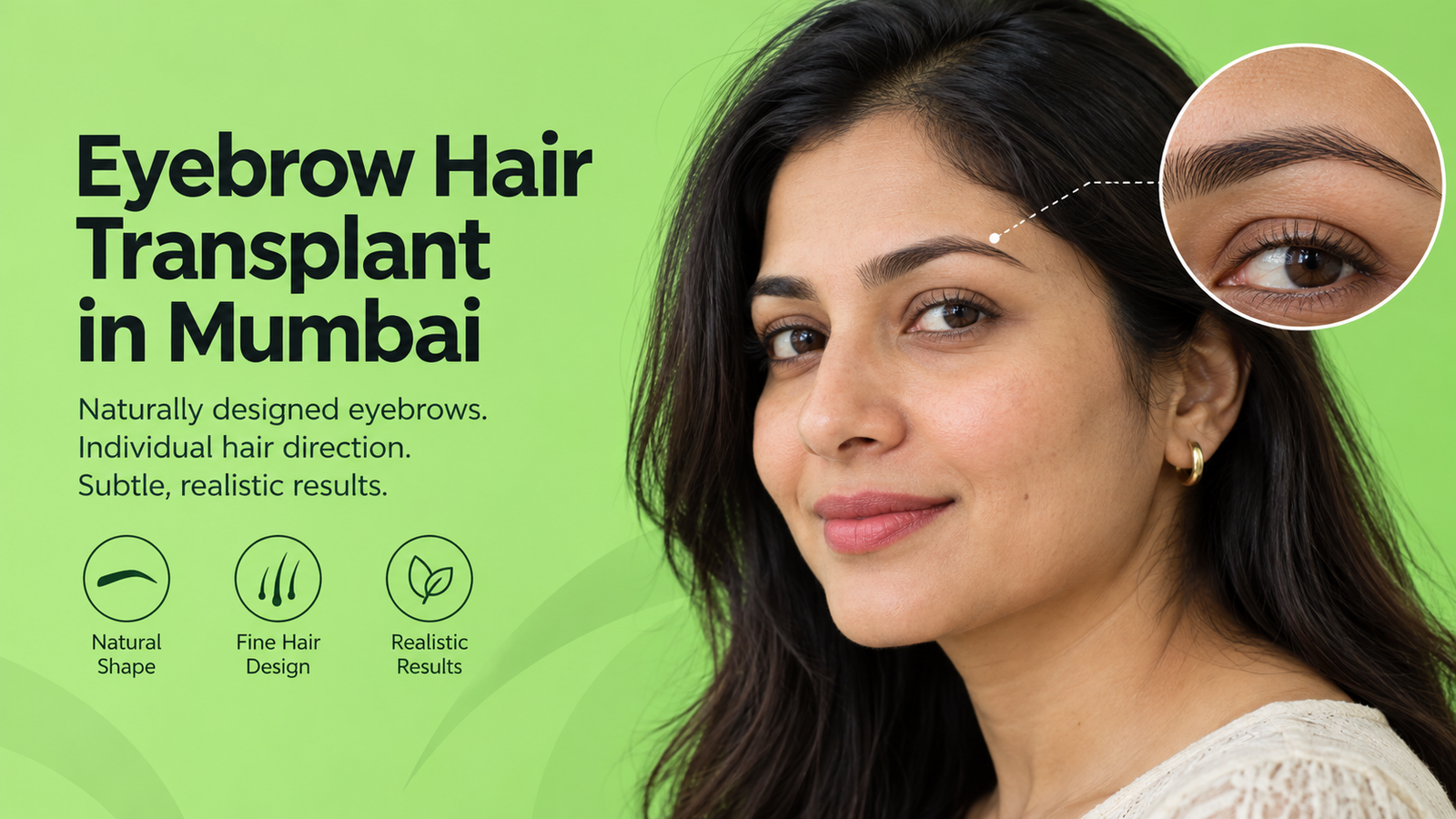
Eyebrow Hair Transplant in Mumbai
Eyebrows influence facial expression, balance and the overall appearance of the eyes. When eyebrow hair is naturally sparse, partially missing or permanently lost, an eyebrow hair transplant may help restore a fuller and more defined appearance.
At Anagen Hair Transplant Clinic in Mumbai, eyebrow transplantation is planned according to each patient’s existing eyebrow pattern, facial proportions, donor-hair characteristics and restoration requirements.
The aim is not simply to add more hair. It is to create an eyebrow that complements the face, respects natural hair-growth directions and remains manageable as the transplanted hair grows.
Not everyone with thin eyebrows requires transplantation. Identifying the cause of eyebrow hair loss is an important part of deciding whether surgery is appropriate.
What Is an Eyebrow Hair Transplant?
An eyebrow hair transplant is a surgical procedure in which suitable hair follicles are collected from a donor area, usually the scalp, and transplanted into selected areas of the eyebrows.
Follicular Unit Extraction (FUE) allows individual follicular units to be obtained without removing a long strip of scalp. For eyebrow restoration, appropriately selected single-hair grafts are generally preferred because natural eyebrow hairs grow individually and lie relatively flat against the skin.
Each graft must be positioned according to the intended eyebrow shape, hair direction and local growth pattern. Unlike eyebrow makeup or cosmetic tattooing, transplantation introduces living hair follicles capable of growing hair. However, transplanted scalp hair may continue to grow differently from native eyebrow hair, making periodic trimming necessary.
Who May Benefit From Eyebrow Hair Transplantation?
An eyebrow transplant may be considered for people with:
- Naturally sparse eyebrows.
- Persistent gaps caused by previous over-plucking.
- Partial or extensive eyebrow hair loss.
- Uneven eyebrows where additional hair may improve balance.
- Stable eyebrow hair loss following selected injuries or previous procedures.
Suitability depends on the cause of hair loss, the condition of the eyebrow skin, donor-hair availability and realistic expectations.
Patients with sudden eyebrow thinning, patchy hair loss, itching, redness, scaling or progressively disappearing eyebrows may require dermatological assessment before transplantation.
Conditions such as alopecia areata, thyroid-related hair loss and inflammatory or scarring disorders may need medical treatment and stabilisation first.
Different Types of Eyebrow Restoration
Eyebrow transplantation can address several different problems, but the treatment plan is not identical for every patient.
Patients with extensive or almost complete eyebrow loss may need Eyebrow Reconstruction, where the eyebrow shape and hair distribution must be planned substantially from the beginning.
Patients who already have eyebrows but want additional fullness may be suitable for Eyebrow Density Enhancement, which concentrates on carefully filling selected areas without disturbing existing hair.
When eyebrow hair is interrupted by a mature scar, Eyebrow Scar Repair requires additional evaluation of the scarred tissue.
For patients primarily concerned about shape, arch, balance or hair direction, Natural Eyebrow Design explains the planning principles used during restoration.
Why Donor-Hair Selection Matters
Natural eyebrow hairs are usually relatively fine and have distinctive direction and growth characteristics.
Scalp hair may be suitable for eyebrow transplantation, but its thickness, texture, curl and growth behaviour must be considered.
The surgeon assesses available donor areas and selects appropriate follicles based on the patient’s eyebrow requirements.
Fine-calibre hair can be especially useful when creating soft eyebrow borders or restoring naturally delicate eyebrows.
Hair that is excessively thick, curly or different from the surrounding eyebrow hair may produce an undesirable contrast.
The donor selection must therefore support the intended eyebrow appearance rather than simply provide the required number of grafts.
How Is an Eyebrow Hair Transplant Performed?
Step 1: Consultation and Eyebrow Assessment
The surgeon examines existing eyebrow hair, the location and extent of hair loss, skin condition and possible medical causes.
The assessment also includes donor-hair availability, previous cosmetic treatments and the patient’s preferred eyebrow appearance.
Step 2: Individualised Eyebrow Design
The proposed eyebrow outline is discussed with the patient.
The surgeon evaluates facial proportions and identifies the eyebrow head, body, arch and tail.
Hair direction, natural asymmetry and the transition between existing and newly transplanted hair are considered.
Step 3: Donor-Hair Selection
Suitable donor follicles are identified, usually from the scalp.
Hair thickness, texture and compatibility with the desired eyebrow appearance influence selection.
Step 4: Local Anaesthesia
The donor and recipient areas are prepared, and appropriate local anaesthesia is administered.
The medical team monitors patient comfort throughout the procedure.
Step 5: Follicular Unit Extraction
Selected follicular units are carefully extracted from the donor area.
Individual grafts are evaluated to identify those suitable for eyebrow restoration.
Step 6: Graft Preparation
The harvested grafts are examined and prepared for implantation.
Suitable single-hair grafts are selected according to the planned eyebrow design.
Step 7: Recipient-Site Planning
Recipient sites are planned according to the changing direction of eyebrow hair.
The proposed exit angles are kept low where anatomically appropriate so that the transplanted hairs follow the natural contour of the eyebrow.
Step 8: Graft Implantation
Prepared follicles are implanted into the planned eyebrow regions.
Careful attention is paid to hair orientation, spacing, natural borders and integration with existing eyebrow hair.
Step 9: Post-Procedure Care
The patient receives individual instructions covering eyebrow protection, hygiene, expected shedding, follow-up and activity restrictions.
Follow-up assessment helps monitor healing and subsequent hair growth.
Why Hair Direction and Exit Angle Are Important
Eyebrow hair does not grow in one uniform direction.
The eyebrow head, central body and tail contain different hair patterns. The upper and lower borders can also have distinct directions, with hairs often converging towards one another.
Incorrectly oriented transplanted hairs can become more noticeable as they grow.
The surgeon must therefore consider each region separately rather than using identical angles and directions across the entire eyebrow.
Recovery and Eyebrow Hair Growth
Mild swelling, redness, small crusts and temporary discomfort may occur after transplantation.
The initial healing phase usually occupies the first several days, although individual recovery varies.
Some transplanted hair shafts may shed during the first few weeks. This does not necessarily indicate that the follicles have failed.
New growth usually develops gradually over the following months. Early hairs may appear fine, sparse or uneven before coverage improves.
The developing result is generally assessed over approximately 9–12 months, and some patients may require longer for the appearance to settle.
The exact recovery and growth pattern varies according to the individual, the procedure and the condition of the recipient skin.
Maintenance After Eyebrow Transplantation
Transplanted scalp hair may retain scalp-like growth characteristics after being transferred to the eyebrows.
As a result, regular trimming may be necessary.
Some patients also need occasional grooming to maintain the preferred direction of individual hairs.
The required maintenance depends on the donor hair and how it behaves after transplantation.
These practical considerations should be discussed before surgery.
Eyebrow Hair Transplant Results: What Can You Expect?
The aim of eyebrow transplantation is to improve eyebrow coverage while achieving a shape and hair pattern appropriate for the individual.
Final appearance depends on donor-hair compatibility, the original eyebrow condition, hair direction, recipient-tissue suitability and healing.
Not every patient can achieve identical density or perfect symmetry. Some patients may benefit from additional treatment after the initial result has matured.
You can explore Anagen’s eyebrow restoration cases to better understand different treatment requirements and realistic outcomes.
What Determines the Cost of Eyebrow Hair Transplantation?
The cost depends on the extent of eyebrow hair loss, the number of grafts required, donor-hair assessment and the complexity of the proposed restoration.
Patients requiring limited density enhancement may have different treatment requirements from those needing extensive reconstruction or transplantation into scarred skin.
An individual consultation is necessary to establish a meaningful treatment plan and estimate.
Frequently Asked Questions
Is eyebrow transplantation permanent?
Successfully established transplanted follicles can provide long-term hair growth. However, outcomes vary, and transplantation does not guarantee that every graft will survive.
Will I need to trim my transplanted eyebrows?
Yes, regular trimming is commonly required when scalp hair is used because it may retain its original growth characteristics.
Can both eyebrows be treated in one procedure?
Both eyebrows can often be treated during the same procedure, depending on the patient’s requirements, donor availability and surgical plan.
Is eyebrow transplantation suitable for alopecia areata?
Not automatically. Active alopecia areata requires medical assessment and management. Transplantation may be inappropriate if the condition remains active or unstable.
Will my eyebrows look exactly identical?
Natural eyebrows are rarely perfectly symmetrical. Surgical planning aims to achieve appropriate facial balance while respecting individual anatomy and growth characteristics.
Book an Eyebrow Hair Transplant Consultation in Mumbai
If you have sparse, partially missing or uneven eyebrows, a personalised assessment can help determine whether transplantation, medical treatment or another approach is appropriate.
At Anagen Hair Transplant Clinic, your consultation includes assessment of your eyebrow condition, donor-hair characteristics, treatment expectations and the feasibility of restoration.
Contact Anagen Hair Transplant Clinic to discuss your eyebrow restoration requirements.