





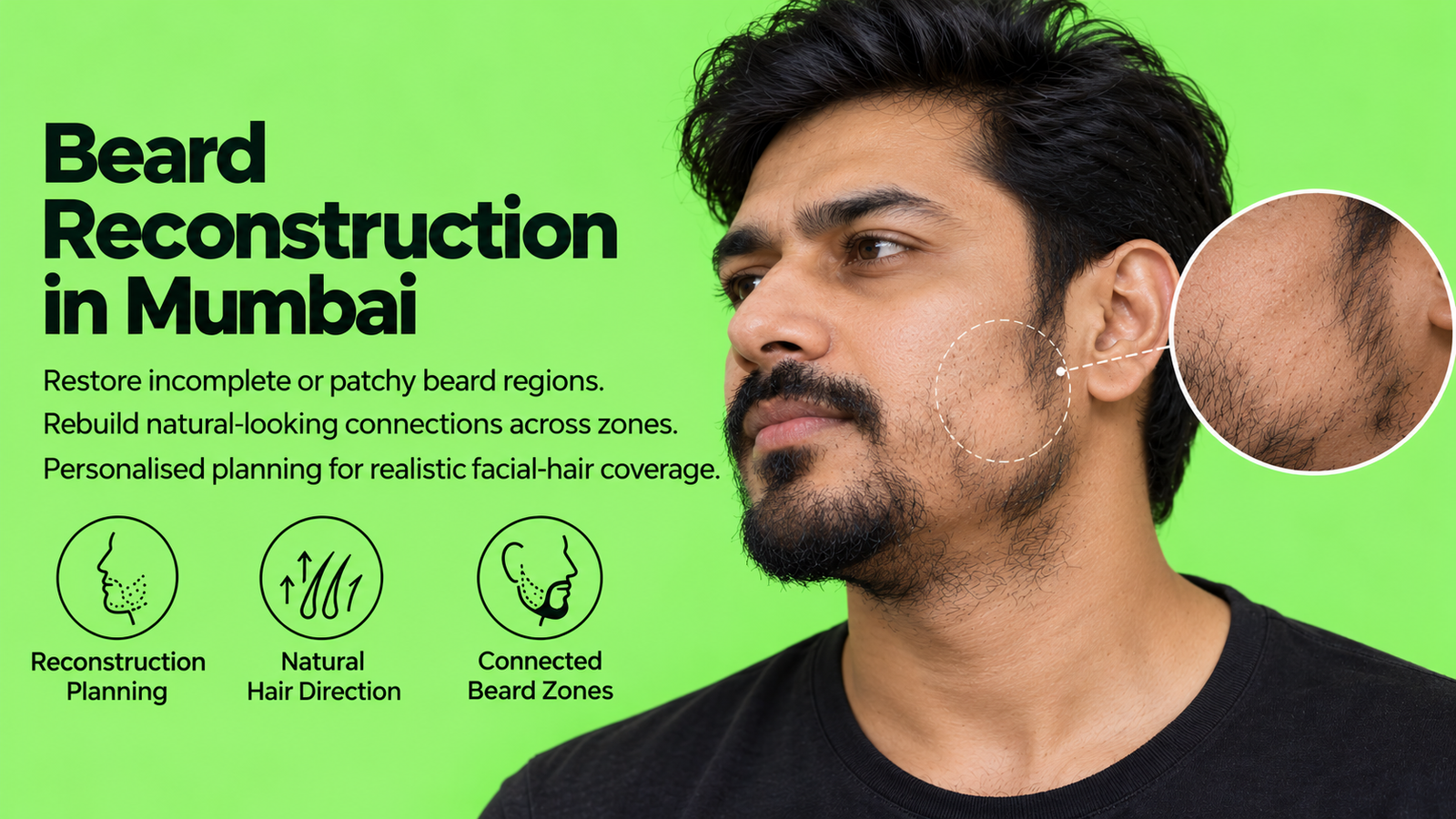
Beard Reconstruction in Mumbai
Beard reconstruction is considered when a substantial portion of the natural beard pattern is missing, severely disrupted or difficult to restore with a small localised transplant. Causes may include marked developmental absence, major asymmetry, trauma, previous reconstructive surgery, selected stable extensive scarring or an earlier procedure that has significantly altered facial-hair distribution.
A reconstructive plan is more complex than simply deciding where to add hair. It may require rebuilding the relationships among several beard zones, studying altered skin or previous surgery and conserving donor follicles across possible treatment stages. The objective is a believable overall pattern that respects your facial anatomy and clinical limitations.
What Does Beard Reconstruction Involve?
The surgeon first determines which natural facial-hair regions remain and which have lost continuity. The beard is assessed as a connected structure: sideburns lead into the cheeks, cheeks transition toward the jawline, and the lower face connects towards the chin. Each region has its own natural hair orientation and typical visual density.
When the main concern is an elective full beard in otherwise healthy skin without major disruption, Full Beard Hair Transplant covers that broader cosmetic plan and its general procedure. Beard Reconstruction is more relevant when developmental absence, altered anatomy, significant loss or prior procedures make planning more complex.
Who Might Need Extensive Beard Reconstruction?
Patients may seek evaluation when much of the beard has never developed, facial hair was lost after a significant healed injury or burn, prior facial surgery altered the hair-bearing skin or an earlier transplant produced a substantially disrupted pattern. Some patients have several disconnected regions rather than simple diffuse sparseness.
A specialist evaluation is important when the skin has been grafted, reconstructed or repeatedly operated on, or when the underlying reason for hair loss is uncertain. An active inflammatory or scarring condition should not be approached as a routine cosmetic transplant. Some people first need dermatology or reconstructive-surgery management; others may find that a conservative beard style or non-transplant approach better fits their options.
How Is the Beard Divided into Reconstruction Zones?
The surgeon maps existing and missing coverage through the sideburns, upper and lower cheeks, jawlines, area beneath the jaw and chin. Each zone must ultimately connect naturally with its neighbours. A patient may prioritise the sideburn and cheek transition for everyday appearance, while another may place greater importance on lower-face continuity. These priorities are discussed before graft allocation.
The moustache is assessed in relation to the overall face, but it has a distinct hair-direction pattern and should not be treated as interchangeable with cheek or jawline grafting. For detailed upper-lip planning, see Anagen’s Moustache Hair Transplant information.
How Is a Reconstructed Beard Shape Chosen?
The clinician considers facial proportions, your existing beard outline, ethnicity-linked hair characteristics where relevant to your individual hair, native hair direction and your preferred style. If little native beard remains, reference photographs can help explain aesthetic preferences, but they cannot substitute for matching your own anatomy and realistic donor supply.
A plausible beard requires appropriate shape, soft visible edges and different density and direction across regions. A perfectly geometric border may be conspicuous, especially when the beard is trimmed short. When only one side has substantial hair remaining, its direction can inform the plan on the other side, but anatomical differences and previous surgery may require adaptation rather than rigid mirroring.
The moustache is assessed in relation to the overall face, but it has a distinct hair-direction pattern and should not be treated as interchangeable with cheek or jawline grafting. For detailed upper-lip planning, see Anagen’s Moustache Hair Transplant information.
Why Is Long-Term Donor Planning Essential?
Extensive reconstruction may need more donor follicles than a small patch procedure. Available scalp follicles must be assessed for hair calibre, curl, colour, density and safety of harvesting. The surgeon should also consider existing or future scalp hair loss, previous donor extraction and whether the proposed beard coverage is achievable within the available reserve.
Scalp hair commonly provides suitable donor material in selected patients, but it may retain scalp-like growth characteristics after transplantation and can require regular trimming. Donor extraction creates small scars and can thin overused donor regions. If donor supply is limited, prioritising a natural visible pattern and accepting less coverage in lower-priority areas may be preferable to overharvesting.
For general information on scalp donor preservation and procedural principles, see Hair Transplant in Mumbai. That scalp-transplant page does not replace a facial reconstruction assessment.
Could Reconstruction Need More Than One Procedure?
Yes. Staging may be considered when extensive regions require coverage, donor supply needs careful allocation, skin condition varies between zones, or previous trauma or reconstruction makes the recipient site unpredictable. The team may address the most visible or structurally important hair connections first and reassess growth before further implantation.
However, multiple sessions are not automatic, nor is a second session guaranteed to be possible or beneficial. The first operation’s healing, available donor hair and the evolving design must inform subsequent decisions.
How Is Natural Hair Direction Reconstructed?
The surgeon studies surviving native hairs where possible, especially at the remaining sideburn, cheek and chin. Each graft needs to be oriented to the relevant facial zone; arrows and surface angles change around the cheek and curved jaw. If native hairs are absent in a zone, the overall natural facial-hair pattern and surrounding anatomy guide design, subject to surgeon assessment and individual variation.
The most visible borders deserve particular attention. Finer or suitable single-hair grafts may support a soft transition; different follicular units may be considered in other regions depending on hair matching and desired density. Incorrectly directed hairs, harsh transitions and skin pitting can remain conspicuous even when follicles grow.
How Is Beard Reconstruction Performed?
Step 1: Investigate the Cause and Previous Treatment
The clinician documents whether absence is developmental or associated with trauma, skin disease, surgery or previous transplantation. Active medical conditions must be assessed before surgery.
Step 2: Assess Skin, Scars and Remaining Native Hair
The surgeon examines the quality of recipient tissue, any previous reconstruction, direction of surviving hairs and whether additional specialist treatment is necessary.
Step 3: Build a Multi-Zone Reconstruction Design
Individual priorities for sideburns, cheeks, jawline, beneath-jaw regions and chin are discussed, along with realistic coverage limits and the need for potential staging.
Step 4: Plan Donor Allocation
Donor hair is assessed for safe availability, calibre, visual match and preservation for possible future hair restoration.
Step 5: Provide Local Anaesthesia and Obtain FUE Grafts
The planned regions are numbed, and selected follicular units are individually harvested from suitable donor sites.
Step 6: Inspect and Sort Follicular Units
The team selects graft types for visible borders and other planned zones, taking into account hair calibre and the agreed design.
Step 7: Create Zone-Specific Recipient Sites
Site angle, direction, spacing and location follow the surgeon’s reconstruction map and the quality of each area of facial skin.
Step 8: Implant According to Priorities
Grafts are placed to rebuild selected transitions while avoiding excessive density, abrupt borders and unnecessary donor consumption.
Step 9: Provide Aftercare and Long-Term Review
The team explains recipient and donor care, protection against friction, warning signs, appropriate shaving timing and the schedule for assessing growth before any optional later stage.
Recovery and When Reconstruction Results Can Be Assessed
Temporary redness, tenderness, swelling and small crusts may develop at donor and treated facial sites. The care plan may be more individualised if you have previous scars or reconstructed skin. Follow the team’s instructions on cleaning, sleeping position, beard contact, shaving, exercise and timely review. Contact the team promptly for increasing pain, spreading redness, discharge or other concerning symptoms.
Transplanted shafts commonly shed after the early healing period. New visible growth may begin around three to four months, with improvement continuing through later months. More meaningful assessment is often made around nine to twelve months or later. Scar-related or previously reconstructed regions may be less predictable and sometimes warrant an even more cautious review. A staged plan, if contemplated, must be revised according to actual healing and growth.
What Are the Risks and Limits of Beard Reconstruction?
In addition to bleeding, infection, swelling, donor scarring or thinning, temporary altered sensation and folliculitis, the result may be limited by donor supply, skin condition, graft survival or difficulty matching native facial hair. Incorrectly angled hairs, abrupt borders, pitting or cobblestoning can undermine an otherwise successful growth response. Previously operated or scarred facial tissue may increase planning complexity and uncertainty.
Full coverage may be impossible or inadvisable. Some patients may prefer an intentionally moderate beard style that makes the best use of existing hairs and available follicles. A second stage may sometimes be offered, but cannot be guaranteed in advance.
How Much Does Beard Reconstruction Cost in Mumbai?
A responsible estimate is based on the number and complexity of facial zones, recipient skin condition, previous procedures, donor availability, expected graft allocation and whether staged treatment is clinically appropriate. A photographic discussion can establish goals, but an examination is needed before committing to graft counts, procedure stages or price.
Beard Reconstruction Results
Extensive beard reconstruction requires individualised planning, particularly when several facial regions need restoration. Genuine Anagen beard transplant cases, once organised on a dedicated results page, may help you understand different restoration patterns and clinical limitations. They should not be used to promise that a different patient’s trauma history, skin or donor capacity will produce the same result.
Frequently Asked Questions
Is reconstruction the same as a full beard transplant?
Not always. Both may involve multiple facial zones, but reconstruction specifically addresses substantial missing or disrupted patterns, including possible previous trauma, reconstructive surgery or more complex tissue conditions.
What if my previous facial surgery changed the skin?
The surgeon needs to assess tissue flexibility, scar stability, previous operative records when available and whether hair transplantation is appropriate at all. A multidisciplinary opinion may be useful.
Could I reconstruct only the most visible zones first?
That can be discussed when donor supply or recipient-site considerations favour a staged, prioritised approach. No particular second stage is assured.
Will transplanted hair require trimming?
It may. Scalp hair can retain donor-site growth characteristics and grow differently from native beard hair.
What if my donor area is limited?
The clinician may recommend fewer treatment zones, a lower-density design or no operation if the likely result would not justify donor use and risk.
Arrange a Beard Reconstruction Assessment in Mumbai
Bring front, both profiles and under-jaw photographs, information about any previous facial operations or burns, and images of your donor scalp. Where available, prior operative records and the history of any inflammatory hair-loss disease help the team distinguish elective coverage from true reconstructive needs. Contact Anagen for a consultation focused on feasibility, natural zone reconstruction and a realistic long-term plan.