




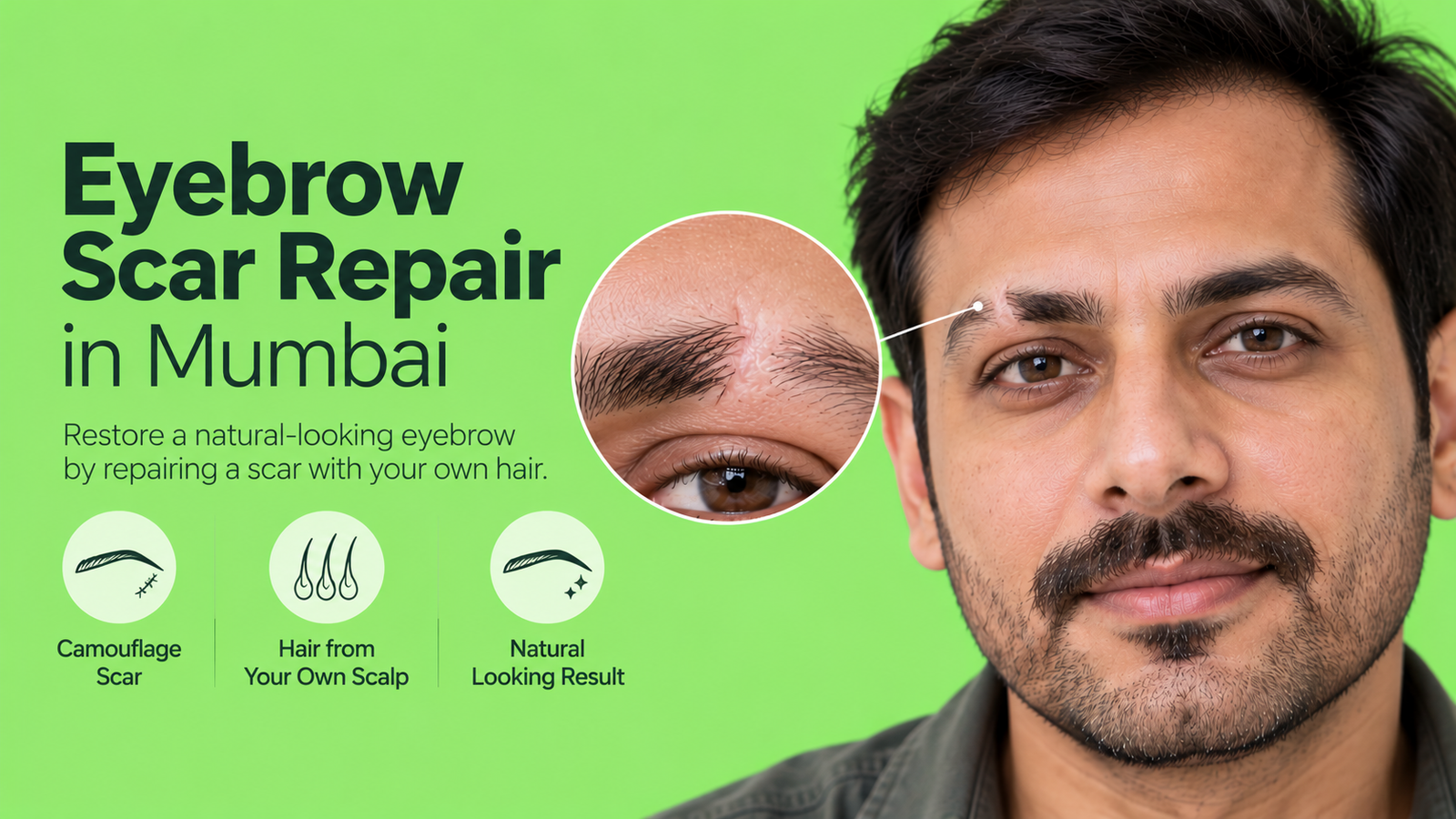
Eyebrow Scar Repair in Mumbai
An injury, previous operation, burn or cosmetic procedure can sometimes leave a scar that interrupts the natural growth of eyebrow hair.
When hair is permanently absent within a stable scar, selected patients may benefit from eyebrow hair transplantation to improve coverage and reduce the visibility of the affected area.
However, scarred skin behaves differently from normal eyebrow-bearing skin.
The suitability of transplantation depends on the scar’s maturity, thickness, flexibility, underlying tissue and blood supply.
At Anagen Hair Transplant Clinic in Mumbai, eyebrow scar repair begins with an individual assessment of the scar and surrounding eyebrow.
The objective is to improve eyebrow continuity and camouflage the scar when clinically appropriate—not to promise complete scar removal.
What Is Eyebrow Scar Repair?
Eyebrow scar repair is a specialised approach to restoring eyebrow hair in selected areas affected by mature scar tissue.
In suitable patients, carefully selected hair follicles may be transplanted into or around the scar to improve the continuity of the eyebrow.
The surrounding native eyebrow hair provides an important reference for hair direction, shape and density.
Unlike transplantation into healthy eyebrow skin, implantation into scarred tissue requires additional consideration of tissue quality and the recipient area’s ability to support graft growth.
Some scars are unsuitable for immediate transplantation and may require further assessment or a different treatment approach.
What Types of Eyebrow Scars May Be Considered?
Patients may request assessment for eyebrow scars associated with:
- Previous accidental injuries.
- Healed surgical incisions.
- Selected mature burn scars.
- Previous cosmetic procedures.
- Other stable injuries involving eyebrow-bearing skin.
The cause of the scar matters, but its present condition is often more important when evaluating transplantation.
An old scar is not automatically suitable simply because several years have passed.
Active disease, unstable scarring or ongoing inflammation may make transplantation inappropriate.
Why Scar Maturity and Tissue Condition Matter?
Scar tissue differs from normal skin in its structure and blood supply.
These differences can influence the ability of transplanted follicles to establish growth.
Before planning scar-related eyebrow transplantation, the surgeon evaluates several important characteristics.
Scar Maturity
The scar should be sufficiently healed and stable.
Recent scars may continue to change in thickness, colour and flexibility as healing progresses.
Scar Thickness and Flexibility
Very thick, tightly contracted or unusually thin scars may require additional evaluation.
Tissue flexibility and the depth of the underlying scar can influence surgical planning.
Recipient Blood Supply
Transplanted follicles depend on the recipient tissue to establish and maintain an appropriate blood supply.
Scar-related changes may make graft growth less predictable.
Underlying Medical Conditions
Active inflammatory or scarring disorders may threaten both existing and transplanted hair.
Such conditions require appropriate medical evaluation and stabilisation before transplantation is considered.
How Is Eyebrow Scar Repair Planned?
The first objective is to establish whether the scar is suitable for transplantation.
The surgeon examines the affected tissue and evaluates how the scar relates to the existing eyebrow.
When the surrounding eyebrow remains intact, its natural hair direction and distribution help guide the treatment plan.
The surgeon may choose a conservative approach, particularly when recipient-tissue quality creates uncertainty about graft growth.
Restoring continuity does not necessarily require placing the maximum number of grafts into the scar.
In selected situations, staged treatment may be considered after observing the response to an initial procedure.
Matching Hair Direction Across a Scar
Scar-related eyebrow transplantation must account for the direction of the surrounding natural eyebrow hair.
A visible change in hair orientation on either side of the scar may make the repaired area appear unnatural.
The surgeon therefore evaluates the direction of the existing hairs and plans the transplanted follicles to follow the local eyebrow pattern wherever possible.
Donor-hair thickness and curvature also matter.
Appropriate hair selection and conservative placement can help achieve better visual integration, although scarring may limit the final appearance.
For additional information about these aesthetic principles, see Natural Eyebrow Design.
How Is Eyebrow Scar Repair Performed?
Step 1: Scar and Medical Assessment
The surgeon examines scar maturity, thickness, flexibility, possible underlying disease and the surrounding eyebrow hair.
The assessment determines whether transplantation is clinically appropriate.
Step 2: Eyebrow and Scar Mapping
The affected eyebrow is mapped according to its existing shape and hair distribution.
The proposed restoration area is identified, accounting for the scar’s location and tissue condition.
Step 3: Donor-Hair Selection
Suitable donor follicles are selected according to the surrounding eyebrow’s hair thickness, texture and direction.
Step 4: Anaesthesia and Preparation
The donor and recipient regions are prepared under appropriate local anaesthesia.
Step 5: Follicular Unit Extraction
Suitable follicles are carefully extracted from the selected donor area.
Step 6: Graft Assessment and Preparation
The harvested follicles are assessed and prepared for implantation.
Single-hair grafts are generally preferred for natural eyebrow restoration.
Step 7: Recipient-Site Planning
Recipient sites are planned conservatively according to scar characteristics, surrounding hair direction and the intended density.
Step 8: Graft Implantation
Prepared follicles are implanted into the selected recipient sites.
The surgical plan accounts for the limitations of scarred tissue rather than assuming that every graft will establish normal growth.
Step 9: Aftercare and Follow-Up
The patient receives instructions for protecting the treated region and monitoring healing.
Follow-up is particularly important for assessing the response of scarred recipient tissue.
Can Every Eyebrow Scar Be Treated With Hair Transplantation?
No.
Some scars may be too recent, unstable, contracted, inflamed or otherwise unsuitable for transplantation.
The affected region may also require assessment for additional reconstructive needs before hair transplantation is considered.
When a scar is associated with extensive eyebrow absence, a broader Eyebrow Reconstruction plan may be more appropriate than limited scar filling.
For general information about follicular transplantation, visit our Eyebrow Hair Transplant in Mumbai page.
Recovery and Hair Growth After Eyebrow Scar Repair
Healing after transplantation into scarred tissue varies according to the patient’s condition and the characteristics of the recipient skin.
Temporary redness, crusting and shedding may occur.
New hair growth generally develops gradually over the following months.
Scarred tissue may support a less predictable growth response than healthy recipient skin.
A more meaningful assessment is generally possible after sufficient healing and growth, often around 9–12 months, although individual timelines vary.
If additional treatment is considered, the decision should follow clinical reassessment rather than a predetermined schedule.
What Results Can You Expect From Eyebrow Scar Repair?
Eyebrow scar transplantation aims to improve hair coverage and camouflage suitable scars.
The scar itself remains present, even when transplanted hair successfully grows within or around it.
Results depend on scar maturity, tissue characteristics, blood supply, donor-hair suitability, graft growth and the extent of the original defect.
Some patients may achieve useful improvement after one procedure. Others may require further assessment or staged treatment.
The objective is realistic improvement rather than guaranteed scar concealment.
You can explore Anagen’s eyebrow restoration results to understand the possibilities and limitations of different eyebrow restoration procedures.
Explore eyebrow scar repair results
Eyebrow Scar Repair Cost in Mumbai
The treatment cost depends on the scar’s extent, recipient-tissue condition, donor-hair requirements and complexity of the surgical plan.
Some patients may require only limited graft placement, while others need a broader reconstruction assessment.
An individual consultation is necessary to determine treatment suitability and provide an appropriate estimate.
Frequently Asked Questions
Can hair grow inside an old eyebrow scar?
In selected patients, transplanted follicles may establish growth within suitable mature scar tissue. The possibility depends on the scar’s characteristics and cannot be guaranteed.
Will eyebrow transplantation remove my scar completely?
No. Transplantation may improve hair coverage and camouflage a suitable scar, but it does not remove the underlying scar tissue.
Can I undergo transplantation immediately after an eyebrow injury?
Recent injuries generally require healing and assessment before transplantation is considered.
Is a second treatment always necessary?
No. Some patients may achieve sufficient improvement with one procedure, while others may require further treatment or may not be suitable for additional transplantation.
Book an Eyebrow Scar Repair Assessment in Mumbai
If you have a healed eyebrow scar with missing hair, a clinical assessment can help establish whether transplantation is appropriate.
The consultation includes evaluation of the scar, surrounding native eyebrow hair, donor-hair compatibility and realistic restoration possibilities.
Contact Anagen Hair Transplant Clinic to discuss your treatment options.