





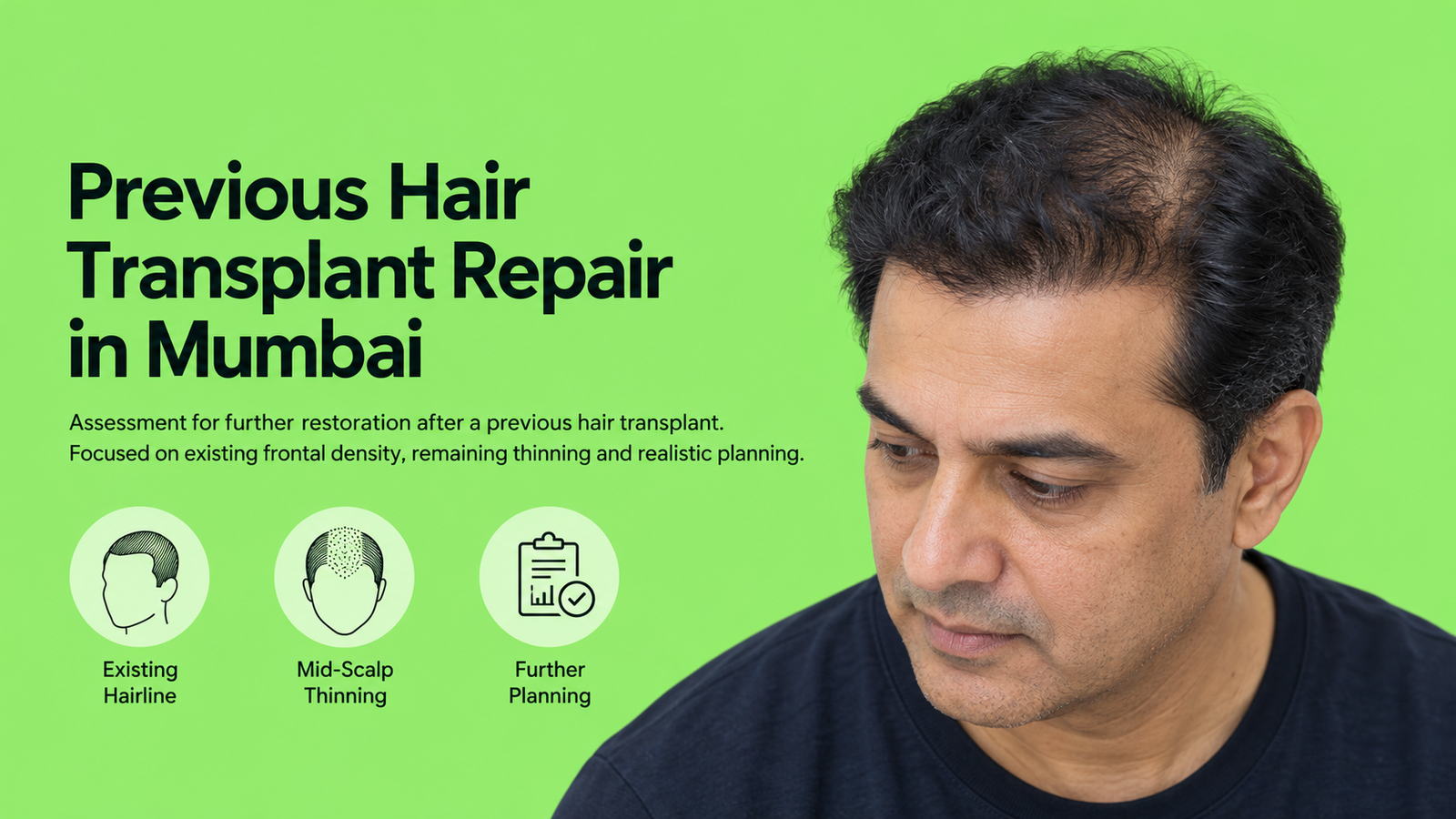
Previous Hair Transplant Repair in Mumbai
Previous hair transplant repair is a specialised revision-planning approach for patients who have already undergone one or more hair transplants and are now considering another procedure.
Not every patient seeking a second transplant has experienced a failed or unnatural result.
Some patients achieved a satisfactory frontal hairline after their first procedure but subsequently developed additional thinning in the mid-scalp or crown. Others want more density, improved coverage or carefully planned refinement of an earlier restoration.
However, transplantation into a previously operated scalp requires a different approach from first-time hair restoration.
The existing grafts, altered recipient tissue, previous donor extraction and remaining lifetime donor supply must all be considered.
At Anagen Hair Transplant Clinic in Mumbai, the purpose of revision planning is to determine whether another procedure is appropriate, what can reasonably be improved and how existing donor resources can be protected.
Can You Have a Second Hair Transplant After a Previous Procedure?
Yes, selected patients may undergo a second hair transplant when sufficient donor hair remains and the recipient scalp is suitable.
However, suitability cannot be determined simply by counting how many months have passed since the first surgery.
The clinician must review the earlier procedure, the pattern of existing transplanted hair and the patient’s current hair-loss progression.
A second procedure may be planned to improve density, treat an untreated region or adapt the original restoration to further native hair loss.
If the donor supply is limited, another operation may not provide sufficient benefit to justify its risks.
Why Might Someone Need Another Hair Transplant?
Further Native Hair Loss
Male pattern hair loss may continue after transplantation, particularly in regions that were not treated previously.
Additional Crown Restoration
A patient whose first procedure concentrated on the frontal scalp may later consider crown coverage.
Density Enhancement
Existing transplanted follicles may have grown adequately, but the patient may want further fullness in selected areas.
Previously Untreated Areas
Mid-scalp or crown thinning may have been intentionally left for a later procedure because of donor limitations or staged planning.
Revision of an Earlier Design
A patient may need selected adjustments to graft distribution, existing hairline position or transitions.
If the main issue is an obviously unnatural hairline or incorrect graft direction, Repair Hair Transplant provides the more relevant corrective pathway.
If the problem is insufficient growth of earlier grafts, see Failed Hair Transplant Correction.
What Must Be Assessed Before Another Hair Transplant?
A previously operated scalp requires a detailed review.
Number and Type of Previous Procedures
The clinician should establish whether the patient previously underwent FUE, FUT or another extraction and implantation technique.
Existing Transplanted Hair
Current graft density, distribution, direction and hairline position are examined.
Native Hair Condition
The remaining natural hair is assessed for further miniaturisation and ongoing progression.
Previous Donor Extraction
Old extraction patterns, linear scars, visible depletion and remaining density are evaluated.
Recipient Scarring
Previously implanted regions may contain changes in tissue structure that affect safe new site creation.
Future Hair-Loss Expectations
The plan must account for the possibility that further native hair loss will occur after the second procedure.
How Are Existing Transplanted Grafts Mapped?
An accurate revision plan begins with understanding where the previous grafts are located and how they relate to the surrounding native hair.
The surgeon evaluates visible follicular density, direction, miniaturisation and the original recipient boundaries.
The treatment map should identify where additional grafts could improve coverage without unnecessarily disturbing functioning follicles.
New grafts should not simply be distributed uniformly over the entire previously treated scalp.
Some regions may already have adequate coverage, while other areas may need priority.
How Does Previous FUE or FUT Affect Future Donor Capacity?
Every extraction procedure permanently uses some of the available donor follicular units.
After previous FUE, the donor region may show reduced density or uneven extraction distribution.
After FUT, a linear scar may be present, and the available donor region must be evaluated with that scar and the earlier excision in mind.
Repeated procedures can make donor preservation increasingly important.
The surgeon should examine density, follicular composition, hair calibre and miniaturisation before estimating how many additional grafts can safely be obtained.
A second or third transplant should not be planned only according to how many grafts the patient wants.
How Much Donor Hair May Be Available for Another Procedure?
There is no universal number of grafts remaining after one hair transplant.
The answer depends on original donor density, prior extraction numbers, extraction distribution, remaining hair calibre, safe donor boundaries and future hair-loss risk.
Some patients retain enough donor capacity for a meaningful second procedure.
Others may have limited reserves despite appearing to have substantial surrounding hair at a glance.
A scalp examination is therefore necessary before making a graft estimate.
Advanced Donor Management provides more information about protecting donor hair over multiple procedures.
Can the Crown Be Transplanted After a Previous Frontal Procedure?
Yes, selected patients may undergo crown restoration after an earlier frontal transplant.
However, the crown can require careful planning because its surface area and whorl pattern influence graft distribution and visual coverage.
The clinician must also consider whether untreated mid-scalp hair is continuing to thin.
For patients with limited donor capacity, maintaining a satisfactory frontal frame may sometimes be more important than attempting extensive crown density.
Crown Hair Transplant and Front + Mid + Crown Hair Transplant explain how different scalp regions influence graft priorities.
Is a Third Hair Transplant Possible?
Some patients may be suitable for a third procedure.
However, repeated transplantation is not automatically safe or appropriate.
The previous graft counts, donor extraction pattern, existing scarring, native hair progression and expected benefit of additional grafts must all be reviewed.
In a patient with limited donor supply, a third procedure may create unacceptable donor thinning without providing enough improvement in the recipient area.
The objective is not to maximise the number of surgeries. It is to develop a sustainable long-term restoration plan.
How Is Previous Hair Transplant Repair Performed?
Step 1: Previous Transplant History
The surgeon reviews the dates, techniques, graft estimates and treated areas of all previous procedures.
Step 2: Recipient Hair and Scalp Examination
Existing transplanted hair, native hair, current density and scalp condition are evaluated.
Step 3: Donor History Mapping
Old FUT scars, FUE extraction patterns, donor density and remaining potential donor capacity are assessed.
Step 4: Current Hair-Loss Assessment
The progression of native hair loss and the likely future treatment requirements are considered.
Step 5: Revision Objective and Design
The surgeon identifies whether the new procedure is intended for density enhancement, previously untreated regions, crown coverage or selected aesthetic revision.
Step 6: Medical Preparation and Local Anaesthesia
The patient undergoes appropriate medical evaluation and preparation according to the proposed surgical plan.
Step 7: Additional Follicular Unit Extraction
Suitable grafts are harvested only from donor regions assessed as appropriate for further use.
Step 8: Recipient-Site Creation and Implantation
New grafts are placed around existing hair or within planned untreated regions, with attention to direction, spacing and tissue characteristics.
Step 9: Follow-Up and Maintenance Planning
Healing, growth, ongoing native hair loss and future donor requirements are reviewed over time.
Should Hair Loss Medication Be Considered Before Revision Surgery?
Medical management may be relevant when the patient continues to lose native hair.
A previous transplant does not stop androgenetic alopecia in untreated follicles.
Depending on clinical suitability, a doctor may discuss established medical options and their risks, benefits and monitoring requirements.
Treatment may help manage ongoing native hair loss, but it cannot reliably replace follicles already destroyed by scarring or correct a poorly angled transplanted graft.
Post Hair Transplant Maintenance Prescription is relevant for patients requiring ongoing follow-up.
What Is Recovery Like After a Second or Third Transplant?
Recovery generally involves temporary crusting, tenderness, redness, swelling or donor-site changes.
The healing process may be influenced by prior surgery, existing scarring and the number of newly implanted grafts.
Previously growing transplanted hair may remain present, but nearby native or transplanted hairs can sometimes undergo temporary shedding.
Newly implanted shafts may shed during the first weeks, with new growth often beginning around three to four months.
More complete assessment generally requires nine to twelve months or longer.
What Are the Risks and Limitations of Revision Surgery?
Risks include donor depletion, additional scarring, temporary numbness, infection, bleeding, follicular injury, shock loss and incomplete growth.
Previously operated recipient tissue may be less predictable than an untreated scalp.
The long-term concern is whether the available donor reserve can support the patient’s future appearance if native hair loss continues.
Some patients may benefit more from medical management or a conservative treatment area than from extensive additional surgery.
How Much Does Previous Hair Transplant Repair Cost in Mumbai?
Cost depends on the number and nature of previous procedures, remaining donor hair, scalp condition, proposed treatment area, additional graft requirement and overall surgical complexity.
A patient seeking a limited density improvement may require a very different plan from someone pursuing extensive mid-scalp and crown coverage after multiple operations.
A personalised consultation is needed before preparing a reliable quotation.
Previous Hair Transplant Repair Results
Patients who have undergone previous transplantation often require more individualised planning for further surgery because existing grafts, previous extraction and remaining donor resources must all be reassessed.
The final result depends on the current scalp condition, treatment priorities and donor capacity rather than simply the number of earlier procedures.
Explore previous hair transplant repair results: view male hair transplant results for broader restoration examples.
Frequently Asked Questions
Can I have a second hair transplant if my first transplant was successful?
Yes, selected patients may consider another procedure to address new hair loss or additional density requirements.
Can a third hair transplant be performed safely?
Possibly, but safety and suitability depend on remaining donor resources, previous scarring and realistic treatment objectives.
How many grafts can I use after my previous FUE?
The remaining number must be estimated after donor examination and review of earlier extraction. There is no universal amount.
Will another transplant damage my existing transplanted hair?
The surgical team should minimise disturbance, but new recipient-site creation near existing follicles carries risk.
Can beard hair be used if scalp donor hair is limited?
Selected cases may benefit from alternative donor hair, but texture, calibre, growth behaviour and intended recipient region must be considered.
Should the second transplant focus on my crown or frontal density?
The answer depends on your current appearance, future hair-loss pattern, donor reserves and cosmetic priorities.
Book a Previous Hair Transplant Revision Consultation in Mumbai
If you have already undergone one or more hair transplants and want further improvement, the first question is whether additional surgery can provide meaningful benefit without unnecessarily exhausting your donor supply.
Anagen can review your existing transplanted hair, current hair loss, previous donor extraction and realistic options for another procedure.
Please share current front, top, crown, both-side and rear donor photographs.
Also include the dates of your previous transplants, approximate graft counts, previous techniques and any available old photographs or operative reports.
Contact Anagen Hair Transplant Clinic to plan your revision assessment.