





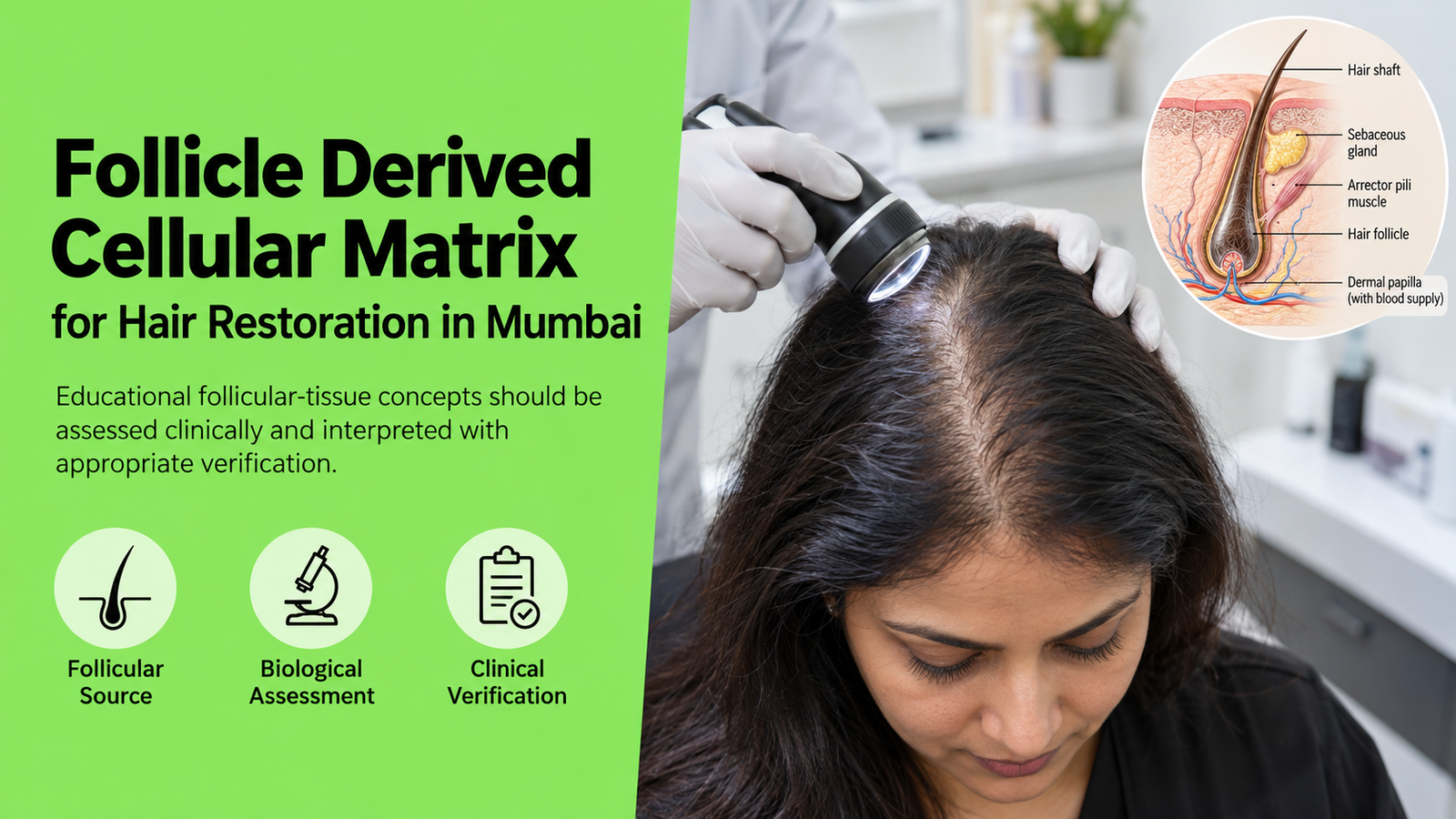
Follicle Derived Cellular Matrix for Hair Restoration in Mumbai
A human hair follicle is more than a strand of hair. It is a small, organised biological structure containing different cell populations and surrounding supporting tissue.
Researchers studying hair restoration have investigated whether material derived from follicles can influence hair growth or help develop future regenerative treatments.
Follicle Derived Cellular Matrix is a term that requires a precise clinical definition before it can be used to describe a specific Anagen treatment.
The term should not be assumed to mean a particular type of cell extraction, stem-cell preparation or laboratory-grown tissue.
What Is a Follicle Derived Cellular Matrix?
In general, a follicle-derived preparation would refer to biological material originating from hair-follicle-associated tissue.
However, the phrase “cellular matrix” does not reveal whether the material includes living cells, fragmented tissue, extracellular material or soluble biological components.
The term also does not establish how the material is collected or processed.
For Anagen, the exact source, composition and clinical objective must be documented before patients are told what the therapy contains.
What Are the Important Parts of a Hair Follicle?
A hair follicle includes epithelial and mesenchymal structures that interact during the normal growth cycle.
The hair bulb contains the hair-producing matrix region, while the dermal papilla provides important regulatory signals.
Other regions, including the outer root sheath and follicular bulge, participate in follicular maintenance.
Understanding this anatomy helps explain why researchers are interested in follicular material.
But identifying cells within a follicle is not proof that a prepared mixture retains the ability to form new follicles.
Follicular Material vs an Intact Transplant Graft
An intact transplant graft contains one or more follicles that can be surgically relocated to an appropriate recipient site.
A processed follicular preparation is a different concept.
Even if it originates from hair follicles, it should not automatically be assumed to preserve the organisation of an intact follicle.
This matters because transferring a functioning follicular unit through hair transplantation is different from administering a processed biological preparation.
The latter cannot be presented as equivalent to placing a complete new follicle in the scalp.
How Is Follicle Derived Cellular Matrix Prepared?
A procedure cannot be accurately described until its components are verified.
If Anagen’s protocol collects follicular tissue, it must specify whether collection uses follicular units, scalp tissue or another biological source.
The preparation process must identify whether tissue is merely processed, whether cells are separated or whether any additional laboratory manipulation is performed.
These distinctions influence safety, evidence interpretation and regulatory classification.
Why Might Follicular Material Be Investigated?
Laboratory research has explored how follicular cells communicate and how their biological properties may be preserved or altered.
Clinical research has also investigated certain autologous micrograft approaches.
Such research provides a basis for scientific investigation, but the outcomes are not automatically transferable to every preparation containing follicular material.
Evidence for Anagen’s specific Follicle Derived Cellular Matrix must be reviewed independently.
Is This the Same as FBM?
It may be related to the Follicular Biocell Matrix concept, but the exact relationship is unknown.
If the matrix is an ingredient or component of FBM rather than a separate treatment, a distinct service page may mislead patients.
Anagen should clarify whether the page explains the material used within FBM or a separate clinically defined procedure.
Is It Dermal Papilla Cell Therapy?
Not necessarily.
Dermal papilla cells are a specific follicular cell population. A general follicle-derived preparation may contain other materials or may not isolate these cells at all.
The specialised Dermal Papilla Cell Therapy page should address that distinct research field.
Who May Be Suitable?
Suitability cannot be defined without knowing the actual preparation.
A patient should undergo diagnosis of the hair-loss disorder, examination of the scalp and discussion of established treatment alternatives.
Particular caution is required for active scalp infection, inflammatory disorders, relevant bleeding risks and any source-tissue collection procedure.
What Should Patients Expect?
The treatment should not be expected to produce unlimited new follicles, permanently reverse pattern hair loss or reliably restore completely bald scalp areas.
If offered clinically under an appropriate framework, progress must be documented using relevant objective measurements and adequate follow-up.
Cost and Availability
The cost of a verified follicle-derived procedure could depend on collection, processing, administration, laboratory requirements and follow-up.
The exact Anagen service and price must be confirmed.
Frequently Asked Questions
What is a follicular cellular matrix?
It is a term requiring definition of the follicular source and actual cellular or extracellular components.
Is it the same as FBM?
That relationship must be verified before separate pages are published.
Is it made from stem cells?
Not necessarily. Stem-cell terminology requires evidence of the actual cells and their classification.
Does it multiply donor follicles?
There is no verified basis for such a claim.
Is it different from a hair transplant?
Yes. A transplant transfers intact follicular units; a processed biological preparation is not an intact graft.
Is it a proven treatment?
Anagen’s exact protocol and applicable clinical evidence must first be evaluated.
Understand the Biological Approach Before Treatment
Patients considering follicle-derived regenerative therapy should receive a clear explanation of the actual material and available evidence.
For a scalp assessment and discussion of options, contact Anagen.