





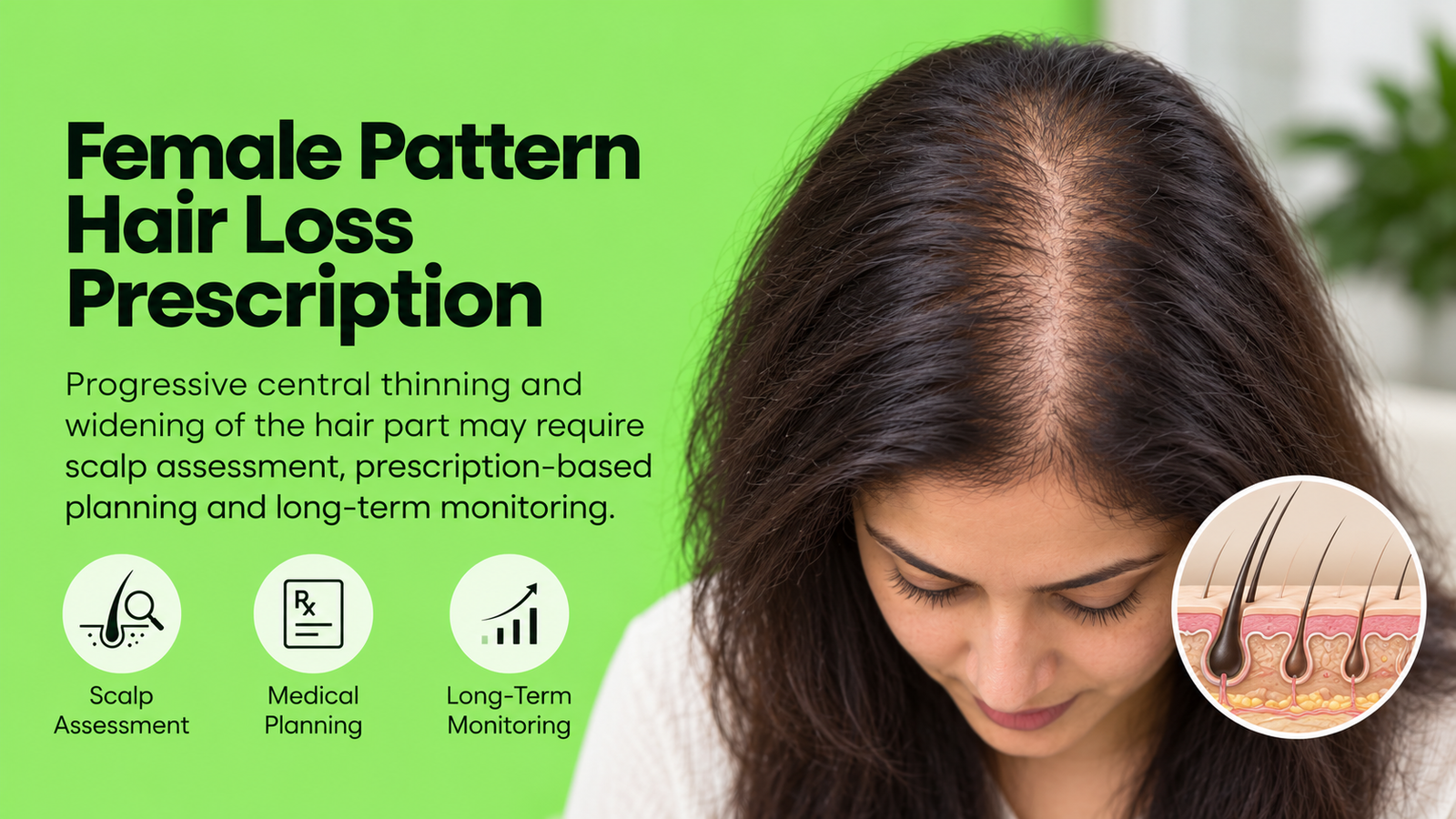
Female Pattern Hair Loss Prescription
If you have noticed a progressively widening hair part, reduced scalp coverage or thinning over the top of your head, you may be experiencing female pattern hair loss. However, similar changes can also occur with temporary shedding, nutritional or medical conditions, scalp disorders or several overlapping causes.
A Female Pattern Hair Loss Prescription focuses on confirming the diagnosis, assessing existing follicles and selecting medically appropriate treatment to preserve hair, manage progression and improve density where possible.
At Anagen Hair Transplant Clinic, Mumbai, the purpose of prescription assessment is to distinguish progressive follicular miniaturisation from other causes of female thinning before recommending medication, investigations or additional procedures.
What Is Female Pattern Hair Loss?
Female pattern hair loss is a common form of progressive, non-scarring hair thinning. Affected follicles gradually produce finer, shorter hair shafts through a process called follicular miniaturisation.
Typical findings may include a broader central parting, decreased volume over the mid-scalp and crown, or increased scalp visibility under overhead lighting. The frontal hairline may remain relatively preserved, although this is not universal.
Genetic susceptibility and local follicular responses to hormones can contribute. Importantly, female pattern hair loss does not automatically mean that circulating hormone levels are abnormal.
How Does the Doctor Assess It?
Assessment may include the duration and progression of thinning, family history, previous treatments, medical conditions, medication use, recent illness, dietary changes and relevant menstrual or reproductive history.
Scalp examination may assess distribution of thinning, hair-shaft calibre, follicular miniaturisation, inflammation and the condition of the donor region. Trichoscopy can help compare affected and relatively unaffected scalp areas.
Prescription Overview
Primary Concern: Progressive reduction of central scalp density and follicular miniaturisation.
Assessment Focus: Hair part width, regional density, shaft-calibre variation, scalp condition and progression.
Possible Contributing Factors: Genetic susceptibility, age-related changes, reproductive or hormonal context and overlapping shedding disorders.
Prescription Goal: Reduce further progression, support remaining follicles and improve hair coverage when treatment-responsive follicles are present.
Possible Prescription Categories: Clinician-selected topical hair-growth therapy, selected oral treatment, management of coexisting conditions and scalp-directed treatment.
Supportive Care: Gentle cleansing, reduced traction, correction of confirmed nutritional deficiencies and hair-care advice.
Monitoring: Standardised scalp photographs, trichoscopy where indicated, tolerance and interval changes in density.
Follow-Up: Clinician-determined review to assess tolerability, adherence and response.
Pregnancy / Breastfeeding Considerations: Medication selection must account for pregnancy, pregnancy planning and breastfeeding.
When Further Investigation May Be Needed: Sudden shedding, atypical progression, systemic symptoms, inflammation or suspected overlapping causes.
When Another Treatment May Be Considered: Selected procedural support or transplant assessment if appropriate medical management does not adequately address stable structural density loss.
This page provides general prescription information and does not replace an individual clinical assessment. Treatment should be selected according to the diagnosis, medical history, reproductive status where relevant, examination and treatment goals.
Why Does Hair Become Progressively Finer?
In female pattern hair loss, some terminal hair follicles gradually produce thinner, shorter hairs. This changes scalp coverage even when many follicles remain present.
Hair diameter is an important determinant of visible fullness. A region containing numerous fine hairs can look less dense than one containing thicker terminal hairs.
Female Pattern Hair Loss Versus Diffuse Shedding
A woman may report excessive hair fall but have no significant miniaturisation. Another woman may experience progressive thinning without noticing substantial daily shedding.
Telogen effluvium often presents with increased shedding following a physiological, medical or nutritional trigger. Female pattern hair loss typically involves progressive hair-shaft miniaturisation.
Both can occur together. Postpartum shedding can also make previously subtle pattern thinning more noticeable.
Other considerations include thyroid disease, iron deficiency, traction alopecia, alopecia areata and inflammatory or scarring scalp disorders. Rapid progression, scalp pain, marked redness or loss of follicular openings requires further assessment rather than an automatic pattern-loss prescription.
What May Be Included in a Female Pattern Hair Loss Prescription?
1. Topical Hair-Growth Treatment
Topical minoxidil is an established treatment option for female pattern hair loss. It may help some women maintain hair and improve growth, although the degree of response varies.
The formulation, suitability and application instructions should be decided after assessment. Possible issues include scalp irritation, unwanted facial hair and temporary early shedding.
2. Selected Oral Prescription Treatment
A clinician may consider oral therapies in selected patients after discussing potential benefits, limitations and systemic risks.
Some treatments used for female pattern hair loss are prescribed off-label and require careful review of reproductive status, medical conditions, interactions and relevant monitoring.
Oral minoxidil and anti-androgen approaches are not interchangeable, and neither is suitable for every patient. Certain medicines require blood-pressure, renal-function or electrolyte assessment according to the selected drug and the patient’s risk profile.
3. Treatment of Coexisting Conditions
If examination or history suggests a concurrent scalp disorder, nutritional deficiency, telogen effluvium or endocrine problem, it may need separate management.
Correcting a confirmed deficiency may support recovery where that deficiency contributes, but routine supplements cannot be assumed to reverse pattern hair loss.
4. Supportive Scalp and Hair Care
Reducing hair breakage, avoiding excessive traction and treating clinically relevant scalp inflammation may improve overall hair condition. These measures support management but do not replace evidence-based treatment for follicular miniaturisation.
Medication Safety in Women
Treatment selection must consider pregnancy, plans for conception, breastfeeding, menopause, other illnesses and concurrent medication.
Minoxidil should be avoided during pregnancy, pregnancy planning and breastfeeding. Anti-androgen medicines can pose important fetal risks, and systemic therapies may have additional contraindications. A patient should never independently start or continue these treatments without a clinician reviewing the circumstances.
Reproductive precautions should be individualised rather than assuming that every woman has the same reproductive circumstances.
Monitoring and Long-Term Maintenance
Follow-up evaluates whether shedding has changed, whether the central part appears stable, whether hair calibre has improved and whether unwanted effects have developed.
Standardised photographs are most meaningful when the hair part, lighting, scalp region and hairstyle remain comparable. Trichoscopy may provide additional objective information.
Because female pattern hair loss is usually progressive, maintenance may be necessary to retain the benefit of effective therapy. Stopping treatment can allow loss of treatment-dependent gains.
Can Biologix Treatment or Hair Transplantation Help?
Prescription treatment mainly addresses existing hair, underlying contributors and ongoing progression.
Selected patients may also discuss PRP Hair Treatment or Advanced GFC Hair Treatment as procedural options. Evidence, treatment protocols and response vary, and such treatments should not be presented as necessary or equivalent to established prescription therapy.
A hair transplant serves a different purpose: redistribution of donor follicles to selected areas of stable structural loss. It may be considered only if the donor region is suitable, the pattern is appropriate and future progression has been assessed.
Patients interested in surgery can read about Female Pattern Hair Loss Transplant. Diffuse donor miniaturisation or unstable thinning can make transplantation unsuitable.
What Results Are Realistic?
Treatment may help stabilise thinning or improve density in some patients, particularly where responsive follicles remain. However, complete reversal is not guaranteed.
Improvement is gradual, often requiring several months before it can be meaningfully assessed. Some women benefit more from stabilisation than visible regrowth.
Long-standing loss, advanced miniaturisation and scarring conditions may limit what medication can achieve. Progression and response should guide subsequent decisions.
Frequently Asked Questions
1. What does female pattern hair loss look like?
It often appears as a widening central part and reduced density over the top of the scalp. Other conditions may look similar, so clinical assessment remains important.
2. Is female pattern hair loss permanent?
It is generally a chronic, progressive condition rather than a temporary shedding event. Treatment may slow progression and improve growth in selected patients, but a permanent cure is not established.
3. Can prescription treatment improve thinning?
Some women experience stabilisation, reduced shedding or increased coverage. The result depends on diagnosis, remaining follicles, treatment response and adherence.
4. Is female pattern hair loss always caused by abnormal hormones?
No. A woman can have female pattern hair loss without demonstrably elevated circulating androgens. Hormonal investigations depend on the clinical history and examination.
5. Do all women require blood tests?
No. Relevant investigations may be recommended when the history or examination suggests an underlying medical, nutritional or hormonal contributor.
6. Can PRP or GFC be combined with prescription management?
Selected procedural treatments may be discussed after diagnosis and assessment of evidence, benefits, risks and costs. They do not replace appropriate medical care.
7. When should transplantation be considered?
Only when structural loss is suitable for graft redistribution and the donor region, stability of loss, underlying diagnosis and patient expectations support surgery.
Get Your Female Hair Loss Assessed at Anagen
Progressive female thinning may involve follicular miniaturisation, increased shedding or several overlapping contributors. A medical assessment can determine whether prescription management, further investigation, supportive treatment or selected structural restoration is appropriate.
Consultation next step: Hair Prescription Consultation — Anagen Hair Transplant Clinic, Mumbai.