





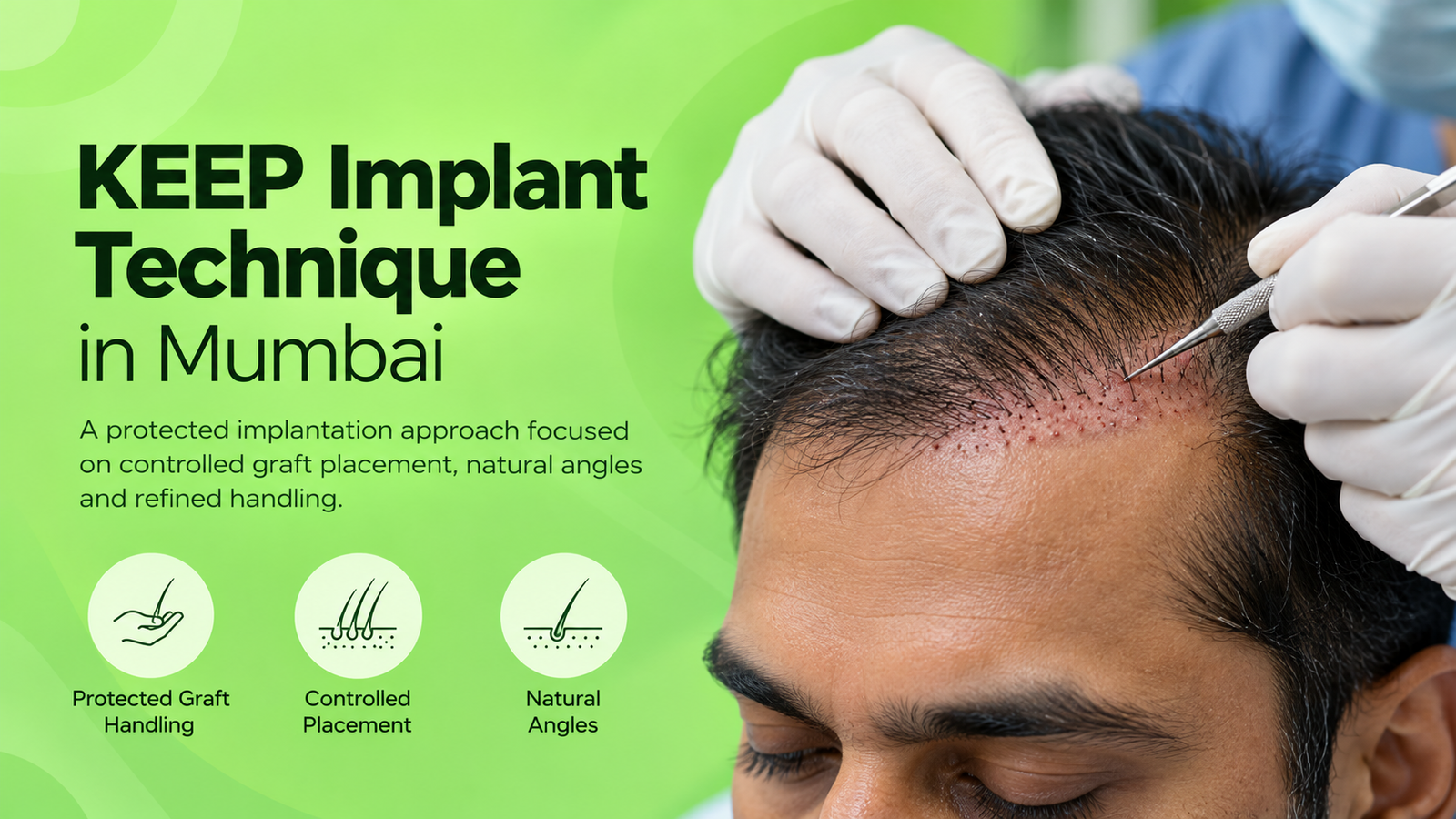
KEEP Implant Technique in Mumbai
The KEEP Implant Technique concerns the placement of prepared follicular grafts during hair transplant surgery.
KEEP stands for Koray Erdogan Embedding Placer, an identified hair-graft placement instrument developed for use in follicular-unit transplantation.
Published descriptions explain that KEEP is designed to assist controlled insertion of grafts into previously prepared recipient sites while reducing unnecessary manipulation of delicate follicular tissue.
Its clinical role is different from extracting donor hair. KEEP is a graft-placement instrument, not a separate harvesting method.
However, patients should distinguish the general published description of KEEP from the exact technique available at an individual clinic.
What Is the KEEP Implant Technique?
KEEP is a named graft-placement instrument associated with hair transplantation.
Its proposed advantage is protecting fragile graft tissue during placement and reducing some of the manipulation that may occur with conventional forceps.
Published descriptions commonly classify KEEP as a graft inserter used with pre-made recipient sites.
This matters because the recipient-site design is generally established before the graft is introduced.
The instrument does not determine the patient’s entire transplant plan.
Natural results continue to depend on the surgeon’s recipient-site design, donor selection, graft quality, handling and postoperative growth.
How Is KEEP Different From a Sharp Implanter Pen?
Different implantation instruments may use different methods of entering the recipient scalp.
With a sharp implanter, the instrument can create a recipient opening and place the graft during the same insertion movement.
KEEP has been described as an instrument for placing grafts into recipient sites that have already been prepared.
This distinction is clinically meaningful.
| Feature | KEEP graft placement | Sharp implanter placement |
|---|---|---|
| Main function | Inserting grafts into prepared sites | Creating an opening and inserting a graft |
| Recipient-site preparation | Generally performed before insertion | May occur during insertion |
| Donor extraction | Separate FUE stage | Separate FUE stage |
| Main technical priority | Protected graft insertion | Controlled simultaneous opening and placement |
| Guaranteed superior outcome | No | No |
Patients interested in the broader instrument category can read Implanter Pen Technique.
Why Is Graft Protection Important?
A follicular unit contains delicate structures that can be injured by excessive compression, traction or repeated manipulation.
During implantation, the operator must position the graft accurately without unnecessarily damaging it.
Graft protection is particularly relevant when working with fragile extracted units or recipient sites that are difficult to access.
A specialised placement instrument may be helpful, but there is no justification for claiming that any individual device completely eliminates graft injury.
Where Does KEEP Fit Into Hair Transplant Surgery?
KEEP concerns the implantation stage.
The broader operation still includes:
- Diagnosis and patient selection.
- Hairline and recipient-area planning.
- Donor-hair assessment.
- Follicular-unit extraction.
- Graft preparation and preservation.
- Recipient-site creation.
- Graft insertion.
- Postoperative management.
The selected FUE technique and the graft-placement method are therefore separate clinical decisions.
For the extraction component, see Biotech FUE Hair Transplant.
Why Is Recipient-Site Design Important When Using KEEP?
Where grafts are placed into prepared recipient openings, the orientation of those openings substantially influences the final hair direction and angle.
The surgeon must plan the visible hairline, density transitions, graft distribution and regional growth pattern in advance.
This requires particular care around the temples, frontal hairline and crown.
A placement instrument cannot correct a fundamentally inappropriate recipient-site design.
How Is the KEEP Implant Technique Used During Hair Transplantation?
This sequence describes the published role of KEEP-type placement. Anagen must verify the exact operative workflow before publication as a clinic-specific protocol.
Step 1: Hair Loss and Donor Assessment
The surgeon assesses donor availability, recipient requirements and medical suitability.
Step 2: Hairline and Graft Distribution Planning
The planned area is mapped according to density objectives, direction and long-term donor management.
Step 3: FUE Graft Extraction
Individual follicular units are harvested using the selected extraction method.
Step 4: Graft Inspection and Preservation
The grafts are examined, organised and maintained under suitable handling conditions.
Step 5: Recipient-Site Creation
Appropriate openings are prepared in the recipient scalp according to the agreed design.
Step 6: Instrument and Graft Preparation
The surgical team selects the appropriate placement approach and prepares grafts for insertion.
Step 7: Controlled Graft Placement
The operator places selected grafts into the prepared openings using the verified KEEP placement method.
Step 8: Inspection of Implanted Grafts
The team checks positioning, visible graft elevation and the recipient area’s condition.
Step 9: Postoperative Care
Scalp protection, cleansing instructions and follow-up guidance are provided.
When Might KEEP Be Considered?
Published descriptions discuss KEEP in relation to delicate graft handling and graft-placement challenges.
However, suitability for an individual patient depends on the surgeon’s assessment, graft characteristics, recipient-skin condition, instrument availability and team experience.
There is insufficient basis for claiming it is the best placement instrument for every hair-transplant patient.
The potential benefits of a tool should be evaluated against the whole surgical plan.
Recovery and Limitations
Using KEEP does not remove the need for normal postoperative healing.
Redness, crusting, swelling, temporary shedding and delayed visible growth remain possible.
Potential complications also include graft loss, folliculitis, infection, scarring, pitting, poor direction or an insufficient cosmetic result.
The device does not prevent progression of untreated native-hair loss.
KEEP Implant Technique Cost in Mumbai
The cost of a transplant involving KEEP would depend on the graft requirement, procedure complexity, instrument workflow, operating time and overall surgical plan.
Anagen-specific pricing should be supplied only after the offered technique and its inclusions are verified.
Patients should not assume that a particular graft-placement instrument necessarily provides better value than other appropriate methods.
KEEP Implant Technique Results
A natural outcome depends on hairline design, donor quality, correctly prepared recipient sites, careful graft placement and biological growth.
An implanting instrument is only one part of that process.
Patients can review Male Hair Transplant Results and Hairline Results in the dedicated Results section.
View hair transplant results.
Frequently Asked Questions
What does KEEP stand for?
KEEP stands for Koray Erdogan Embedding Placer, a named graft-placement instrument described in hair-transplant literature.
Is KEEP another method of extracting hair?
No. It concerns placement of grafts after extraction.
Does KEEP use pre-made recipient sites?
Published descriptions commonly associate KEEP with graft placement into previously prepared recipient openings.
Is KEEP the same as a sharp implanter pen?
Not exactly. A sharp implanter may create the opening during placement; KEEP is described as an inserter for pre-made sites.
Does KEEP guarantee better graft survival?
No. No specific improvement can be guaranteed for an individual patient.
Is KEEP suitable for all patients?
Suitability depends on the grafts, recipient area, instrument availability and the clinical team’s expertise.
Does KEEP change the recovery period?
It does not eliminate the normal healing and growth phases associated with hair transplantation.
Consult Anagen About Hair Implantation Options
The choice of implantation method should follow a complete assessment of the patient’s donor hair, recipient area, hairline design and surgical requirements.
Ask the treating surgeon which actual instruments will be used and why they are appropriate for your case.
Send clear FRONT, TOP and BACK donor photographs or contact Anagen in Mumbai for a surgical assessment.