




Weak Hair Follicle Prescription: Finding the Cause of Weak Hair, Shedding and Breakage
Many patients describe their hair as weak when they notice increased hair fall, easily broken strands, fine hair or reduced scalp coverage.
Some say that their hair roots are becoming weak or that follicles are no longer holding the hair properly.
However, “weak hair follicle” is not a precise medical diagnosis.
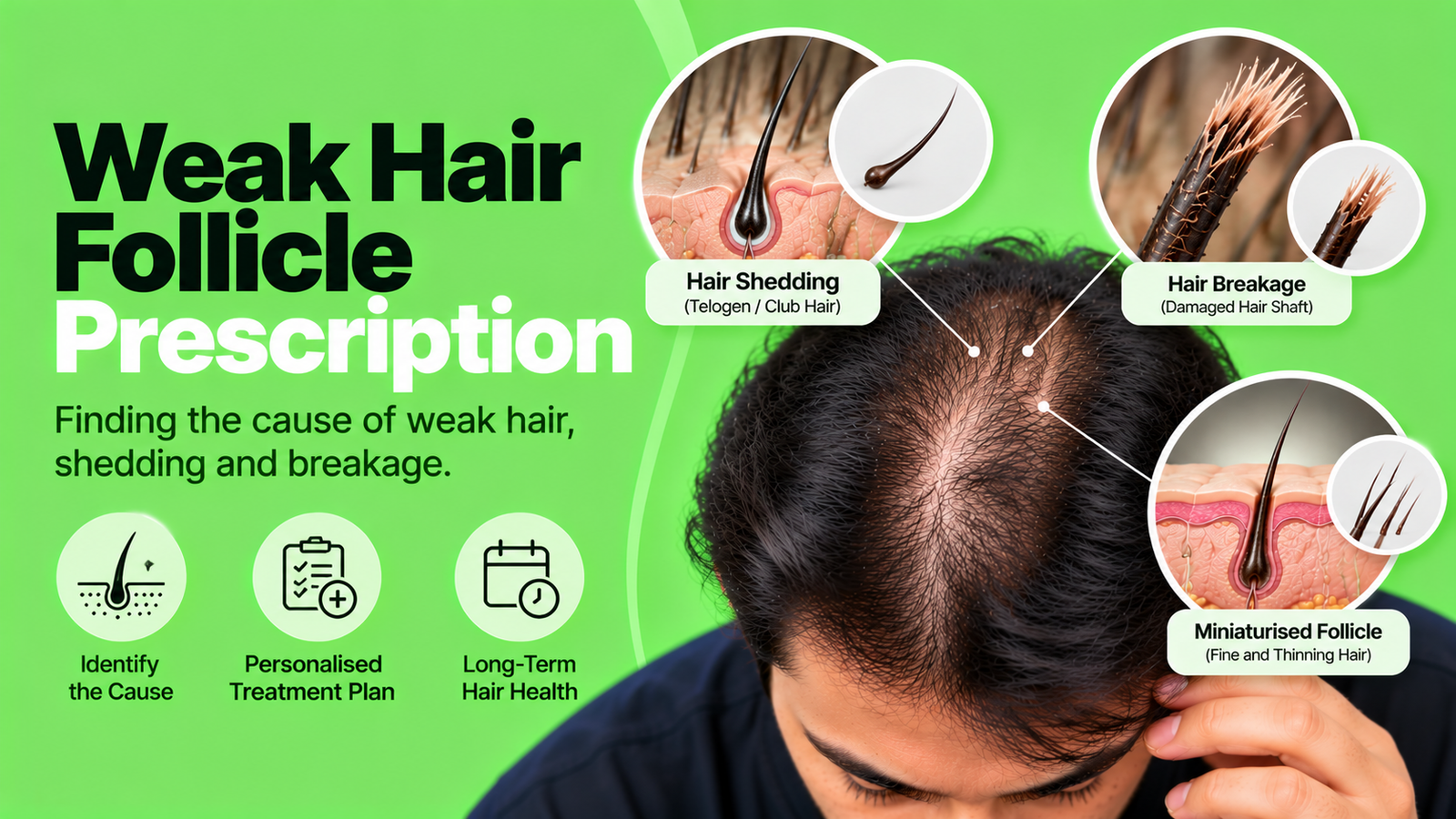
The phrase may describe several different problems, including increased hair shedding, follicular miniaturisation, hair shaft breakage, scalp inflammation or an underlying medical condition.
A weak hair follicle prescription should therefore begin by identifying what is actually happening rather than automatically prescribing a hair-strengthening medicine.
The appropriate treatment depends on whether the concern originates within the follicle, the hair-growth cycle, the hair shaft or the scalp environment.
What Do Patients Mean by Weak Hair Follicles?
Patients commonly use the term “weak roots” to describe one or more of the following situations.
Hair Falling During Washing
Hair may be noticed on the hands, towel or bathroom floor during washing. This can represent normal shedding or excessive shedding, depending on the clinical context.
Hair Breaking During Combing
Short fractured strands may appear on the comb or clothing. This can reflect hair shaft damage rather than the loss of a complete hair from the follicle.
Fine Hair That Looks Less Dense
Some patients have progressively thinner hair, particularly around the frontal scalp or crown. This may indicate follicular miniaturisation.
Hair Loss Associated With Scalp Symptoms
Itching, scaling, redness, soreness or inflammation may suggest a scalp disorder requiring its own diagnosis.
Reduced Hair Growth After Illness or Stress
A temporary disruption in the hair cycle may cause increased shedding.
These problems cannot all be treated with the same prescription.
Hair Shedding Versus Hair Shaft Breakage
One of the most useful distinctions is whether an entire hair shaft has been shed naturally from the follicular cycle or whether the shaft has broken along its length.
Hair Shedding
A shed telogen hair may have a small club-shaped end. This does not mean the entire hair follicle has been pulled out.
The follicle generally remains within the scalp and may enter another growth cycle.
Excessive shedding may occur in telogen effluvium or other disorders.
Hair Shaft Breakage
A broken strand is often shorter and may show an irregular or fractured end.
Repeated heat styling, chemical processing, friction, excessive tension or certain shaft disorders can contribute to breakage.
Treating breakage may require a change in hair-care practices rather than a medicine directed at follicular miniaturisation.
Can Follicular Miniaturisation Cause Weak-Looking Hair?
Yes. A follicle affected by miniaturisation may produce a progressively finer and shorter hair shaft.
This is a different problem from simple hair breakage.
In men, androgenetic alopecia is a common cause of patterned follicular miniaturisation, but other conditions can also produce abnormal hair findings.
When a patient has fine hair, widening scalp visibility and progressive thinning around the temples or crown, the doctor may assess for androgenetic alopecia.
The Miniaturised Hair Follicle Prescription page explains this process more specifically.
Medical Causes That May Need Investigation
When patients complain of weak or excessive hair fall, the doctor may consider several conditions according to the history and examination.
Androgenetic Alopecia
Progressive patterned thinning with miniaturisation of susceptible hair follicles.
Telogen Effluvium
Increased shedding associated with a shift in the hair cycle, sometimes following illness, stress or another physiological trigger.
Nutritional Deficiencies
Certain clinically relevant deficiencies may contribute to shedding or impaired hair quality.
Thyroid Disorders
Thyroid dysfunction can affect hair growth and shedding.
Scalp Inflammation
Some inflammatory scalp diseases are associated with hair changes, discomfort or hair loss.
Hair Shaft Damage
Heat, chemicals, friction, traction and other factors may produce increased breakage.
Other Hair-Loss Disorders
Patchy loss, scalp scarring, significant pain or inflammatory symptoms may require specialised assessment.
The presence of one symptom does not establish a specific diagnosis.
Clinical Assessment for Weak Hair Concerns
During examination, the doctor may ask when the problem began, whether the patient notices shedding or breakage, and whether the hair has become gradually finer.
Other relevant details may include recent illness, changes in weight, medicines, diet, stressors, scalp symptoms and family history.
The examination may involve scalp inspection, trichoscopy and, where clinically appropriate, additional investigation.
The doctor should distinguish a hair-growth problem from a structural shaft problem before selecting treatment.
Prescription Overview
Primary Concern: Weak-looking hair, increased shedding, easily broken strands or progressively finer hair.
Likely Assessment Focus: Distinguishing shedding, shaft breakage, miniaturisation, scalp disease and systemic contributors.
Prescription Goal: Treat the identified underlying cause and support appropriate follicular or hair shaft management.
Possible Prescription Categories: Diagnosis-specific medical treatment, scalp-directed medicines, correction of confirmed deficiencies or hair-growth treatment when indicated.
Supportive Care: Gentle hair handling, reduction of avoidable shaft damage and appropriate scalp care.
Monitoring: Shedding pattern, hair calibre, breakage, scalp symptoms, treatment response and tolerance.
Follow-Up: Based on the identified condition and treatment selected.
When Another Treatment May Be Considered: When progressive follicular disease, substantial established hair loss or another condition requires specialist intervention.
What Prescription May Be Used for Weak Hair Follicles?
There is no single prescription that treats every problem described as weak follicles.
The treatment must follow the diagnosis.
If the Problem Is Follicular Miniaturisation
Appropriate medical management for androgenetic alopecia may be considered, including established growth-support or androgen-pathway treatment when suitable.
If the Problem Is Excessive Shedding
The clinician should investigate possible causes and address an identified trigger or medical condition.
Not every shedding disorder requires the same medicine.
If the Problem Is Hair Shaft Breakage
Management may involve reducing damaging practices, improving hair handling and treating any identified shaft or scalp disorder.
If the Problem Is Nutritional Deficiency
Correction should target a clinically established deficiency rather than routine use of multiple supplements.
If the Problem Is Scalp Inflammation
A diagnosis-specific anti-inflammatory, antifungal or other treatment may be needed.
Monitoring Treatment Response
Follow-up should focus on the actual diagnosis rather than on the vague label “weak hair.”
For excessive shedding, the clinician may review whether shedding has reduced and whether the trigger has resolved.
For miniaturisation, changes in hair calibre and patterned thinning may be monitored.
For breakage, the doctor may assess whether damage continues and whether modified hair-care practices are helping.
For scalp disease, symptom control and evidence of ongoing inflammation are important.
Different conditions therefore require different measures of improvement.
Long-Term Hair and Scalp Maintenance
Maintenance may involve suitable hair care, appropriate scalp hygiene, control of underlying medical disease and continued prescription treatment where necessary.
A patient with temporary shedding may not require the same long-term treatment as someone with progressive androgenetic alopecia.
If a prescription medicine is used, the doctor should explain how to follow it, what adverse effects to report and when reassessment is appropriate.
When Is Another Treatment Needed?
Biologix therapies should not be presented as treatment for all forms of weak hair.
Selected supportive options may be discussed only after the underlying problem is identified and the likely benefits and limitations are explained.
Hair transplantation is also not a standard treatment for shaft breakage or temporary shedding.
It may be relevant in selected patients with established structural hair loss and suitable donor characteristics.
Frequently Asked Questions
What does a weak hair follicle actually mean?
It is a common description rather than a specific diagnosis. It may refer to shedding, miniaturisation, breakage or a scalp-related condition.
Does hair falling from the root mean the follicle is damaged?
Not necessarily. A normally shed hair does not mean the entire follicle has been lost.
How can I distinguish breakage from shedding?
Broken hairs may be shorter and have fractured ends. Shed club hairs can have a characteristic proximal end. Clinical examination can help distinguish them.
Can nutritional deficiency cause weak hair?
Certain deficiencies may contribute to hair problems, but they should be investigated according to the patient’s history and examination.
Can scalp inflammation affect hair growth?
Some inflammatory scalp diseases can contribute to shedding or hair loss. The diagnosis and severity determine the appropriate treatment.
Do I need hair-strengthening medicine?
Not automatically. Some patients require medical treatment, while others primarily need correction of hair-care damage or management of an underlying condition.
When should I seek a scalp examination?
Persistent or progressive thinning, sudden excessive shedding, patchy loss, scalp pain, redness, scarring or significant inflammation should be clinically assessed.
Weak Hair and Hair Follicle Consultation at Anagen
Hair that seems weak may be affected by shedding, shaft damage, follicular miniaturisation or another medical condition.
Anagen’s hair prescription consultation can help identify the underlying cause and determine whether the patient requires prescription treatment, scalp management, supportive care or another approach.
The objective is to treat the actual condition rather than assign one prescription to every complaint of weak hair.