




Advanced Donor Management for Hair Transplant in Mumbai
A hair transplant is not only a decision about where hair should be added.
It is equally a decision about how donor hair should be preserved.
Every extraction affects the remaining donor reserve.
For patients with progressive hair loss, previous transplantation, advanced baldness or complex restoration needs, donor planning should therefore extend beyond one operation.
Advanced Donor Management is the process of assessing, mapping, preserving and allocating available follicles so that today’s transplant does not unnecessarily compromise tomorrow’s options.
Why Donor Management Matters
Hair loss may continue for years.
A transplant performed today cannot be planned as though the patient’s current bald area will always remain unchanged.
The donor area may eventually need to support:
- current frontal restoration
- future mid-scalp thinning
- later crown loss
- repair of earlier work
- refinement procedures
- treatment after additional native-hair loss
A large first procedure can therefore be inappropriate if it exhausts follicles needed later.
What Is the Safe Donor Zone?
The safe donor zone refers to scalp regions considered more resistant to the progressive miniaturisation seen in androgenetic hair loss.
Its boundaries are not identical in every patient.
They depend on individual hair-loss patterns, miniaturisation and long-term stability.
A donor map should therefore not use rigid universal borders.
Donor Density and Follicular-Unit Distribution
Two donor areas can look similar from a distance but provide very different usable resources.
Assessment may include:
- follicular-unit density
- hairs per follicular unit
- hair calibre
- curl
- colour
- scalp visibility
- donor surface area
- existing miniaturisation
- previous extraction
Why Miniaturisation Matters
A donor region can appear populated with hair while still containing follicles that are becoming progressively thinner.
If miniaturising hair is harvested without recognising the underlying pattern, long-term donor reliability may be reduced.
This is especially relevant when diffuse thinning or an unstable donor pattern is suspected.
Previous Extraction Changes the Donor Map
A patient who has already undergone FUE should not be assessed as though the donor area were untouched.
The clinician needs to determine:
- where follicles were previously removed
- whether extraction was evenly distributed
- which zones are visibly thinner
- where density remains stronger
- whether further scalp harvesting is reasonable
- whether alternative donor sources need assessment
Balanced Extraction Distribution
Removing too many follicles from a small region can produce visible thinning even when the total graft count seems acceptable.
Balanced donor management considers:
- spacing
- regional density
- hair calibre
- hairstyle
- previous extraction
- future harvesting requirements
Lifetime Donor Strategy
A lifetime plan asks a different question from a one-procedure plan.
Instead of:
“How many grafts can we take today?”
it asks:
“How should the available follicles be allocated across the patient’s likely future hair-loss journey?”
That may mean:
- reserving fine singles for the frontal transition
- avoiding an unnecessarily low hairline
- prioritising frontal framing
- limiting crown expenditure
- staging surgery
- protecting unharvested scalp reserve
- assessing beard or selected body donor only when genuinely useful
Scalp, Beard and Body Donor Allocation
Alternative donor follicles can sometimes expand the available pool, but they should not be used indiscriminately.
Scalp hair is generally preferred where its characteristics matter most.
Coarser beard follicles may be blended into selected regions.
Chest or other body follicles require greater selectivity.
For donor-source options, see Alternative Donor Hair Restoration.
For the actual transfer of selected non-scalp follicles to the scalp, see Body Hair To Scalp Hair Transplant.
Advanced Donor Management in Repair Cases
Repair patients can have two simultaneous problems:
- recipient areas that require correction; and
- donor areas that have already been partially depleted.
Further extraction should therefore be based on a fresh assessment rather than simply repeating the previous surgical approach.
Repair planning may require:
- remaining scalp-donor mapping
- assessment of donor scarring
- evaluation of overharvesting
- recipient-priority review
- possible alternative donor supplementation
- staged correction
Future Hair Loss Must Be Considered
Native non-transplanted hair can continue to thin after surgery.
The more progressive the likely hair loss, the more important donor preservation becomes.
A transplant that looks appropriate today should ideally remain supportable if additional hair is lost later.
How Is Advanced Donor Management Assessed?
This is primarily a planning process rather than a separate surgical technique.
Assessment may include:
Donor History
Previous FUE, FUT, repair procedures and known graft numbers are reviewed where records are available.
Scalp Examination
Density, miniaturisation, calibre and extraction patterns are evaluated.
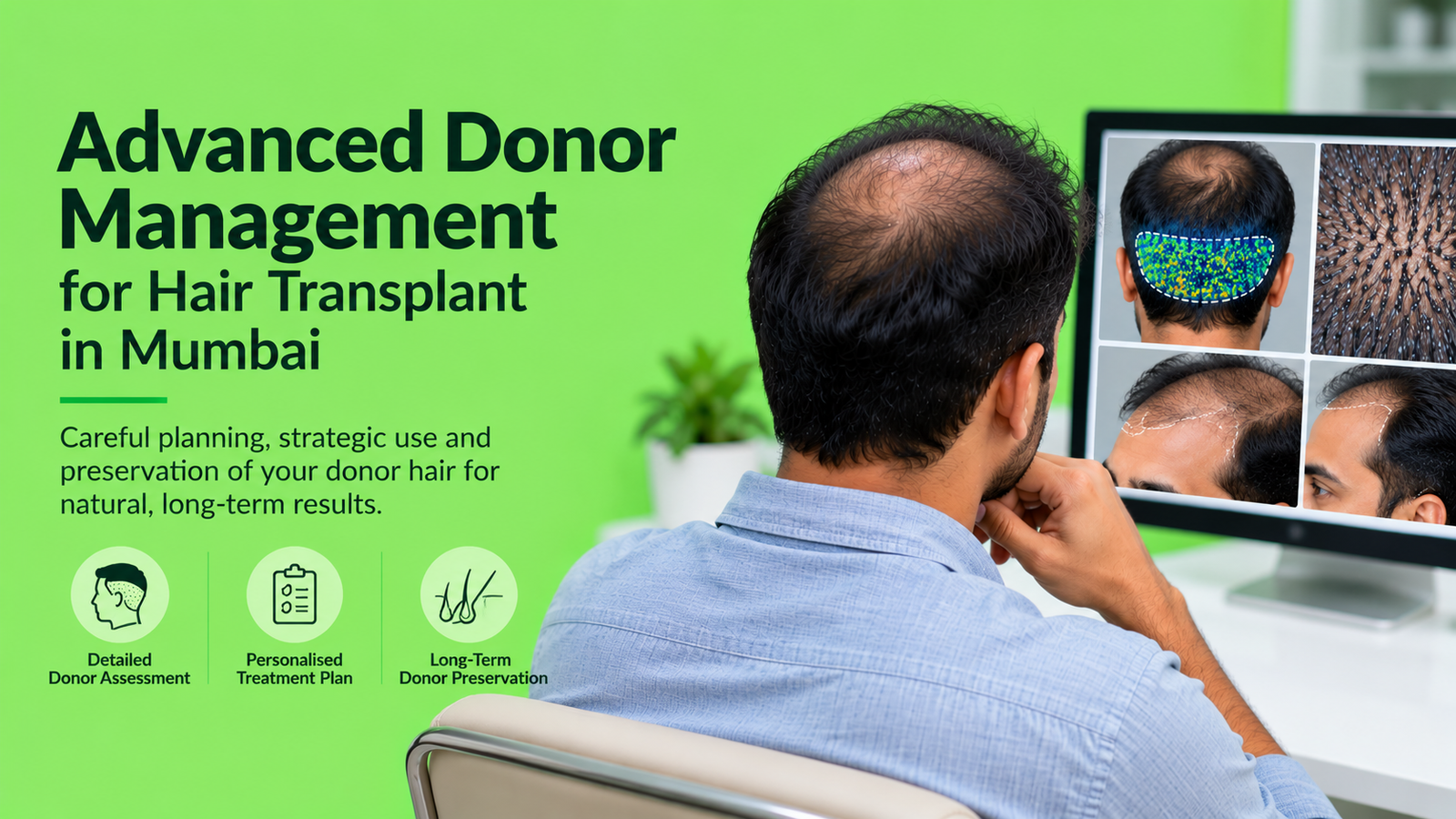
Donor Mapping
Stronger, weaker and previously harvested regions are documented.
Recipient-Demand Analysis
Hairline, frontal scalp, mid-scalp and crown requirements are considered separately.
Alternative Donor Assessment
Beard or selected body donor sources are considered only if needed.
Long-Term Allocation
The treatment plan determines how much donor hair should be used now and what should remain available.
What Does a Good Donor-Management Result Mean?
Successful donor management is not simply the largest possible graft extraction.
It means achieving worthwhile recipient improvement while maintaining a donor area that remains cosmetically acceptable and preserving reasonable future options wherever possible.
In advanced cases, this balance can be more important than maximum short-term coverage.
Original patient results should remain within Anagen’s Results architecture.
Frequently Asked Questions
How many grafts can safely be taken from my donor?
There is no single safe number that applies to everyone.
Can donor hair grow back after extraction?
An extracted follicular unit should not be assumed to regenerate simply because surrounding hairs make the area look fuller.
Can repeated FUE make the donor visibly thin?
Yes. Cumulative harvesting matters.
Should all available donor hair be used in my first procedure?
Not necessarily. Progressive hair loss may make preservation valuable.
Can beard or body hair prevent donor depletion?
No. They may add supplementary options but do not make donor supply unlimited.
Can an overharvested donor be fully restored?
Not automatically. The donor and recipient problems require individual assessment, and complete restoration cannot be promised.
Advanced Donor Management Consultation in Mumbai
Patients who may particularly benefit from detailed donor mapping include those with:
- advanced baldness
- previous FUE
- previous FUT
- visible donor thinning
- previous failed transplantation
- planned large restoration
- young age with progressive hair loss
- possible need for multiple future procedures
Send clear front, top, both sides and back/donor photographs.
Use Anagen’s Contact page to arrange formal assessment.