





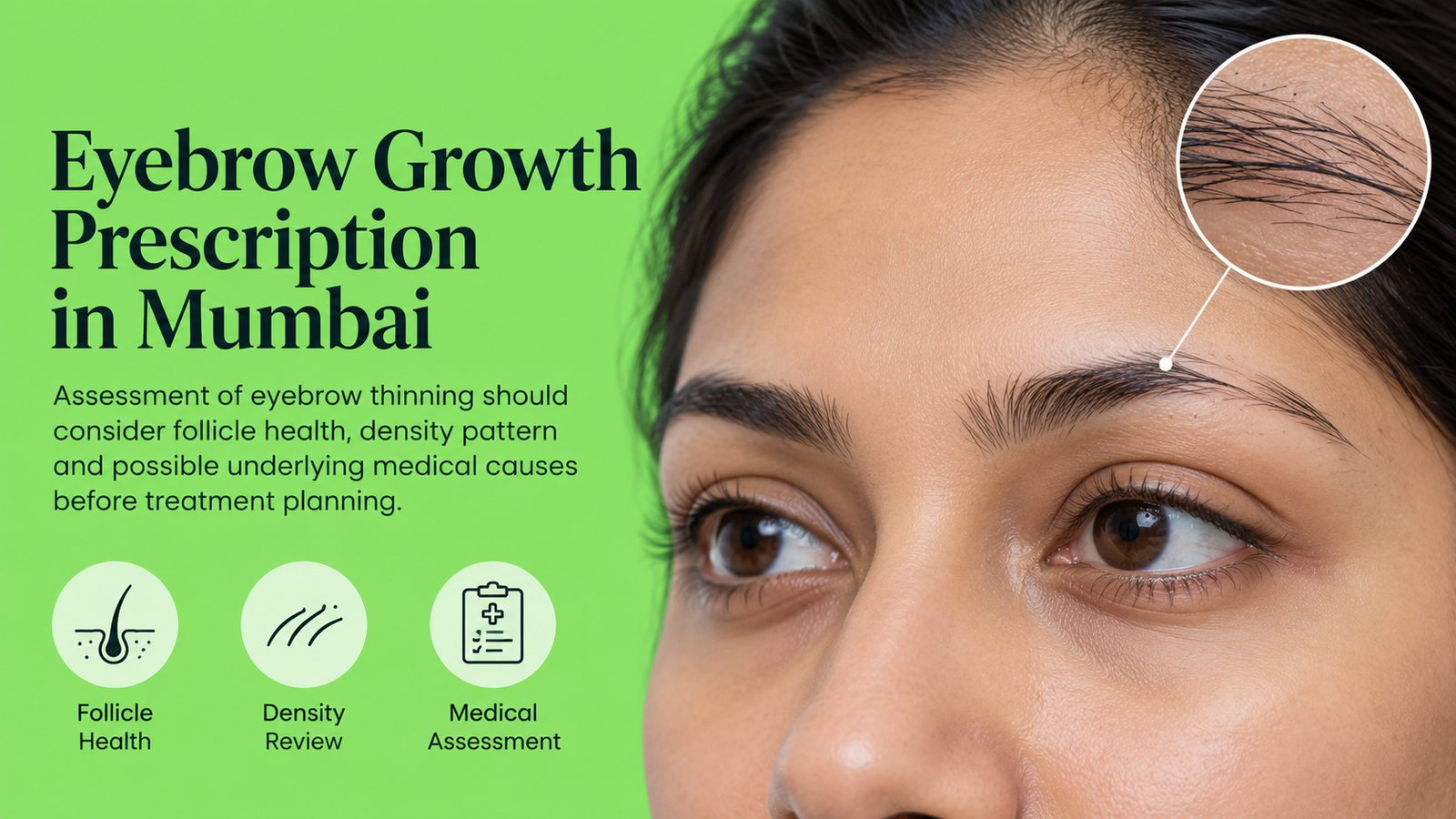
Eyebrow Growth Prescription in Mumbai
Thin, sparse or gradually disappearing eyebrows may be associated with natural hair patterns, repeated plucking, aging, inflammatory skin conditions, alopecia areata or certain underlying medical disorders.
At Anagen Hair Transplant Clinic, Mumbai, an Eyebrow Growth Prescription focuses on identifying the cause of eyebrow thinning before selecting an appropriate treatment approach.
Depending on the condition of existing follicles and the diagnosis, supervised prescription treatment may help selected patients. Because the eyebrow region is close to the eyes, medication safety requires particular attention.
Clinical evaluation helps determine whether medical treatment, supportive care or another eyebrow-restoration option is appropriate.
Understanding Eyebrow Thinning and Reduced Eyebrow Growth
Eyebrows help frame the eyes, contribute to facial expression and protect the eye region from moisture and debris. Changes in eyebrow density may affect appearance, but they can also provide clues about an underlying dermatological or medical condition.
Some people naturally have fine or sparse eyebrows. Others experience gradual thinning with age, repeated plucking, skin disease or specific forms of hair loss.
An Eyebrow Growth Prescription is a medically guided approach to identifying the cause of eyebrow thinning and deciding whether prescription management may help.
The first priority is to distinguish a normal eyebrow-density variation from acquired loss of existing hairs.
This distinction matters because treatment directed at normal hair growth is different from treatment for alopecia areata, dermatitis, thyroid disease or permanent follicular damage.
Not every patient requires medicine, and products designed for scalp hair growth should not automatically be applied around the eyes.
What Causes Eyebrow Thinning?
Several conditions may produce a similar appearance. Clinical history and examination help determine which explanation is most likely.
1. Naturally Sparse Eyebrows
Eyebrow density, width and distribution vary between individuals. Some people have naturally fine hair shafts or reduced coverage, particularly around the eyebrow tails.
Stable lifelong sparseness without additional symptoms may be a normal inherited characteristic.
2. Repeated Plucking and Cosmetic Trauma
Frequent eyebrow plucking, waxing, threading or other grooming practices can cause mechanical trauma to follicles.
In some cases, hair may recover after the repeated trauma stops. However, longstanding follicular damage may reduce the potential for regrowth.
The degree of reversibility depends on whether functional follicles remain.
3. Alopecia Areata
Alopecia areata can affect the eyebrows independently or alongside scalp and other body-hair loss.
Patients may notice smooth patches, sudden density reduction or loss of part of the eyebrow.
Treatment is selected according to disease activity, extent and the patient’s clinical circumstances.
4. Eyebrow Dermatitis and Inflammatory Skin Disease
Seborrheic dermatitis, eczema, contact dermatitis and other inflammatory conditions can affect the skin surrounding eyebrow follicles.
Symptoms may include scaling, itching, redness, flaking or irritation.
The skin condition should be identified and appropriately treated before introducing potentially irritating growth products.
5. Thyroid and Other Medical Conditions
Thyroid disorders may sometimes contribute to eyebrow thinning, including changes involving the outer eyebrow.
However, loss of the eyebrow tail is not a reliable diagnosis of thyroid disease by itself.
Associated symptoms, medical history and examination determine whether thyroid assessment is appropriate.
Patients with suspected thyroid-associated hair changes may also benefit from information in the Thyroid & Hair Loss Prescription section.
6. Nutritional and Medication-Associated Hair Loss
Certain nutritional deficiencies, systemic illnesses and medications can contribute to eyebrow-hair loss.
Testing or supplementation should be individualized and based on clinical indications.
Routine use of hair supplements without confirming a relevant deficiency is not a reliable eyebrow-regrowth strategy.
7. Scarring Eyebrow Hair Loss
Burns, injury, surgery and some inflammatory disorders can permanently damage eyebrow follicles.
Certain scarring alopecias may involve the eyebrows, sometimes before substantial scalp-hair loss becomes apparent.
Where active scarring disease is suspected, prompt dermatological evaluation is important because delayed control of inflammation may permit further irreversible loss.
When Should Eyebrow Thinning Be Medically Investigated?
Not every patient with naturally thin eyebrows requires extensive testing.
Medical assessment becomes particularly relevant when eyebrow loss is new, progressive or accompanied by other symptoms.
Reasons for a more detailed evaluation include:
- Sudden or rapidly progressing eyebrow loss.
- Clearly defined patches of missing eyebrow hair.
- Persistent redness, scaling, pain or inflammation.
- Changes in the surrounding skin or possible scarring.
- Associated scalp or eyelash loss.
- Relevant systemic symptoms such as fatigue, weight change or cold intolerance.
- Eyebrow thinning following medication changes or medical treatment.
- Significant asymmetry that has developed recently.
A clinician may use dermoscopy or trichoscopy to examine hair shafts, follicular openings, skin inflammation and signs suggesting non-scarring or scarring alopecia.
Laboratory investigations are guided by the suspected diagnosis. They are not automatically necessary in every case.
If eyebrow loss is accompanied by eye pain, visual disturbance, substantial eyelid swelling or rapidly worsening inflammation, the patient should seek prompt medical assessment rather than treating it as a routine cosmetic issue.
Prescription Overview
Concern: Thin eyebrows, reduced eyebrow density, eyebrow patchiness, over-plucking-associated loss or acquired eyebrow thinning.
Assessment Required: History of onset, grooming practices, medical conditions, medications, eyebrow-hair distribution and examination for inflammatory or scarring disease.
Possible Prescription Categories: Diagnosis-specific dermatological therapy, selected topical treatment where appropriate, management of autoimmune or inflammatory hair loss, and treatment of confirmed underlying medical conditions.
Supportive Care: Gentle cleansing, avoidance of repeated trauma, appropriate skin moisturization and removal of irritating cosmetic products.
Monitoring: Eyebrow density and distribution, progression of hair loss, skin inflammation, ocular safety and medication tolerability.
Follow-Up: Determined by the cause, treatment selected and progression of the condition.
When Further Treatment May Be Considered: Stable permanent thinning, mature scar-related loss or inadequate hair coverage where medical treatment cannot reasonably restore the desired density.
Important: This page provides general prescription information and does not replace an individual clinical assessment. Prescription medicines, where indicated, should be selected according to the patient’s medical history, diagnosis and examination.
What Prescription Treatments May Help Eyebrow Growth?
The appropriate prescription depends on the specific cause of thinning.
There is no universally suitable eyebrow-growth medicine, and medications used on the scalp are not automatically safe for application near the eyes.
1. Treatment of Eyebrow Alopecia Areata
When eyebrow loss results from alopecia areata, the primary objective is to manage the autoimmune disease affecting the follicles.
A dermatologist may consider selected local anti-inflammatory treatment or other disease-specific therapies depending on the patient’s condition and disease extent.
For some patients, physician-administered treatments may be appropriate.
Systemic immune-modulating therapy may be considered in selected patients with sufficiently extensive disease, not simply because a person has cosmetically thin eyebrows.
Regrowth is variable, and recurrence may occur.
2. Topical Treatment to Support Existing Eyebrow Hair
Some topical hair-growth medicines have been studied or used under medical supervision for eyebrow thinning.
However, a medicine’s safety and approval for scalp use do not establish its suitability for application near the eyes.
The clinician must evaluate the product’s indication, evidence, formulation, potential ocular exposure and individual risk.
Patients should not apply scalp minoxidil or any other scalp-growth preparation to the eyebrow region without appropriate medical advice.
3. Treatment of Eyebrow Dermatitis
Where eczema, seborrheic dermatitis or another inflammatory skin condition is contributing to eyebrow changes, the clinician may prescribe treatment aimed at controlling that disorder.
Appropriate treatment may improve skin health and support recovery where follicles remain viable.
Because the area is close to the eyes, medicine selection and application instructions require particular care.
4. Management of Thyroid or Other Systemic Disorders
Where a clinically relevant medical disorder is identified, management of the underlying condition may be necessary.
Correcting the underlying disease does not guarantee complete eyebrow regrowth, particularly if additional causes of follicular damage are present.
5. Correction of Confirmed Nutritional Deficiency
When testing identifies a relevant deficiency, targeted correction may be included in the medical plan.
Supplements should not be promoted as a universal treatment for thin eyebrows.
6. Management of Scarring Alopecia
When inflammatory scarring alopecia is suspected, the immediate priority is to diagnose and control the disease to prevent further follicular damage.
Medication may help suppress active inflammation but cannot reliably replace follicles already destroyed by scar formation.
Transplantation is generally not considered during active or unstable inflammatory hair loss.
How Should an Eyebrow Prescription Be Used Safely?
The eyebrow region requires additional caution because it is close to the eyelids, ocular surface and delicate surrounding skin.
Any prescribed topical medicine should have clear, individualized instructions regarding the appropriate treatment area, application method and precautions.
Patients should understand the risk of irritation, allergy, unwanted spread of a topical preparation and potential eye exposure.
The clinician should also review contact-lens use, relevant eye conditions and other medications where applicable.
Self-medicating with concentrated scalp solutions, steroid creams or unverified eyebrow-growth serums is inappropriate.
If a product causes eye discomfort, significant redness, swelling or visual symptoms, medical advice should be obtained promptly.
Existing Eyebrow Follicles vs Permanent Eyebrow Loss
An eyebrow may look thin for several different biological reasons.
Existing follicles may produce finer or shorter hairs than before.
Some follicles may be affected by a reversible inflammatory condition or temporary disruption of hair growth.
In other cases, chronic trauma or scarring disease may have destroyed follicles, making medication-induced regrowth less likely.
A clinically stable hairless region does not automatically prove permanent follicular absence. The skin and follicular condition require assessment.
The key prescription decision is whether treatment can reasonably preserve or improve hair production from the follicles that remain.
How Long Does Eyebrow Prescription Treatment Take?
The response depends on the cause of hair loss and the therapy used.
In some non-scarring conditions, hair may recover after the underlying trigger is controlled. In others, treatment may reduce further loss without restoring the original density.
Eyebrow hair follows a different growth pattern from scalp hair. Improvements may therefore be gradual and require repeated clinical review.
There is no single reliable timeline applicable to every eyebrow condition.
Where scarring is established, the objective of medical treatment may be preventing additional loss rather than regrowing destroyed follicles.
A responsible prescription plan explains both the intended treatment objective and the limitations.
When Should Eyebrow Transplantation Be Considered?
Eyebrow transplantation and prescription management serve different purposes.
Prescription management aims to treat a relevant medical condition or support existing follicle activity where appropriate.
An eyebrow transplant redistributes donor follicles to selected eyebrow areas. The procedure requires careful attention to hair-shaft characteristics, direction, exit angle and natural eyebrow anatomy.
Transplantation may be considered in suitably selected patients with stable structural deficiency, scar-associated hair loss or persistent density limitations that cannot be adequately addressed with medical management.
Patients with active autoimmune or scarring disease require particularly careful assessment before surgery.
Relevant Anagen pages include:
Eyebrow Hair Transplant — surgical restoration where donor follicles may be appropriate.
Eyebrow Density Enhancement — surgical management of selected density gaps.
Eyebrow Reconstruction — restoration of more substantial eyebrow defects.
Eyebrow Scar Repair — selected stable scar-associated eyebrow deficiencies.
Natural Eyebrow Design — anatomical considerations involved in surgical eyebrow design.
These are distinct procedural topics, not substitute pages for the diagnosis and medical treatment of eyebrow thinning.
Monitoring and Follow-Up for Eyebrow Prescription Treatment
Follow-up helps establish whether the condition is stable, improving or progressing.
A clinical review may include:
- Changes in eyebrow density and distribution.
- Recovery or progression of patchy loss.
- Signs of redness, scaling, inflammation or scarring.
- Changes in associated scalp or eyelash hair.
- Medication tolerability and potential ocular adverse effects.
- Any new medical symptoms.
- Whether the prescription remains necessary or requires adjustment.
With consent, standardized photographs can help document changes over time.
Photography should use consistent lighting, camera angle and grooming conditions. Makeup, eyebrow pencils and cosmetic pigmentation can otherwise make interpretation misleading.
Eyebrow Care During Prescription Treatment
Supportive eyebrow care may improve comfort and reduce unnecessary trauma.
Patients may be advised to minimize repeated plucking, aggressive threading, harsh scrubbing and products that irritate the eyebrow skin.
Existing eyebrow hairs should be treated gently, particularly when there is active inflammation or fragile hair growth.
Cosmetic filling products can sometimes improve appearance while medical assessment or treatment is ongoing, but they do not address the underlying cause.
Microblading or similar cosmetic procedures should be discussed with a qualified clinician if there is active skin disease, unstable hair loss or other relevant risk.
Frequently Asked Questions About Eyebrow Growth Prescriptions
1. Why are my eyebrows becoming thinner?
Eyebrow thinning may result from age-related changes, repeated plucking, inflammatory skin disease, alopecia areata, medication effects, scarring or certain medical conditions. An examination helps identify the likely cause.
2. Can eyebrow hair grow back?
Regrowth may be possible when follicles remain functional and the cause is reversible or treatable. Longstanding scarring and follicular destruction may limit recovery.
3. Can thyroid problems cause eyebrow thinning?
Yes, thyroid disorders can sometimes contribute to eyebrow changes, but the appearance alone cannot confirm thyroid disease. Testing should depend on associated symptoms and clinical assessment.
4. Can I use scalp hair-growth medicine on my eyebrows?
Not without medical advice. Scalp products are not automatically appropriate for use close to the eyes. Safety, indication, formulation and application precautions must be considered.
[MEDICAL REVIEW REQUIRED — CONFIRM SAFETY AND INDICATION FOR EYEBROW USE.]
5. Can over-plucked eyebrows recover?
Some eyebrows regrow after repeated mechanical trauma stops, particularly when follicles remain intact. Persistent trauma over a long period can sometimes produce lasting loss.
6. How is eyebrow alopecia areata treated?
Treatment is individualized according to disease extent and activity. A dermatologist may consider observation, selected anti-inflammatory treatment or other appropriate therapies. No option guarantees complete regrowth.
7. When should I consider an eyebrow transplant?
Transplantation may be considered for stable structural hair loss when medical treatment is unlikely to restore adequate coverage. Active medical or inflammatory causes should be evaluated first.
Eyebrow Growth Prescription Consultation at Anagen, Mumbai
Eyebrow thinning should not automatically be treated as a cosmetic density problem.
Identifying whether the cause is a normal hair pattern, repeated trauma, inflammatory skin disease, alopecia areata, a systemic condition or permanent follicular damage helps determine the appropriate next step.
A clinical assessment can establish whether observation, prescription treatment, management of an underlying disorder or eyebrow-restoration consultation is suitable.
Arrange a Hair Prescription Consultation
Discuss your eyebrow concern with a qualified clinician before starting medicines near the eyes.