





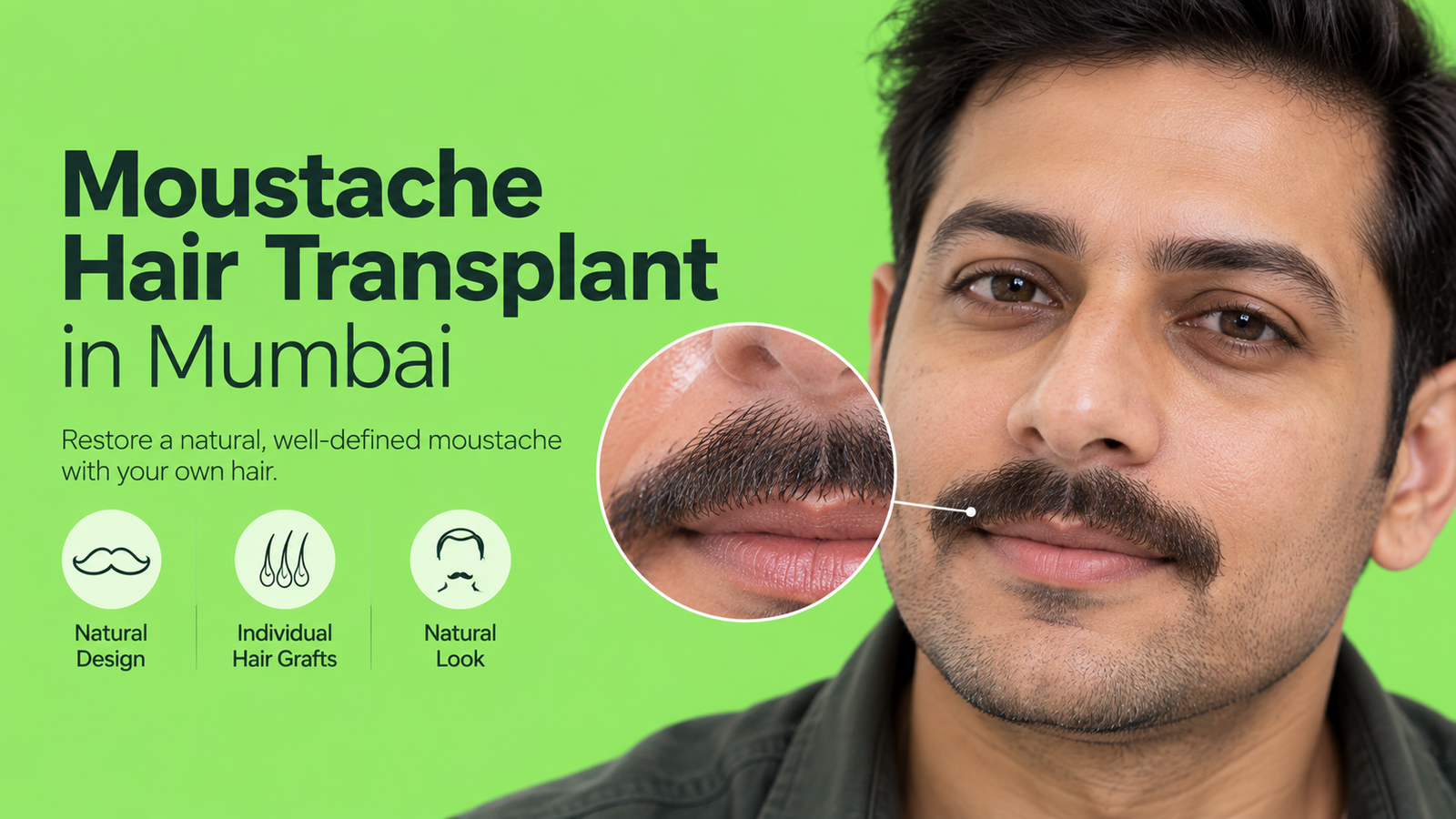
Moustache Hair Transplant in Mumbai
A moustache may be naturally absent, poorly developed, incomplete or too sparse to create the shape a person wants. For selected patients, a moustache hair transplant can restore hair by transferring suitable follicles from a donor area and placing them individually into carefully planned areas of the upper lip.
A natural-looking moustache transplant is not simply about adding more hair. The design, hair calibre, exit angle, direction and transition between different parts of the moustache all matter. Because the moustache sits in the centre of the face, even small errors in direction or positioning can become noticeable.
At Anagen, moustache restoration is therefore planned around the patient’s existing facial hair, facial proportions, donor characteristics and the type of moustache they want to achieve.
What Is a Moustache Hair Transplant?
A moustache hair transplant is a surgical facial-hair restoration procedure in which suitable hair follicles are removed from a donor area and transplanted into the moustache region.
The procedure may be considered when the moustache is:
- almost completely absent
- naturally poorly developed
- significantly incomplete
- irregular despite otherwise normal facial hair
- too limited to create the desired moustache shape
The purpose is not to place as many grafts as possible. The objective is to create an appropriate distribution of hairs that follows natural moustache anatomy and looks convincing both when closely trimmed and when allowed to grow longer.
Someone who already has a reasonable moustache but wants only additional fullness may instead need Moustache Density Enhancement rather than complete reconstruction.
Who May Consider a Moustache Hair Transplant?
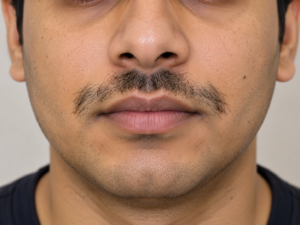
The procedure may be considered by men who have adequate donor hair and a stable facial-hair pattern but are unable to achieve their preferred moustache because of insufficient natural growth.
Typical situations include:
- very little natural moustache development
- a moustache limited mainly to the central region
- incomplete connection between different moustache zones
- marked asymmetry
- naturally wide gaps
- a long-standing moustache pattern that has remained sparse despite maturity
A consultation should determine whether transplantation is actually necessary before surgical planning begins.
What Can Cause an Absent or Weak Moustache?
Not every person develops the same amount of facial hair. Genetics can strongly influence moustache density, distribution, hair calibre and the age at which facial hair matures.
However, reduced moustache growth can also occur after:
- facial injury
- surgery
- burns
- previous procedures
- certain inflammatory or dermatological conditions
- local scarring
- some forms of hair loss
A transplant should not automatically be the first response to every thin moustache.
If hair growth has recently changed, is progressively reducing, or is associated with redness, scaling, itching or other skin changes, the underlying cause should first be assessed.
For patients in whom non-surgical management may still be relevant can read our Moustache Growth Prescription.
When May Surgery Not Be Appropriate?
A moustache transplant may need to be postponed or avoided when:
- there is active infection or inflammation in the recipient area
- the cause of recent facial-hair loss has not been established
- a scar or dermatological condition is still active
- donor hair is unsuitable or insufficient
- the patient has a medical condition requiring further evaluation before elective surgery
- expectations cannot realistically be achieved with available donor hair
- the desired moustache design would look unnatural for the patient’s anatomy
The decision is therefore based on more than the size of the empty area.
How Is a Natural Moustache Designed?
Moustache design should be individualised rather than copied from another person.
Factors considered may include:
- width of the upper lip
- distance between the nose and upper lip
- existing native moustache pattern
- facial shape
- beard distribution
- age
- preferred grooming style
- donor-hair calibre
- amount of available donor hair
The objective is usually controlled natural irregularity rather than perfect geometric symmetry.
A completely straight, sharply outlined moustache can look artificial—particularly when the hair is kept short.
Central and Lateral Moustache
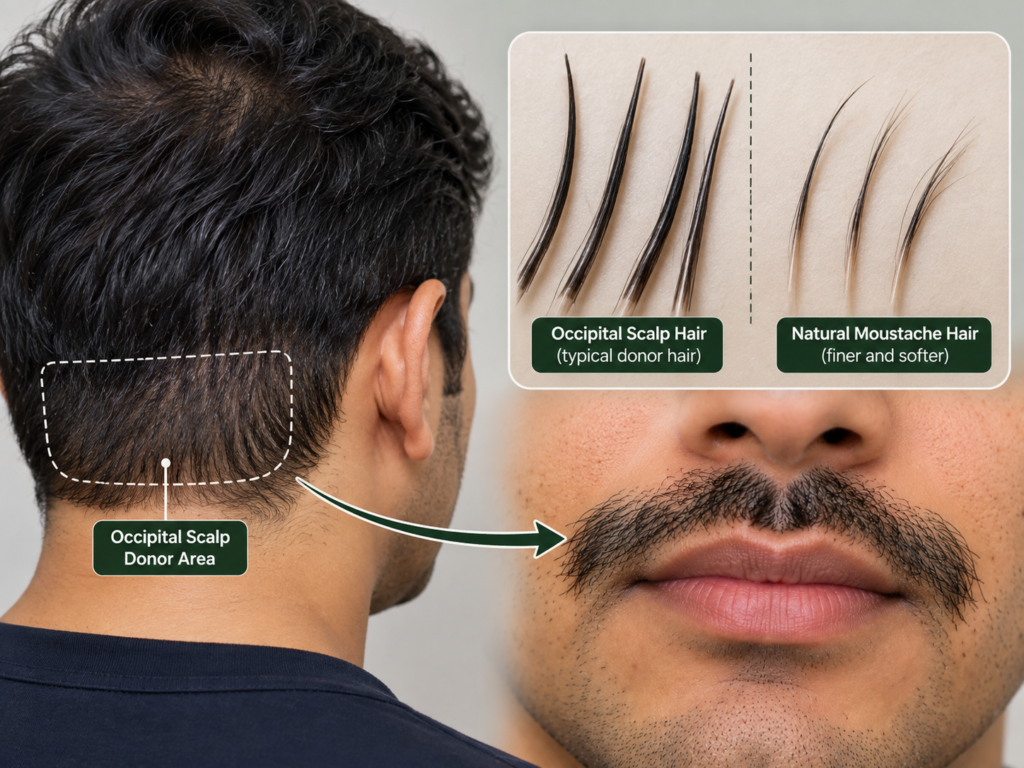
The direction of hair is not identical throughout the moustache. The central region and lateral portions may require different orientation so that transplanted hairs follow the natural flow of facial hair. Where native moustache hairs are already present, they provide an important guide for recipient-site direction.
Natural Borders
Highly visible borders require particular care. Strategically selected single-hair grafts may be useful near visible transition areas so that the moustache does not suddenly begin with coarse grouped hairs.
Where Does the Donor Hair Come From?
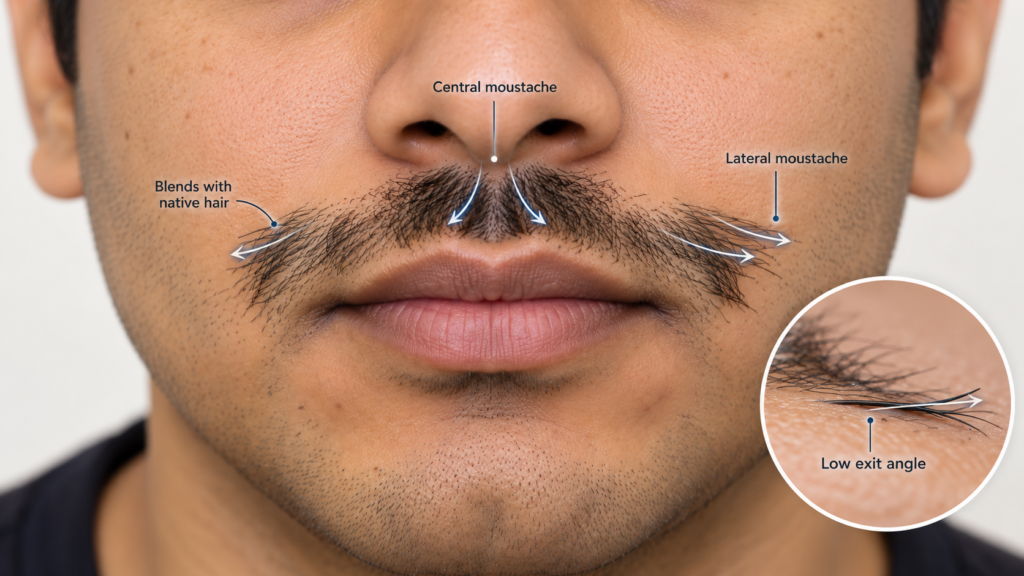
Suitable donor hair is selected according to factors such as calibre, texture, colour, curl and availability.
Scalp hair is commonly considered because individual follicular units can be selectively harvested using FUE. However, scalp hair may behave differently from native moustache hair and can continue to grow with scalp-like characteristics. This is important because transplanted hairs may need regular trimming.
In selected patients, the surgeon may consider other appropriate donor sources depending on hair characteristics and the overall restoration plan. Donor selection should not be based only on the number of hairs available. A mismatch between very coarse donor hair and fine native moustache hair can make the result less natural.
Why Are Direction and Angle So Important?
Moustache hairs normally lie relatively close to the skin. If transplanted hairs are placed at an incorrect angle, they may project outward rather than following the face. This becomes particularly obvious when the moustache is trimmed short.
Recipient sites therefore need to consider both:
Angle — how the hair exits the skin.
Direction — where the hair points after leaving the skin.
The direction must also change gradually across the moustache rather than remaining identical from the centre to the sides. Precise recipient-site creation also helps reduce the risk of visible surface irregularities such as pitting or cobblestoning.
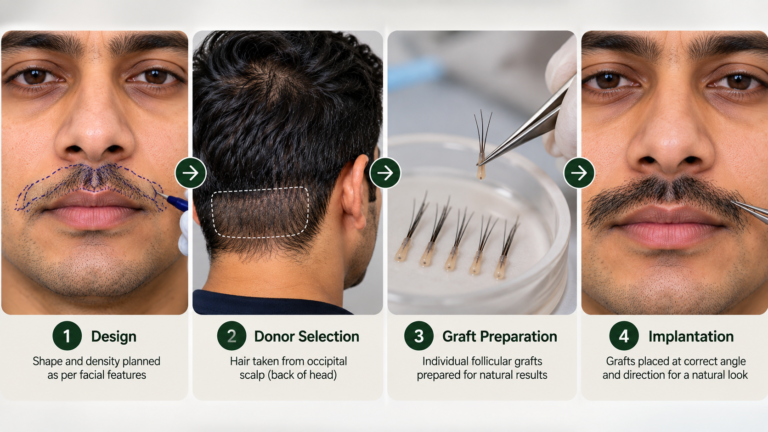
How Is Moustache Hair Transplant Performed?
Step 1: Assessment
The doctor assesses the moustache region, existing facial hair, donor area, skin condition and the patient’s objective. Medical history and suitability for an elective procedure are also reviewed.
Step 2: Moustache Design
The planned moustache outline and areas requiring transplantation are marked. The design should complement the patient’s natural facial anatomy rather than reproducing another person’s moustache.
Step 3: Donor Selection
Suitable donor follicles are identified according to calibre, texture and available supply.
Step 4: Local Anaesthesia
Local anaesthesia is administered to numb the donor and recipient regions. Patients may still feel the initial injections, pressure or movement even though the treated areas are intended to remain numb during the procedure.
Step 5: FUE Extraction
Selected follicular units are individually extracted from the donor area using an FUE approach where appropriate.
Step 6: Graft Sorting
Extracted grafts are examined and organised according to their characteristics.
Single-hair follicular units may be particularly valuable in highly visible transition zones.
Step 7: Recipient-Site Creation
Small recipient sites are created according to the planned moustache design.
The surgeon considers angle, direction, spacing, existing native hairs and the intended transition between moustache regions.
Step 8: Implantation
Prepared grafts are carefully implanted into the recipient sites while maintaining the planned orientation and distribution.
Step 9: Early Post-Procedure Care
The patient receives instructions on protecting the newly implanted grafts, cleansing the treated region and following the prescribed postoperative plan.
How Many Grafts Are Needed?
There is no universal graft number for moustache transplantation.
The requirement depends on:
- whether the moustache is completely or partially absent
- size of the area requiring restoration
- existing native density
- desired moustache width and shape
- donor-hair calibre
- number of hairs within suitable follicular units
- required visual density
- whether scars are present
- whether transplantation is planned in one or more stages
A patient with a nearly absent moustache may require substantially more grafts than someone with a stable moustache that has only a few gaps.
The final estimate should therefore be based on examination and design rather than a fixed online graft number.
What Happens After the Procedure?
The recipient area may initially appear red and contain small crusts around implanted grafts.
Patients need to avoid rubbing, scratching or disturbing the newly implanted follicles during early healing.
The exact washing, medication, shaving, exercise and activity instructions should be provided by the treating clinical team according to the procedure performed.
Because the transplanted area is highly visible, patients should also plan for a short period during which crusting or redness may be noticeable.
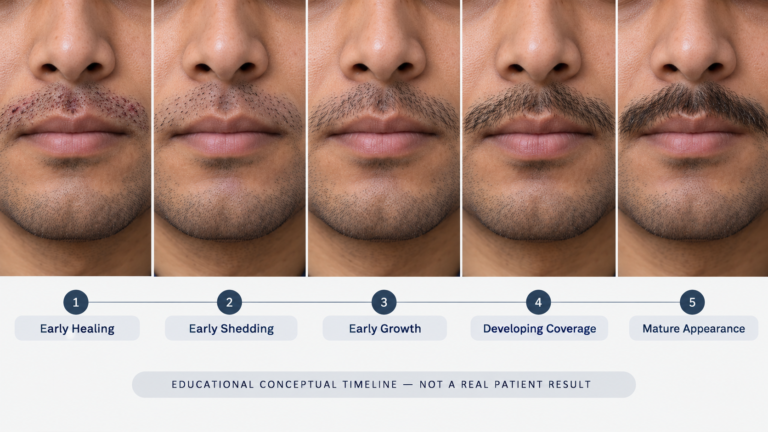
Moustache Hair Transplant Growth Timeline
Transplanted hair does not immediately turn into the final moustache.
First Few Days
The grafts are settling and the recipient skin begins healing.
First Few Weeks
Some implanted hair shafts may shed. Shedding of the visible shaft does not necessarily mean that the follicle itself has been lost.
Around 3–4 Months
Early new growth may start becoming visible in some patients.
Around 6 Months
Coverage generally becomes easier to assess as more transplanted hairs enter visible growth.
Around 9–12 Months
Hair characteristics and visual coverage continue to mature.
Final timing varies between patients, and additional maturation may continue beyond these general stages.
Will Transplanted Moustache Hair Need Trimming?
Often, yes.
Hair generally retains important characteristics of its donor origin after transplantation. If scalp follicles are used, they may continue to grow longer than surrounding native moustache hairs.
Regular trimming can therefore be necessary to maintain the preferred moustache length and shape.
Over time, the patient usually learns how frequently the transplanted hairs need grooming.
Can a Moustache Hair Transplant Look Natural?
It can look natural when the procedure is appropriately planned and executed, but naturalness cannot be guaranteed for every patient.
Important elements include:
- correct design
- suitable donor selection
- low exit angles
- accurate direction
- gradual transitions
- appropriate spacing
- strategic single-hair placement
- preservation of existing native hairs
- avoidance of excessive density
- careful recipient-site creation
A moustache should still look believable when viewed closely, not only from several metres away.
What Can Make a Moustache Transplant Look Artificial?
Potential problems include:
- hairs pointing outward from the face
- identical direction across the entire moustache
- an unnaturally straight border
- excessively coarse hairs at visible edges
- abrupt density transitions
- excessive symmetry
- pitting
- cobblestoning
- overpacking
- poor blending with existing facial hair
These problems are particularly difficult to disguise because the moustache is centrally located on the face.
Risks and Limitations
Moustache transplantation is still a surgical procedure.
Possible issues may include temporary swelling, redness, crusting, folliculitis, infection, temporary numbness, pigmentation changes, ingrown hairs, visible textural irregularities, suboptimal graft growth, asymmetry or an appearance that does not fully meet the patient’s expectations.
Additional treatment may occasionally be needed.
Patients should also understand that donor hair is finite. The goal should therefore be efficient use of suitable grafts rather than pursuing an unrealistic density.
Moustache Hair Transplant Results
Result assessment should consider more than whether hair has grown.
A successful-looking result should ideally demonstrate:
- believable moustache shape
- natural hair direction
- soft visible borders
- appropriate density
- blending with existing hair
- compatibility with different trimming lengths
Check our Moustache Transplant Results to know the difference between before and after transplant.
How Much Does a Moustache Hair Transplant Cost?
The cost should be based on the individual treatment plan rather than a single standard price.
Relevant factors include:
- number of grafts required
- size of the recipient area
- existing moustache density
- complexity of the design
- donor-hair characteristics
- surgical technique
- presence of previous procedures
- presence of scar tissue
- whether one or more treatment sessions are required
An examination or photographic assessment is therefore more useful than estimating cost only from the name of the procedure.
For broader information about hair transplantation, patients can also read Anagen’s Hair Transplant in Mumbai guide.
Frequently Asked Questions
Is moustache hair transplant permanent?
Transplanted follicles selected from a suitable donor area can provide long-term growth. However, individual graft growth and long-term appearance vary, and any existing native facial hair can also change with time.
Will people know that I had a moustache transplant?
During early healing, redness and crusting may be visible. After healing and growth, the aim is for transplanted hairs to blend naturally. Detectability depends strongly on design, angle, direction, donor-hair characteristics and growth.
Can I choose any moustache shape I want?
Patient preference is important, but the final design should also respect facial anatomy, existing facial hair, donor supply and what can realistically look natural.
Is the procedure painful?
The procedure is generally performed using local anaesthesia. The initial anaesthetic injections can cause brief discomfort, and some soreness or sensitivity may occur afterward.
Can I shave the transplanted moustache?
Transplanted hair can generally be groomed once adequate healing has occurred, but the patient should follow the treating team’s postoperative timeline rather than shaving the area prematurely.
Can I have another session if I want more density?
In selected patients, an additional procedure can be considered after the first result has adequately matured and the remaining donor supply has been reassessed.
For general patient questions about hair transplantation, see Anagen’s Hair Transplant FAQs.
Moustache Hair Transplant Consultation in Mumbai
The first question is not simply, “How many grafts do I need?”
The more useful questions are:
- Is transplantation appropriate for my moustache pattern?
- Do I need full restoration or only density enhancement?
- Is any scar involved?
- Which donor hair best matches my facial hair?
- What shape will look natural on my face?
- How much improvement is realistically possible?
A personalised assessment allows these questions to be answered before a surgical plan is created.
Patients can reach Anagen through the Contact Us page.